
.svg)

Many marketing managers chase high impression counts, believing more visibility automatically translates to better campaign performance. This assumption leads to wasted budgets and disappointing results. Ad impressions represent only one piece of the advertising puzzle, measuring visibility without guaranteeing engagement or conversions. Understanding what impressions truly measure, how they influence costs and performance metrics, and when to optimize them versus other factors separates effective campaigns from expensive mistakes. This guide clarifies ad impression fundamentals, accurate measurement techniques, and practical strategies to leverage impression data for stronger ROI in your 2026 digital advertising efforts.
Table of Contents
- What Are Ad Impressions And Why Do They Matter?
- How Ad Impressions Impact Campaign Performance And Costs
- Accurately Tracking And Interpreting Ad Impressions
- Applying Ad Impression Insights To Improve Your Campaigns
- Enhance Your Digital Advertising With Adventure PPC
- FAQ
Key takeaways
| Point | Details |
|---|---|
| Impressions measure visibility | Ad impressions count each time your ad displays, not user interactions like clicks or conversions. |
| They influence key metrics | Impressions affect quality score calculations, click through rate measurements, and CPM pricing models. |
| Accurate counting matters | Industry viewability standards and deduplication techniques ensure reliable impression data for optimization decisions. |
| Context drives value | High impressions without proper targeting or engagement signals waste budget rather than improve campaign performance. |
What are ad impressions and why do they matter?
Impressions are a fundamental metric in Google Ads, indicating the number of times an ad is displayed, regardless of user interaction. When your ad appears in search results, on a display network site, or within a social media feed, that single appearance registers as one impression. This metric focuses purely on visibility, the moment your creative enters a user’s viewport or appears on their screen.
Impressions differ fundamentally from clicks and conversions. A click requires active user engagement, someone deliberately interacting with your ad. A conversion represents a completed goal, whether a purchase, form submission, or phone call. Impressions precede both actions, measuring the initial exposure that creates opportunity for engagement. You can accumulate thousands of impressions without generating a single click if your targeting, creative, or messaging fails to resonate.
Marketers use impression data to understand reach and potential audience exposure across campaigns. High impression volumes indicate broad visibility, showing how many opportunities you created for users to notice your brand. Low impressions might signal budget constraints, narrow targeting parameters, or low search volume for your chosen keywords. Tracking impressions alongside essential digital advertising metrics provides the foundation for assessing campaign scale and identifying optimization opportunities.
Impressions serve as a key indicator when assessing digital campaign scope:
- They reveal whether your ads reach sufficient audience volume to generate meaningful results
- They help identify when budget limitations restrict campaign potential
- They expose targeting issues when impressions concentrate in wrong demographics or locations
- They establish baseline visibility metrics for competitive analysis and market penetration assessment
How ad impressions impact campaign performance and costs
Google’s Quality Score, which influences ad placement and cost per click, is affected by impressions. Quality Score combines expected click through rate, ad relevance, and landing page experience to determine your ad rank in auction environments. Impressions contribute to this calculation because they establish the denominator in your CTR equation. More impressions with steady clicks improve your historical performance signals, potentially lowering costs and improving positions.
Click through rate calculation depends entirely on impression volume. CTR equals clicks divided by impressions, expressed as a percentage. If your ad generates 50 clicks from 10,000 impressions, your CTR sits at 0.5%. This metric helps platforms and advertisers assess ad relevance and appeal. Strong CTR signals effective targeting and compelling creative, while weak CTR despite high impressions indicates disconnects between your audience, message, or offer.

In cost per mille pricing models, advertisers pay based on every thousand impressions delivered. CPM campaigns charge for visibility rather than engagement, making impression accuracy critical for budget management. If you agree to $5 CPM rates, you pay $5 for each 1,000 impressions regardless of resulting clicks or conversions. This model suits brand awareness goals where exposure value exceeds immediate response requirements. Understanding ads cost and pricing models helps you choose between CPM, CPC, and other bidding approaches based on campaign objectives.
Optimizing impressions without corresponding engagement wastes budget quickly. Broad targeting generates massive impression volumes but often delivers poor relevance, resulting in low CTR and wasted spend. Your ads appear to users unlikely to engage, consuming budget without advancing business goals. Strategic PPC bidding strategies balance impression volume with audience quality, ensuring visibility reaches users most likely to convert.
Proper impression tracking supports several critical functions:
- Billing accuracy verification, ensuring you pay only for impressions actually delivered
- Campaign pacing assessment, revealing whether daily budgets exhaust too quickly or slowly
- Dayparting analysis, identifying which hours generate optimal impression volumes and engagement
- Competitive intelligence gathering, comparing your impression share against competitors in shared auctions
Pro Tip: Monitor impression share metrics to identify lost opportunities. Low impression share due to budget means you’re missing potential visibility because funds run out before auction opportunities end. Low impression share due to rank indicates your bids or quality scores need improvement to compete effectively.
Accurately tracking and interpreting ad impressions
Tracking ad impressions requires embedding analytics code that counts each time an ad loads or enters a viewer’s viewport. Publishers and advertising platforms deploy tracking pixels, JavaScript tags, or server side logging to register impression events. When a user’s browser requests your ad creative from the ad server, that request triggers an impression count. The technical implementation varies across platforms, but the fundamental principle remains consistent: document each instance when your ad becomes available for viewing.
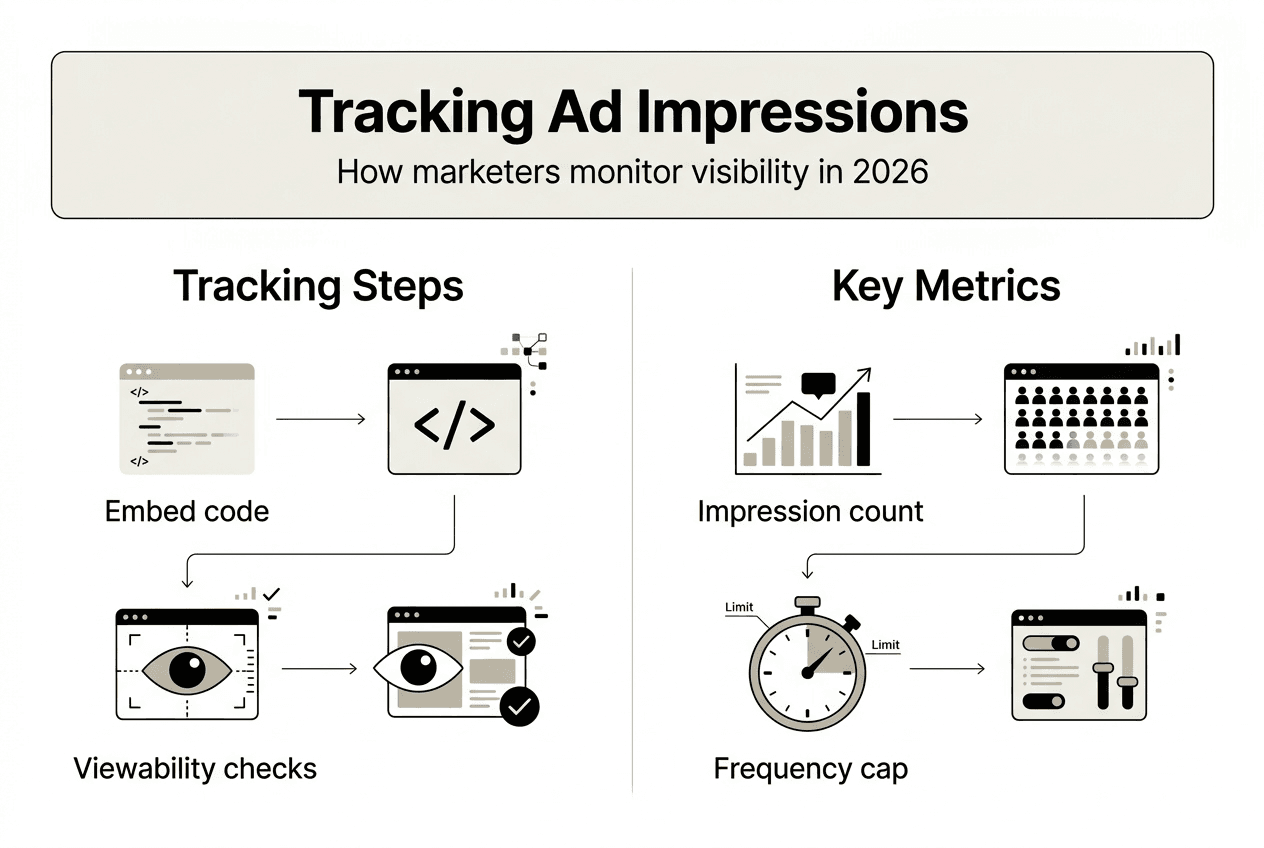
Industry standards from organizations like the Interactive Advertising Bureau define when impressions legitimately count. The IAB’s viewability standard requires at least 50% of an ad’s pixels to appear in the viewport for a minimum of one second for display ads, or two seconds for video ads. This standard prevents counting impressions for ads that load below the fold or in background tabs where users never actually see them. Viewability standards ensure impression counts reflect genuine exposure opportunities rather than technical delivery alone.
Deduplication techniques prevent counting repeated impressions from the same user inappropriately. Frequency capping limits how often individual users see your ads within specified timeframes, controlling both user experience and impression inflation. Without deduplication, a single user refreshing a page multiple times could generate dozens of impressions, distorting your reach metrics and cost calculations. Advanced tracking systems use cookies, device IDs, or probabilistic matching to identify unique users and apply appropriate frequency controls.
Accurate impression data enables better campaign optimization decisions. When you trust your impression counts, you can confidently calculate CTR, assess audience reach, and evaluate cost efficiency. Inaccurate data leads to misguided optimizations, potentially cutting effective campaigns or scaling ineffective ones. Regular PPC audit processes should verify impression tracking implementation and identify discrepancies between platform reported impressions and third party measurement tools.
Pro Tip: Compare impression counts across multiple measurement sources to identify tracking discrepancies. Significant differences between Google Ads reported impressions and Google Analytics sessions might indicate implementation problems, bot traffic, or viewability issues requiring investigation.
Consider these technical factors affecting impression accuracy:
- Ad blocker usage prevents impression tracking for users with blocking software enabled
- Page load speed influences whether ads render before users navigate away
- Lazy loading implementations may delay ad requests until users scroll toward ad placements
- Cross device behavior complicates deduplication when users access content from multiple devices
| Measurement Challenge | Impact on Data | Solution Approach |
|---|---|---|
| Ad blocker interference | Undercounted impressions | Accept measurement gaps, focus on engaged audiences |
| Bot traffic inflation | Overcounted impressions | Implement bot filtering, verify traffic sources |
| Viewability thresholds | Impression vs viewable impression gaps | Optimize for viewable impressions, adjust placements |
| Cross platform tracking | Fragmented user journeys | Use unified measurement frameworks, accept limitations |
Applying ad impression insights to improve your campaigns
Impressions do not equate to engagement; they simply reflect visibility. High impressions paired with low clicks may indicate issues with ad relevance or targeting. Use impression data alongside CTR and conversions for holistic performance evaluation. Viewing impressions in isolation creates misleading conclusions about campaign effectiveness. A campaign generating 100,000 impressions with 50 conversions performs differently than one generating 10,000 impressions with 50 conversions, even though conversion volume matches. The first scenario suggests targeting or creative problems, while the second indicates efficient audience alignment.
Adjust targeting if impression volume is high but engagement is low. This pattern signals that your ads reach broad audiences including many uninterested users. Refine demographic parameters, geographic targeting, or keyword match types to concentrate impressions among higher intent prospects. Reducing impression volume while improving engagement rates typically delivers better ROI than maximizing reach indiscriminately. Quality impressions from relevant audiences outperform quantity impressions from disinterested viewers.
Optimize creatives and messaging to convert impression visibility into clicks. Even perfectly targeted impressions fail without compelling ad copy, relevant imagery, and clear value propositions. Test multiple creative variations to identify which messages resonate strongest with your audience. Strong creative transforms passive impression exposure into active engagement, improving CTR and downstream conversion metrics. Understanding the benefits of PPC campaigns includes recognizing how creative quality multiplies the value of each impression.
Compare CPM and CPC strategies to align impressions with budget goals. CPM bidding suits campaigns prioritizing awareness and reach, accepting that many impressions won’t generate immediate clicks. CPC bidding focuses budgets on engaged users, potentially reducing total impressions while improving engagement quality. Your campaign objectives should dictate which approach makes sense. Brand awareness initiatives often justify CPM approaches, while direct response campaigns typically perform better with CPC models.
Follow this optimization sequence:
- Audit current impression volume and distribution across campaigns, ad groups, and individual ads
- Calculate CTR for each segment to identify high impression, low engagement areas
- Investigate targeting settings for underperforming segments, looking for overly broad parameters
- Test creative variations specifically in high impression, low CTR placements
- Monitor digital marketing ROI measurement metrics to ensure optimization improves business outcomes, not just engagement rates
Continuously monitor impression quality, not just quantity, to maximize ROI. Impression quality encompasses factors like audience relevance, ad position, viewability rates, and competitive context. Top positioned ads with high viewability rates deliver more value per impression than bottom positioned ads users rarely scroll to see. Premium placements often cost more per impression but generate superior engagement and conversion rates, justifying higher CPMs through better overall performance.
Pro Tip: Segment impression analysis by device type, time of day, and geographic location to uncover hidden optimization opportunities. Mobile impressions might generate higher volume but lower engagement than desktop, suggesting device specific creative or bidding adjustments could improve efficiency.
| Strategy | Best For | Impression Approach | Expected Outcome |
|---|---|---|---|
| Brand awareness | New market entry | Maximize impressions with broad targeting | High reach, lower engagement rates |
| Lead generation | B2B services | Moderate impressions with precise targeting | Balanced reach and conversion rates |
| Direct sales | E-commerce | Optimize impressions for high intent audiences | Lower reach, higher conversion rates |
| Retargeting | Previous visitors | Controlled impressions with frequency caps | Efficient re-engagement without ad fatigue |
Enhance your digital advertising with Adventure PPC
Adventure PPC specializes in optimizing ad impressions alongside comprehensive campaign performance metrics to maximize your marketing ROI. Our team analyzes impression data within broader strategic contexts, identifying opportunities to improve targeting precision, creative effectiveness, and bidding efficiency. We’ve helped clients transform underperforming campaigns generating empty impressions into conversion engines delivering measurable business growth.
Our creative digital advertising transformation case study demonstrates how strategic creative optimization converts impression visibility into engaged audiences. We’ve also driven significant results through systematic testing approaches, as shown in our work with Survey Money Machines seeing year over year growth in conversion rates. The AB testing framework we implemented for International Culinary Center illustrates our data driven methodology for continuous improvement.
Explore how expert strategies can enhance your digital advertising results across Google Ads, Meta platforms, and other channels. Contact Adventure PPC for tailored guidance to improve your campaigns through better impression management, audience targeting, and performance optimization.
FAQ
What is the difference between an ad impression and a click?
An ad impression counts each time your ad displays on a user’s screen, regardless of whether they interact with it. A click represents active user engagement, occurring when someone deliberately selects your ad to visit your website or landing page. Impressions measure visibility and reach, while clicks measure interest and engagement. You can generate thousands of impressions without any clicks if your targeting or creative fails to resonate with viewers.
How does CPM pricing relate to ad impressions?
CPM stands for cost per mille, meaning cost per thousand impressions delivered. Advertisers using CPM bidding pay based on impression volume rather than clicks or conversions. If you agree to a $10 CPM rate, you pay $10 for every 1,000 times your ad appears, regardless of resulting engagement. This pricing model suits brand awareness campaigns where exposure value matters more than immediate response metrics.
What standards ensure accurate ad impression counting?
Industry standards from the Interactive Advertising Bureau require ads to meet specific viewability criteria before counting as impressions. Display ads must have at least 50% of pixels visible in the viewport for a minimum of one second. Video ads require two seconds of viewability at the same threshold. Deduplication techniques prevent multiple counts of the same impression when users refresh pages or revisit sites, ensuring accuracy in reach and frequency measurements.
Why do high impressions sometimes produce poor campaign results?
High impression volumes without corresponding engagement typically indicate targeting or creative problems. Your ads may reach broad audiences including many users with no interest in your offering. Overly general targeting parameters, weak ad copy, or irrelevant creative elements cause users to ignore your ads despite seeing them repeatedly. Optimizing for impression quality through refined targeting and compelling messaging delivers better results than simply maximizing impression quantity.
Recommended


Baketivity YoY Growth Soars after Analyzing Customer LTV's


Unique Campaign Structure Saves Leading Logistics Company $27K Month Over Month


Qualified Leads Increase 238% for SaaS Company Using Machine Learning
Request A Marketing Proposal
We'll get back to you within a day to schedule a quick strategy call. We can also communicate over email if that's easier for you.
Visit Us
New York
1074 Broadway
Woodmere, NY
Philadelphia
1429 Walnut Street
Philadelphia, PA
Florida
433 Plaza Real
Boca Raton, FL
General Inquiries
info@adventureppc.com
(516) 218-3722
AdVenture Education
Over 300,000 marketers from around the world have leveled up their skillset with AdVenture premium and free resources. Whether you're a CMO or a new student of digital marketing, there's something here for you.
OUR BOOK
We wrote the #1 bestselling book on performance advertising
Named one of the most important advertising books of all time.
buy on amazon
OUR EVENT
DOLAH '24.
Stream Now.
Over ten hours of lectures and workshops from our DOLAH Conference, themed: "Marketing Solutions for the AI Revolution"
check out dolah
The AdVenture Academy
Resources, guides, and courses for digital marketers, CMOs, and students. Brought to you by the agency chosen by Google to train Google's top Premier Partner Agencies.
Bundles & All Access Pass
Over 100 hours of video training and 60+ downloadable resources
 view bundles →
.png)


