
.svg)
Role of Automation in Advertising: Driving Profitable Growth

Managing digital ad campaigns across multiple platforms can feel overwhelming even for the most experienced Marketing Directors. Pressures to drive growth and control costs are rising fast as competitors embrace new technologies. Today, automation in advertising is redefining what is possible, offering American e-commerce companies smarter tools for targeted optimization and real-time campaign improvements. This article clarifies how modern automated systems transform everyday advertising tasks into strategic opportunities for unlocking measurable results.
Table of Contents
- Defining Automation In Advertising Today
- Types Of Ad Automation And Core Functions
- How Automation Optimizes Campaign Performance
- Risks, Challenges, And Regulatory Considerations
- Comparing Manual Versus Automated Ad Management
Key Takeaways
| Point | Details |
|---|---|
| Automation Enhances Efficiency | Advertising automation streamlines repetitive tasks, allowing marketers to focus on strategy and creativity. |
| Data-Driven Decision Making | Advanced technologies like predictive analytics and machine learning enable smarter ad strategies and optimize campaign performance. |
| Immediate Adaptability | Real-time optimization and dynamic content generation allow campaigns to adjust on the fly, maximizing engagement and return on investment. |
| Ethical Considerations Required | Organizations must navigate algorithmic bias and data privacy issues by implementing robust regulatory compliance and ethical oversight. |
Defining Automation in Advertising Today
Advertising automation represents a strategic technological evolution transforming how businesses approach marketing and customer engagement. At its core, automation in advertising means using advanced technological systems to execute repetitive tasks, optimize campaign performance, and deliver more personalized experiences with minimal manual intervention.
The emergence of automation is driven by several key technological advancements, particularly in artificial intelligence and machine learning. Large language models are revolutionizing ad strategies by enabling more sophisticated targeting, predictive analytics, and real-time optimization across digital platforms. These systems can now:
- Process massive datasets instantaneously
- Predict consumer behavior with remarkable accuracy
- Dynamically adjust advertising parameters
- Create personalized ad content at scale
- Optimize bidding strategies in milliseconds
Modern advertising automation goes far beyond simple task delegation. It represents a comprehensive approach to marketing that integrates multiple technological capabilities to drive strategic outcomes. By leveraging automated intelligence, businesses can transform traditional advertising workflows into data-driven, hyper-efficient growth engines.
Automation is not about replacing human creativity, but amplifying it through intelligent technological support.
Key Components of Advertising Automation:
- Predictive Analytics
- Machine Learning Algorithms
- Real-time Performance Optimization
- Dynamic Content Generation
- Audience Segmentation Technologies
Pro tip: Start small by identifying one repetitive marketing task that could benefit from automation and gradually expand your technological capabilities.
Types of Ad Automation and Core Functions
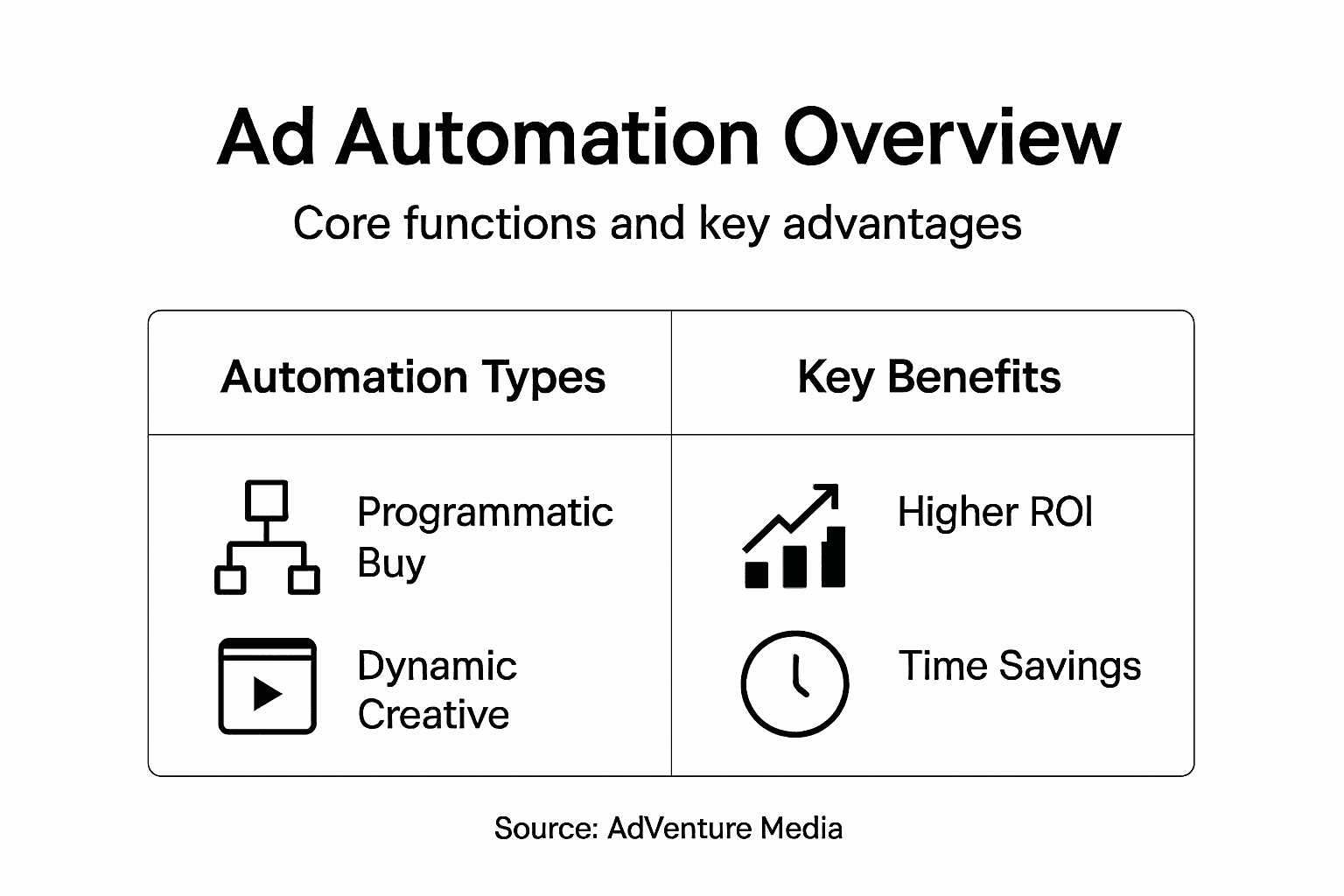
Advertising automation encompasses multiple sophisticated technologies designed to streamline and optimize digital marketing efforts. Budget pacing algorithms play a critical role in managing campaign spending and performance across different digital platforms, enabling marketers to achieve more precise and efficient advertising outcomes.
The primary types of ad automation can be categorized into several core functional areas:
- Bidding Automation: Intelligent systems that dynamically adjust bid prices in real-time
- Targeting Optimization: Machine learning algorithms that refine audience segmentation
- Creative Personalization: Dynamic content generation tailored to individual user profiles
- Performance Monitoring: Automated tracking and reporting of campaign metrics
- Budget Management: Intelligent allocation and reallocation of advertising spend
One of the most advanced functions of ad automation involves predictive analytics, which enables marketers to anticipate consumer behavior and optimize ad delivery. Advanced CTR prediction models allow advertisers to understand potential engagement levels before launching campaigns, significantly reducing wasted ad spending.
Effective ad automation transforms data into actionable insights, turning complex information into strategic marketing opportunities.
The technological landscape of ad automation continues to evolve, integrating increasingly sophisticated machine learning techniques that can process massive datasets and make instantaneous optimization decisions. These systems are not just about reducing manual work but about creating more intelligent, responsive advertising ecosystems.
Key Technological Components of Ad Automation:
- Artificial Intelligence Algorithms
- Real-time Data Processing
- Predictive Analytics Engines
- Machine Learning Models
- Cross-Platform Integration Capabilities
Pro tip: Regularly audit and update your automation strategies to ensure they align with changing market dynamics and consumer behaviors.
How Automation Optimizes Campaign Performance
Automation has revolutionized digital advertising by transforming how marketers approach campaign performance and optimization. Large language models enable dynamic ad strategies that continuously adapt and improve marketing outcomes through intelligent, real-time decision-making processes.
The core mechanisms of campaign performance optimization through automation include:
- Intelligent Bidding: Automatic price adjustments based on real-time market conditions
- Precision Targeting: Refined audience segmentation using machine learning
- Creative Optimization: Dynamic content modifications to maximize engagement
- Performance Prediction: Advanced analytics forecasting potential campaign results
- Resource Allocation: Smart budget redistribution across most effective channels
Budget pacing algorithms represent a critical technological breakthrough in campaign management. These sophisticated systems continuously monitor and adjust advertising spend, ensuring maximum efficiency and alignment with specific marketing objectives. Adaptive bidding strategies allow marketers to maintain precise control over campaign expenditures while maximizing potential returns.
Automation transforms data complexity into strategic marketing intelligence, turning massive information streams into actionable insights.
By leveraging machine learning and artificial intelligence, advertisers can now create self-optimizing campaigns that learn and improve continuously. These systems analyze multiple performance variables simultaneously, making split-second decisions that would be impossible through manual management.
Key Performance Optimization Strategies:
- Real-time Performance Monitoring
- Predictive Analytics Integration
- Automated A/B Testing
- Intelligent Audience Segmentation
- Cross-Channel Optimization
Pro tip: Implement a consistent performance review process to validate and refine your automation strategies, ensuring they remain aligned with evolving business goals.

Risks, Challenges, and Regulatory Considerations
Advertising automation presents significant technological opportunities alongside complex ethical and regulatory challenges. Federal guidelines emphasize advertising transparency to ensure consumer protection and maintain trust in increasingly sophisticated digital marketing ecosystems.
The primary risks and challenges associated with advertising automation include:
- Algorithmic Bias: Potential discrimination in audience targeting
- Data Privacy Concerns: Risk of inappropriate personal information usage
- Transparency Issues: Difficulty explaining complex automated decision-making
- Ethical Targeting: Potential manipulation of vulnerable consumer segments
- Compliance Complexity: Navigating evolving regulatory landscapes
Regulatory frameworks are critically important in managing these potential risks. Automated advertising systems must balance technological innovation with strict ethical guidelines, ensuring that machine learning algorithms do not inadvertently create discriminatory or misleading marketing practices. Automation’s broader economic implications require comprehensive governance approaches that protect consumer interests.
Technological advancement must always be balanced with robust ethical considerations and consumer protection mechanisms.
The most successful organizations will develop proactive strategies that anticipate potential regulatory challenges, implementing self-governance mechanisms that exceed minimum legal requirements. This approach demonstrates commitment to responsible technological innovation while maintaining consumer trust.
Reviewing the main risks in advertising automation alongside mitigation examples helps clarify best practices:
| Risk Type | Business Impact | Common Mitigation Approach |
|---|---|---|
| Algorithmic Bias | Discriminatory targeting | Frequent model audits |
| Data Privacy | Regulatory fines, loss of trust | Transparent data policies |
| Compliance Breaches | Legal penalties | Cross-functional compliance team |
| Ethical Concerns | Brand reputation damage | Independent ethical review |
Key Risk Mitigation Strategies:
- Regular Algorithmic Audits
- Transparent Data Usage Policies
- Comprehensive Consent Frameworks
- Ongoing Staff Training
- Independent Ethical Review Processes
Pro tip: Develop a cross-functional compliance team that includes legal, technical, and ethical experts to continuously monitor and adapt your automated advertising strategies.
Comparing Manual Versus Automated Ad Management
The landscape of digital advertising management has fundamentally transformed with the emergence of sophisticated automation technologies. Real-time bidding strategies revolutionize ad management by introducing unprecedented speed and precision that manual processes cannot match.
Key differences between manual and automated ad management include:
- Speed of Execution: Automated systems operate milliseconds, manual processes take hours
- Precision Targeting: Machine learning enables hyper-specific audience segmentation
- Data Processing: Automated systems analyze massive datasets instantaneously
- Cost Efficiency: Reduced human labor and optimized spending
- Scalability: Unlimited campaign complexity and volume handling
Technological capabilities have dramatically shifted the traditional advertising paradigm. While manual management relies on human intuition and periodic adjustments, internet advertising auctions demonstrate how automated systems can handle complex, large-scale bidding environments with remarkable efficiency.
Here’s how manual and automated ad management differ in critical business areas:
| Aspect | Manual Management | Automated Management |
|---|---|---|
| Speed | Hours for execution | Milliseconds processing |
| Scalability | Limited campaign volume | Handles unlimited campaigns |
| Optimization Frequency | Periodic, human-driven | Continuous, real-time |
| Labor Costs | Higher due to manual work | Lower with automation |
| Data Analysis | Small datasets | Massive, complex datasets |
Automation does not replace human creativity, but exponentially enhances strategic decision-making capabilities.
Modern advertisers must recognize that automation is not about eliminating human involvement, but creating more intelligent, responsive marketing ecosystems. The most successful approaches will integrate technological capabilities with nuanced human oversight and strategic thinking.
Comparative Performance Metrics:
- Campaign Optimization Speed
- Budget Utilization Efficiency
- Audience Targeting Accuracy
- Real-time Performance Adjustment
- Cost per Acquisition Reduction
Pro tip: Develop a hybrid approach that leverages automation’s technical capabilities while maintaining strategic human insight and creative direction.
Unlock Profitable Growth Through Advertising Automation
The challenge many businesses face today is harnessing the full power of automation in advertising without losing strategic control or clarity. As the article highlights, mastering predictive analytics, intelligent bidding, and real-time optimization can dramatically reduce wasted spend and improve campaign precision. However, implementing these complex technologies while navigating risks like algorithmic bias and compliance issues is no easy feat.
At AdVenture Media, we specialize in turning these challenges into opportunities. Our performance-driven marketing strategies across platforms like Google and Meta combine cutting-edge automation with expert human oversight. We focus on data-driven growth, creative optimization, and strategic audience targeting to ensure your campaigns not only run smarter but deliver measurable results. Explore how our expertise can help you leverage automated intelligence confidently and profitably with tailored PPC management designed for your unique business goals.
Ready to transform your advertising approach with trusted automation strategies that drive real business growth? Connect with our team today to schedule a consultation and start maximizing your campaign efficiency now. Don’t let complexity hold you back from the future of digital marketing. Contact us at AdVenture Media and take the first step toward smarter, more profitable advertising.
Frequently Asked Questions
What is advertising automation?
Advertising automation refers to the use of advanced technological systems to execute repetitive marketing tasks, optimize campaign performance, and deliver personalized experiences with minimal manual intervention.
How does automation improve campaign performance?
Automation improves campaign performance by enabling intelligent bidding, precise audience targeting, dynamic content generation, and real-time performance monitoring, all of which contribute to more efficient and effective advertising.
What are the risks associated with advertising automation?
The risks include algorithmic bias, data privacy concerns, transparency issues, ethical targeting complications, and compliance complexities which could affect consumer trust and brand reputation.
What should businesses consider when implementing advertising automation?
Businesses should consider technology integration, regular audits of algorithms, transparent data usage policies, continuous staff training, and developing cross-functional compliance teams to manage risks and maximize the effectiveness of their automated advertising strategies.
Recommended


Global Fintech App Uses Automation To Profitably Grow Customer Base


Advanced Retargeting Helps Illustrate Jewelry Brand's Buyer Journey

.svg.png)
Budget Optimization Leads to eCommerce Growth For Sennheiser
Request A Marketing Proposal
We'll get back to you within a day to schedule a quick strategy call. We can also communicate over email if that's easier for you.
Visit Us
New York
1074 Broadway
Woodmere, NY
Philadelphia
1429 Walnut Street
Philadelphia, PA
Florida
433 Plaza Real
Boca Raton, FL
General Inquiries
info@adventureppc.com
(516) 218-3722
AdVenture Education
Over 300,000 marketers from around the world have leveled up their skillset with AdVenture premium and free resources. Whether you're a CMO or a new student of digital marketing, there's something here for you.
OUR BOOK
We wrote the #1 bestselling book on performance advertising
Named one of the most important advertising books of all time.
buy on amazon
OUR EVENT
DOLAH '24.
Stream Now.
Over ten hours of lectures and workshops from our DOLAH Conference, themed: "Marketing Solutions for the AI Revolution"
check out dolah
The AdVenture Academy
Resources, guides, and courses for digital marketers, CMOs, and students. Brought to you by the agency chosen by Google to train Google's top Premier Partner Agencies.
Bundles & All Access Pass
Over 100 hours of video training and 60+ downloadable resources
 view bundles →
.png)


