
.svg)
Master the Digital Advertising Planning Process for Results

Most american businesses waste over 25 percent of their digital advertising budgets due to unclear goals and undefined audiences. Standing out in a crowded online market takes more than luck or guesswork. By focusing on the right strategies from the start, you can connect with the people who matter and turn ad spend into real growth. This step-by-step guide uncovers how to sharpen your approach for digital advertising success.
Table of Contents
Quick Summary
| Key Message | Explanation |
| 1. Define clear business goals | Identify specific objectives like increasing sales or brand awareness to guide your advertising strategy. |
| 2. Target audience analysis is crucial | Understand demographics and behaviors for precise messaging and effective ad targeting. |
| 3. Choose platforms based on audience | Select digital channels that align with where your target audience spends time online. |
| 4. Craft compelling and relevant creatives | Develop messaging that resonates with consumer motivations to increase engagement and conversions. |
| 5. Monitor performance and optimize | Regularly review analytics and metrics for continuous improvement of your advertising campaigns. |
Step 1: Define Business Goals and Target Audiences
Successful digital advertising starts with razor sharp clarity about who you want to reach and what you want to achieve. Your mission: create a strategic blueprint that transforms vague aspirations into measurable, actionable targets.
Begin by pinpointing your core business objectives with precision. Are you looking to increase sales, boost brand awareness, generate leads, or drive website traffic? Each goal demands a unique approach. Identifying unique demographic profiles provides the foundation for targeted advertising strategies. Break down your goals into specific, quantifiable metrics like percentage increase in revenue, number of new customer acquisitions, or specific conversion rates.
Next, construct a detailed profile of your target audience. Go beyond basic demographics. Analyze customer behavior and understand consumer motivations to create laser focused targeting. Consider factors like age, income, professional status, online behaviors, pain points, and purchasing patterns. The more granular your understanding, the more effectively you can craft messaging that resonates.
Pro Tip: Don’t just guess. Use data analytics, customer surveys, and market research to validate your audience assumptions.
Once you’ve defined clear goals and audiences, you’re ready to design advertising strategies that speak directly to the right people at the right moment. Your precision here sets the stage for everything that follows in your digital advertising journey.
Step 2: Select Digital Advertising Platforms Strategically
Picking the right digital advertising platforms can make or break your marketing efforts. Your goal is to create a targeted approach that maximizes reach while minimizing wasted resources.
Selecting digital marketing platforms that align with your target audience’s preferences is critical for success. Start by mapping out where your potential customers spend their online time. Some platforms excel at different objectives social media works great for brand awareness, search ads drive direct conversions, while display networks support retargeting strategies. Consider factors like user demographics, platform engagement rates, and your specific campaign goals.
Dont rely on a onesize fits all strategy. Research indicates that both traditional and digital advertising platforms can be competitive when used strategically Experiment with multiple channels but track performance meticulously. Look at metrics like click through rates, cost per acquisition, and conversion quality to understand which platforms deliver the best return on investment.
Pro Tip: Start small. Test platforms with limited budgets before scaling up your advertising spend.
Careful platform selection transforms your digital advertising from a scattershot approach to a precision instrument targeting exactly the right audience at the right moment.
Step 3: Develop Compelling Creative and Messaging
Crafting advertising creative that captures attention and drives action is both an art and a science. Your mission is to develop messaging that speaks directly to your target audience’s deepest motivations and needs.

Leveraging AI for creating personalized content and dynamic messaging can dramatically improve your creative strategy. Start by understanding your audience’s pain points, desires, and language. Develop multiple creative variations that speak to different emotional triggers. Some ads might highlight problem solving, while others focus on aspiration or social proof. Ensure your visuals and copy align perfectly with the platform youre advertising on each channel has its own visual language and audience expectations.
Remember that great creative is about connection not just communication. Test different approaches ruthlessly. Track metrics like click through rates, engagement, and conversion to understand which messages resonate most. Dont fall in love with your first draft. Successful advertising requires constant refinement and a willingness to pivot based on real world performance.
Pro Tip: Create a messaging matrix that maps different emotional triggers to specific audience segments for more targeted creative.
Your creative is the bridge between your brand and potential customers. Make it compelling, clear, and impossible to ignore.
Step 4: Allocate Budgets and Set Measurable KPIs
Budget allocation and key performance indicator (KPI) selection are the financial backbone of your digital advertising strategy. Your objective is to transform marketing dollars into measurable business growth.
Setting goals using the SMART framework helps prioritize spending and ensure effective resource utilization. Start by determining your total advertising budget based on your business size, revenue, and growth objectives. Break down this budget across different platforms proportionally. Consider factors like historical performance, audience reach, and potential return on investment. Allocate more resources to channels that have consistently delivered results while leaving room for experimentation.
Evaluating platform features and targeting capabilities is crucial for maximizing your budget efficiency. Define clear KPIs that directly align with your business goals. These might include conversion rates, cost per acquisition, click through rates, or total revenue generated. Avoid vanity metrics that look impressive but dont drive real business outcomes. Track these KPIs religiously and be prepared to reallocate funds quickly based on performance.
Pro Tip: Implement a 70/30 budget rule. Invest 70% in proven strategies and 30% in innovative experimental approaches.
Remember your budget is a living strategy. Stay flexible, measure relentlessly, and be ready to pivot when data speaks.
Step 5: Launch Campaigns and Implement Tracking
Your digital advertising strategy transforms from theory to action in this critical stage. Its time to deploy your meticulously planned campaigns and set up robust tracking mechanisms that will provide real world performance insights.
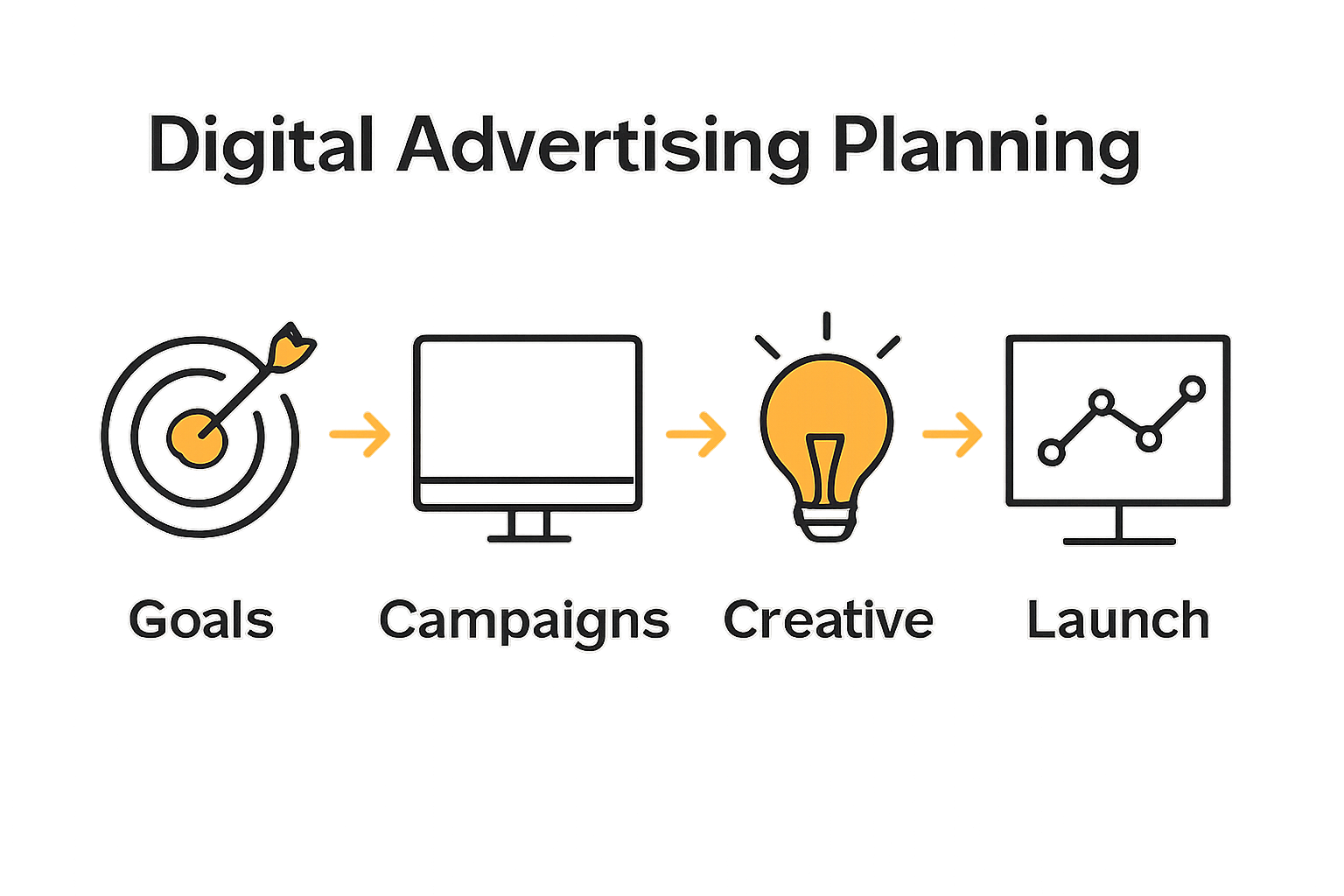
Understanding audience behavior and preferences is crucial when designing impactful marketing campaigns. Begin by configuring conversion tracking pixels, event tracking, and analytics integrations across your chosen platforms. Install tracking codes on key website pages like landing pages, thank you pages, and checkout confirmations. Ensure each platform has unique tracking parameters that allow you to distinguish performance between different channels and ad variations.
Launching campaigns with integrated tracking systems enables data driven decision making and continuous optimization. Set up conversion tracking that measures meaningful actions beyond simple clicks. Track metrics like form submissions, phone calls, email sign ups, and actual revenue generated. Configure your analytics to provide granular insights into user behavior, helping you understand not just how many people clicked but how they interacted with your ads and website.
Pro Tip: Create a tracking dashboard that consolidates data from multiple platforms for easier performance monitoring.
Your tracking setup is the nervous system of your digital advertising strategy. Implement it carefully and youll transform raw data into actionable intelligence.
Step 6: Optimize Performance and Validate Results
Your digital advertising journey reaches its most dynamic stage optimization and continuous improvement. Your mission now is to transform raw data into strategic insights that drive better performance.
Consistent monitoring of analytics and key performance indicators provides essential insights for digital marketing strategies. Start by conducting a comprehensive performance review across all platforms. Compare actual results against your initial benchmarks and goals. Analyze metrics like click through rates, conversion rates, cost per acquisition, and return on ad spend. Identify top performing ad variations, audience segments, and targeting parameters. Look for patterns that reveal what resonates most with your target audience.
Establishing clear digital marketing goals and regularly evaluating performance ensures continuous improvement. Implement a systematic optimization approach. Run A/B tests on ad creatives, adjust audience targeting, refine bidding strategies, and reallocate budgets based on performance. Dont be afraid to pause underperforming campaigns and double down on strategies showing promising results. Create a feedback loop that allows rapid iteration and improvement.
Pro Tip: Set up automated performance reports that highlight key metrics and trends to streamline your optimization process.
Remember optimization is an ongoing journey. Stay curious, data driven, and ready to adapt your strategy at a moments notice.
Unlock Your Digital Advertising Potential with Expert Guidance
Mastering the digital advertising planning process requires clear goals, precise audience targeting, smart platform selection, compelling creative, and continuous optimization. If you find it challenging to translate strategy into measurable results or struggle to allocate budgets effectively and track campaigns, you are not alone. Many businesses face these exact hurdles described in the article, such as creating actionable KPIs and implementing data-driven optimizations that truly move the needle.
At AdVenture Media, we understand these pain points deeply. Our strategy-first approach combines performance-driven marketing expertise across Google, Meta, and other platforms with creative strategies tailored to your audience’s motivations. We provide end-to-end solutions that help you cut through the noise and connect with the right customers at the right moment, turning complex digital advertising concepts into clear, profitable actions. Discover how our proven methods powered success stories like Grown Brilliance and Slinger Bag by visiting AdVenture Media.
Need help turning your digital advertising strategy into real revenue growth now?
Take the next step toward measurable performance. Explore our expert insights on advertising strategy and creative strategy designed to elevate your campaigns. Reach out today at AdVenture Media and let us help you achieve digital advertising results that matter.
Frequently Asked Questions
How do I define my business goals for digital advertising?
To define your business goals, start by identifying what you want to achieve—such as increasing sales, generating leads, or boosting brand awareness. Break Down your goals into specific metrics, like a 15% increase in revenue or acquiring 50 new customers within the next quarter.
What should I consider when selecting digital advertising platforms?
When selecting digital advertising platforms, consider where your target audience spends their time online. Research the user demographics and engagement rates of different platforms, and allocate a portion of your budget for testing various channels to see which delivers the best results.
How can I create compelling messaging for my ads?
To craft compelling messaging, identify your audience’s pain points and what motivates them. Develop multiple ad variations that focus on different emotional triggers, and regularly test them to see which messaging resonates most effectively with your audience.
What are key performance indicators (KPIs) I should track for my advertising campaigns?
Key performance indicators (KPIs) to track include conversion rates, click-through rates, and cost per acquisition. Set clear, measurable KPIs based on your initial goals, and review them regularly to assess performance and make necessary adjustments.
How do I optimize my digital advertising campaigns?
Optimizing your digital advertising campaigns involves regularly reviewing performance data and making adjustments based on findings. Run A/B tests on your ads and budget allocation, and be ready to eliminate underperforming strategies to improve your results over time.
What is a good budget strategy for digital advertising?
A good budget strategy is to implement the 70/30 rule: invest 70% of your budget in proven channels and 30% on experimenting with new strategies. Review your spending and results routinely to ensure that you are maximizing your budget efficiency and adapting as necessary.
Recommended


20% Increase in Subscribers for Forbes Magazine

.png)
Optimizing for Purchases and App Installs Leads to 69% Decrease in CPA for Woodspoon
.avif)

PictureFrames.com Sees Profitable Ecommerce Sales Growth Year Over Year
Request A Marketing Proposal
We'll get back to you within a day to schedule a quick strategy call. We can also communicate over email if that's easier for you.
Visit Us
New York
1074 Broadway
Woodmere, NY
Philadelphia
1429 Walnut Street
Philadelphia, PA
Florida
433 Plaza Real
Boca Raton, FL
General Inquiries
info@adventureppc.com
(516) 218-3722
AdVenture Education
Over 300,000 marketers from around the world have leveled up their skillset with AdVenture premium and free resources. Whether you're a CMO or a new student of digital marketing, there's something here for you.
OUR BOOK
We wrote the #1 bestselling book on performance advertising
Named one of the most important advertising books of all time.
buy on amazon
OUR EVENT
DOLAH '24.
Stream Now.
Over ten hours of lectures and workshops from our DOLAH Conference, themed: "Marketing Solutions for the AI Revolution"
check out dolah
The AdVenture Academy
Resources, guides, and courses for digital marketers, CMOs, and students. Brought to you by the agency chosen by Google to train Google's top Premier Partner Agencies.
Bundles & All Access Pass
Over 100 hours of video training and 60+ downloadable resources
 view bundles →
.png)


