
.svg)
Build an effective branding strategy to power digital growth

TL;DR:
- Branding strategy guides all brand decisions and should precede visual identity development.
- A clear purpose, positioning, personality, promise, and values are essential components of effective strategy.
- Measuring success through metrics linked to sales and consumer sentiment ensures strategy translates into growth.
Most enterprises spend enormous budgets on logos, color palettes, and visual guidelines, then wonder why their digital campaigns underperform. The uncomfortable truth is that brand identity is the output of strategy, not the starting point. When strategy is missing or muddled, every downstream decision, from creative to media buying to messaging, operates without a compass. This guide is built for marketing executives who need more than a brand refresh. We’ll break down the core frameworks, real-world evidence, and measurement systems that turn branding strategy into a genuine growth engine across paid search, social, and beyond.
Table of Contents
- What is branding strategy?
- Core components: Framework for strategic branding
- From theory to practice: Evidence and edge cases in branding strategy
- Measuring branding strategy: From awareness to financial impact
- Balancing brand purpose and performance for lasting growth
- Why getting branding strategy right is harder, and more rewarding, than most leaders think
- Turn strategy into ROI: Partner with specialists for branding that delivers
- Frequently asked questions
Key Takeaways
| Point | Details |
|---|---|
| Strategy leads, identity follows | A brand’s long-term direction should always come before visual identity or messaging decisions. |
| Measure beyond awareness | Use metrics like Favorability, Familiarity, and Recall (FFR) which are far more predictive of enterprise sales growth. |
| Purpose must connect to results | Brand purpose should only drive strategy when it directly supports measurable business goals. |
| Avoid overextension | Past failures show that ignoring core equity or over-purposing risks massive value loss. |
What is branding strategy?
Branding strategy is a long-term plan that defines how your brand earns and holds a distinct, valuable position in the minds of your audience. It answers the foundational questions: Why does this brand exist? What does it stand for? How is it different? And how should it make people feel? Without those answers, you’re not building a brand. You’re just producing content.
The confusion between brand identity and branding strategy is one of the most expensive mistakes enterprises make. Identity is what people see: logos, fonts, photography style, tone of voice in copy. Strategy is the architecture underneath all of it. It determines which markets you compete in, what emotional territory you own, and how you differentiate from competitors at every touchpoint.
As neurobranding research confirms, strategy must precede identity and avoid the consensus traps that water down bold positioning. Too many enterprise teams build strategy by committee, arriving at something safe, generic, and forgettable.
A complete branding strategy covers five core components:
- Purpose: The reason the brand exists beyond profit
- Positioning: The distinct space the brand occupies in the competitive landscape
- Personality: The human traits and tone the brand consistently expresses
- Promise: The specific value customers can reliably expect
- Values: The principles that guide every brand decision and action
Each component shapes how your campaigns are built, how your creative performs, and how audiences remember you across channels.
Pro Tip: Lock down your strategy document before briefing any creative team or agency. Skipping this step means your identity will reflect the designer’s instincts, not your market position.
“Strategy precedes identity, not vice versa.”
Core components: Framework for strategic branding
Now that we’ve established what a branding strategy is and why it matters, let’s examine the key elements every winning strategy must include.
Building strategy with an enterprise team requires a structured process, not a brainstorming session. Here’s a numbered framework that actually works in practice:
- Define your purpose with precision. Not a vague mission statement. A specific articulation of the problem your brand solves and for whom.
- Map your competitive positioning. Identify the white space where your brand can own something meaningful and defensible.
- Develop your brand personality. Decide how the brand speaks, behaves, and shows up emotionally across every channel.
- Articulate your brand promise. Make it specific enough to be tested and measured, not aspirational fluff.
- Build delivery and evidence systems. Determine how you’ll prove the promise through product, service, and communication.
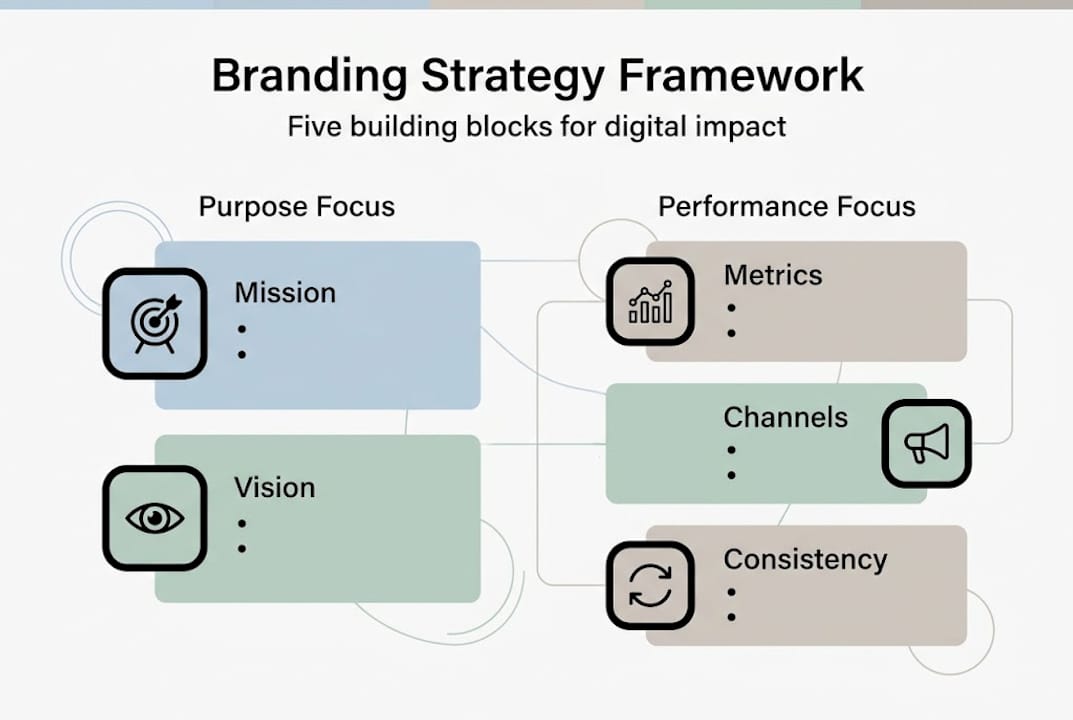
Here’s how purpose-driven and performance-driven strategies compare in practice:
| Dimension | Purpose-driven strategy | Performance-driven strategy |
|---|---|---|
| Primary focus | Emotional resonance and values | Measurable outcomes and ROI |
| Risk | Can dilute focus if overextended | Can feel transactional without brand equity |
| Digital ad fit | Strong for top-of-funnel awareness | Strong for conversion and retargeting |
| Long-term value | Builds loyalty and recall | Drives short-term revenue |
| Best use case | Brand building campaigns | Direct response campaigns |
The science behind why this matters is compelling. Neurobranding research shows that memory creation, emotional priming, and subconscious triggers outperform rational appeals in digital feed environments. People don’t consciously evaluate every ad they see. They feel it first, and remember it later. Your strategy needs to be engineered for that reality.

The smartest enterprise brands activate each of these five components consistently across paid search, social, email, and organic content. Consistency is what creates the mental availability that drives purchase decisions.
From theory to practice: Evidence and edge cases in branding strategy
With a framework in hand, it’s critical to stress-test your approach against real-world edge cases and evidence.
The data on branding failures is sobering. Heritage rebrands can spark backlash and significant losses when core equity is ignored, as Cracker Barrel’s $262M market value drop demonstrates. That wasn’t a creative failure. It was a strategy failure rooted in misalignment with what customers actually valued about the brand.
Similarly, Unilever’s purpose-driven approach risked diluting performance by extending purpose too broadly across brands that didn’t have the equity to carry it. Purpose without performance tethering is a liability.
Here’s a quick look at how strategy alignment plays out across real cases:
| Brand | Strategy move | Result | Lesson |
|---|---|---|---|
| Cracker Barrel | Heritage rebrand | $262M market value loss | Never ignore core equity |
| Unilever | Broad purpose extension | Diluted focus, investor pressure | Purpose needs performance guardrails |
| Apple | Consistent personality and positioning | Premium pricing power maintained | Clarity compounds over time |
| Old Spice | Personality pivot with bold creative | Sales doubled within a year | Bold repositioning works when strategy is clear |
Common edge cases that trip up large enterprises include:
- Heritage backlash: Long-tenured customers reject changes that feel like betrayal of the original promise
- Diluted focus: Extending purpose too broadly confuses audiences and weakens the core offer
- Neglecting core equity: Rebranding without auditing what customers actually love about you
The connection to digital advertising performance is direct. When we’ve worked on digital advertising brand transformation for clients, the campaigns that outperform are always the ones backed by a clear, emotionally resonant strategy. Creative without strategy is just noise.
Measuring branding strategy: From awareness to financial impact
Rigorous measurement closes the loop between brand-building and outcomes. Here’s how enterprises can track real impact.
Most marketing teams measure awareness. Awareness tells you if people have heard of you. It does not tell you if they’ll buy from you. The metrics that actually predict revenue are Familiarity, Favorability, and Recall, collectively known as FFR. FFR is 4x more predictive of sales than basic awareness metrics. That gap matters enormously when you’re allocating eight-figure media budgets.
Here’s a practical breakdown of metrics worth tracking:
- Digital metrics: Click-through rate trends, branded search volume, engagement rate, video completion rate
- Social metrics: Sentiment analysis, share of voice, follower quality, brand mention velocity
- Offline metrics: Net Promoter Score, customer lifetime value, unaided brand recall in surveys
- Financial metrics: Sales lift attributed to brand campaigns, revenue per customer, price premium maintenance
The crosswalk between brand metrics and financial reporting is where most enterprise teams struggle. Brand managers speak in sentiment and recall. CFOs speak in revenue and margin. Building a measurement system that connects both is not optional. It’s the only way to defend brand investment at the board level.
Exploring the best marketing analytics tools available today can help you build that bridge. And if you want a structured approach to connecting brand KPIs to business outcomes, a solid performance marketing checklist is a good starting point.
Pro Tip: Don’t just measure impressions and reach. Build a measurement cadence that captures memory formation: track branded search lift, aided and unaided recall, and sentiment shifts quarter over quarter.
Balancing brand purpose and performance for lasting growth
The most powerful brands know when to pull back on purpose, and always tie it to performance.
Purpose-led branding has genuine power. It builds emotional connection, drives loyalty, and creates the kind of brand equity that sustains premium pricing. But purpose must tie directly to performance, not become marketing overreach. When purpose becomes a substitute for performance, the brand loses its commercial edge.
Symptoms of over-purposing in enterprise brands include:
- Campaigns that generate applause but not conversions
- Budget allocated to values-based content with no measurable business outcome
- Internal teams more focused on brand narrative than audience need
- Audience confusion about what the brand actually offers
The debate between transient and static competitive advantage is relevant here. Some strategists argue brand advantage is always temporary and must be continuously re-earned. Others argue that consistent, distinctive brand assets compound over time. Both are right in different contexts. The practical answer is to build long-term brand equity while maintaining short-term performance activation.
“Purpose must not dilute performance.”
The framework we recommend is a 60/40 split between brand-building and performance activation, adjusted by category, competitive intensity, and funnel stage. Performance-driven marketing and brand strategy are not opposites. They’re partners. Understanding how strategy shapes the future of digital advertising means recognizing that the brands winning in paid media right now are the ones with the clearest strategic foundation underneath their creative.
Why getting branding strategy right is harder, and more rewarding, than most leaders think
Here’s our honest take: most large organizations fail at branding strategy not because they lack talent, but because they default to process over conviction. They run workshops, build consensus, and produce a strategy document that everyone can live with. That’s exactly the problem. A strategy everyone can live with is a strategy that moves no one.
The brands that win in digital environments are the ones willing to own a specific emotional territory and activate it relentlessly. Not just in the annual brand campaign, but in every ad unit, every landing page, every keyword strategy. Strategy as a daily operating system, not a once-a-year deck.
Enterprise inertia is real. Committees sand down the edges. Legal reviews remove the boldness. Approval chains dilute the original insight. We’ve seen it happen repeatedly. And the result is always the same: forgettable creative, mediocre recall, and a brand that competes on price because it can’t compete on meaning.
The data is clear. Emotional, FFR-driven branding outperforms rational appeals in digital feed environments. Understanding what performance marketing actually requires means accepting that emotion and memory are not soft metrics. They are the mechanism of commercial success.
Pro Tip: In every campaign brief, require a clear answer to this question: what do we want the audience to feel and remember? If the brief can’t answer that, the creative won’t perform.
Turn strategy into ROI: Partner with specialists for branding that delivers
Ready to put a cohesive branding strategy to work for your business? Here’s what effective partnership delivers.
At AdVenture Media, we engineer branding strategies that connect directly to measurable business outcomes. Not just positioning documents, but full activation across paid search, social, and creative. Our clients have seen significant year-over-year conversion growth by aligning brand strategy with performance media execution. We’ve also driven results through rigorous A/B testing and creative strategy that ties brand identity to conversion performance. If your enterprise is ready to move beyond logo refreshes and build a strategy that actually drives digital growth, talk to our team and let’s map out what’s possible.
Frequently asked questions
How do you know if your branding strategy is working?
Reliable signals include sustained increases in Familiarity, Favorability, and Recall (FFR), alongside positive sentiment trends and sales uplift. FFR is 4x more predictive of actual sales than standard awareness metrics alone.
What’s the difference between brand identity and branding strategy?
Brand identity is the visible layer: logos, colors, typography, and tone. Branding strategy is the plan that determines how the brand earns and holds its distinct market position, and strategy is foundational, always coming before identity development.
How can a poorly executed rebrand hurt enterprise value?
Ignoring what customers genuinely value about a brand can destroy trust and erode market value fast. Cracker Barrel’s failed rebrand resulted in a $262M market value loss, a direct consequence of misaligning strategy with core brand equity.
Should purpose always drive branding strategy?
Not automatically. Purpose adds value when it’s tethered to real business performance, but Unilever’s sustainability overreach showed that extending purpose too broadly dilutes brand focus and invites investor and consumer pushback.
Recommended
- Digital Marketing Planning Process: Achieve Measurable Growth
- Creative Strategy: Driving Measurable Results in Digital Ads
- Business Strategy for Digital Ads: A Proven Step-by-Step Guide
- How “Strategy” Will Shape The Future of Digital Advertising
- CharteGraphique | Easygarage · L’outil préféré des loueurs


.svg.png)
Budget Optimization Leads to eCommerce Growth For Sennheiser


Xebec Tri-Screen Completely SOLD OUT Earlier Than Expected


Qualified Leads Increase 238% for SaaS Company Using Machine Learning
Request A Marketing Proposal
We'll get back to you within a day to schedule a quick strategy call. We can also communicate over email if that's easier for you.
Visit Us
New York
1074 Broadway
Woodmere, NY
Philadelphia
1429 Walnut Street
Philadelphia, PA
Florida
433 Plaza Real
Boca Raton, FL
General Inquiries
info@adventureppc.com
(516) 218-3722
AdVenture Education
Over 300,000 marketers from around the world have leveled up their skillset with AdVenture premium and free resources. Whether you're a CMO or a new student of digital marketing, there's something here for you.
OUR BOOK
We wrote the #1 bestselling book on performance advertising
Named one of the most important advertising books of all time.
buy on amazon
OUR EVENT
DOLAH '24.
Stream Now.
Over ten hours of lectures and workshops from our DOLAH Conference, themed: "Marketing Solutions for the AI Revolution"
check out dolah
The AdVenture Academy
Resources, guides, and courses for digital marketers, CMOs, and students. Brought to you by the agency chosen by Google to train Google's top Premier Partner Agencies.
Bundles & All Access Pass
Over 100 hours of video training and 60+ downloadable resources
 view bundles →
.png)


