
.svg)

TL;DR:
- Effective campaign goals are essential to align creative, media, and business teams, ensuring measurable results.
- Setting clear objectives requires aligning with top-level business priorities, data infrastructure, customer journey stages, and cross-team agreement.
You’ve approved the creative, launched the campaign, and watched the budget burn. Then reporting day arrives and someone asks, “What did we actually achieve?” Silence. That moment happens more often than most enterprise teams admit, and it almost always traces back to the same root problem: campaign goals were vague, mismatched with platform capabilities, or never fully operationalized. The good news is that this is entirely fixable. What follows is a practical, expert-backed framework for setting campaign goals that are strategic, measurable, and built to move the needle on real business outcomes.
Table of Contents
- Why clear campaign goals are essential for growth
- What you need before setting campaign goals
- Step-by-step process to set effective campaign goals
- How to validate your measurement and avoid common pitfalls
- Our take: The uncomfortable truths about campaign goal setting
- Partner with us for smarter, measurable campaign results
- Frequently asked questions
Key Takeaways
| Point | Details |
|---|---|
| Align goals with business impact | Every campaign goal should be directly connected to how your business drives and measures value. |
| Configure and document metrics | Select and clearly define the metrics and reporting windows that best reflect campaign success. |
| Validate and audit regularly | Routinely check that your platform measurement matches your true business outcomes to avoid inflated results. |
| Use the right tools | Leverage platform goal trackers to centralize, update, and report on all your campaign goals efficiently. |
Why clear campaign goals are essential for growth
Before you can set campaign goals, you have to understand why clarity and alignment are the backbone of both strategy and measurement.
Vague goals don’t just make reporting uncomfortable. They cost money. When a team runs a campaign without a clearly defined success metric, the platform optimizes toward a proxy, the creative team shoots for engagement, and the media buyer watches cost-per-click. Everyone is working, but no one is pulling the same lever in the growth machine. Budget bleeds across audiences and placements without a unifying purpose.
The distinction between acquisition and retention goals is a perfect example of where teams go wrong. Acquisition campaigns aim to bring net-new customers into the funnel. Retention campaigns aim to increase purchase frequency or lifetime value from people who already know you. These two objectives require entirely different targeting logic, creative approaches, bidding strategies, and success metrics. Conflating them under a single campaign “goal” of “drive more revenue” is a recipe for murky data and misdirected spend.
Well-structured goals deliver real, compounding benefits:
- Strategic alignment across creative, media, and business teams
- Focused targeting that matches audience selection to funnel stage
- Meaningful measurement where metrics actually reflect business impact
- Reliable reporting that finance and leadership can trust
- Faster optimization because you know exactly what you’re improving
Measuring ad performance with clear goals tied to business outcomes produces materially better results. In fact, teams that structure their goals and measure them routinely see 30% higher ROI compared to those running with loosely defined objectives.
Here’s a quick comparison of common goal types and the metrics that should accompany them:
| Goal type | Primary objective | Core metrics |
|---|---|---|
| Acquisition | Win new customers | CPA, new user conversion rate, first-time purchase volume |
| Retention | Increase repeat purchases | Repeat purchase rate, LTV, cost per retained customer |
| Engagement | Deepen brand interaction | CTR, time on site, video completion rate, micro-conversions |
| Brand awareness | Expand reach and recognition | Impressions, reach, frequency, brand search lift |
The key insight from setting digital ad goals effectively is that your goals must align not just with your internal business logic, but with how platforms measure outcomes. Google Ads, for instance, treats acquisition and retention as distinct campaign modes with different signals and bidding implications. If you configure a retention goal but your platform is optimizing for new visitors, you’re flying blind.
What you need before setting campaign goals
After seeing the stakes, let’s get concrete about what needs to be in place before meaningful goal setting can begin.
Most teams skip directly to the “set the goal” step and wonder why nothing sticks. Goal setting without preparation is guesswork dressed up as strategy. Here’s what you actually need in place first.
Clear top-level business objectives. Your campaign goals should be a direct translation of what the business needs this quarter or year. Is the priority revenue growth, market share capture, reducing customer churn, or launching in a new vertical? Each of those business priorities maps to a specific campaign goal type.

Reliable data infrastructure. If your CRM isn’t passing accurate conversion data to your ad platforms, any goal you set will be measured against noise. CRM integration, pixel validation, and offline conversion imports need to be confirmed before you set a single target.
Defined customer journey stage. Are you talking to people who’ve never heard of you, people in active consideration, or people who bought six months ago? The customer journey stage determines which goal type is appropriate, which platforms are most relevant, and which metrics you should care about.
Stakeholder and cross-functional alignment. Finance needs to know what ROAS or CPA targets mean in terms of business model viability. Sales needs to know how lead quality will be measured. If your goal is invisible to the teams that depend on its outcomes, it won’t survive the first reporting cycle.
Pro Tip: Use a structured campaign goals tracker to centralize your targets, assign reporting owners, and document progress. HubSpot’s campaign goals tracker makes it easy to operationalize goals with explicit targets and defined reporting frequencies, so nothing falls through the cracks.
Here’s a practical requirements checklist before you go live:
| Requirement | Status to confirm |
|---|---|
| CRM integration and data sync | Verified and tested |
| Conversion tracking validation | All key events firing accurately |
| Stakeholder sign-off on targets | Finance, sales, and marketing aligned |
| Platform goal configuration capability | Confirmed for each channel in scope |
| Attribution model selected | Documented and agreed upon |
| Reporting frequency defined | Monthly, quarterly, or custom cadence set |
When you’re building campaigns for measurable results, this preparation phase is what separates teams that consistently hit targets from those that scramble at the end of every quarter. And when in doubt, over-document. The logic behind every goal, the data source it depends on, and the team member accountable for it should all live in one place before the campaign goes live.
Aligning with finance is especially important at the enterprise level. Finance teams often have their own definition of what a “conversion” is worth. If your platform is optimizing for a specific conversion value and finance is calculating ROI using a different number, you’ll have conflicting scorecards. Getting everyone in the same room before campaign launch, even for 30 minutes, prevents weeks of confusion post-launch.
Step-by-step process to set effective campaign goals
With everything prepared, it’s time to set and configure high-impact campaign goals, step by step.
This process applies whether you’re running Google Ads, Meta campaigns, programmatic display, or a combination of channels. The logic is universal. The configuration details will vary by platform.
-
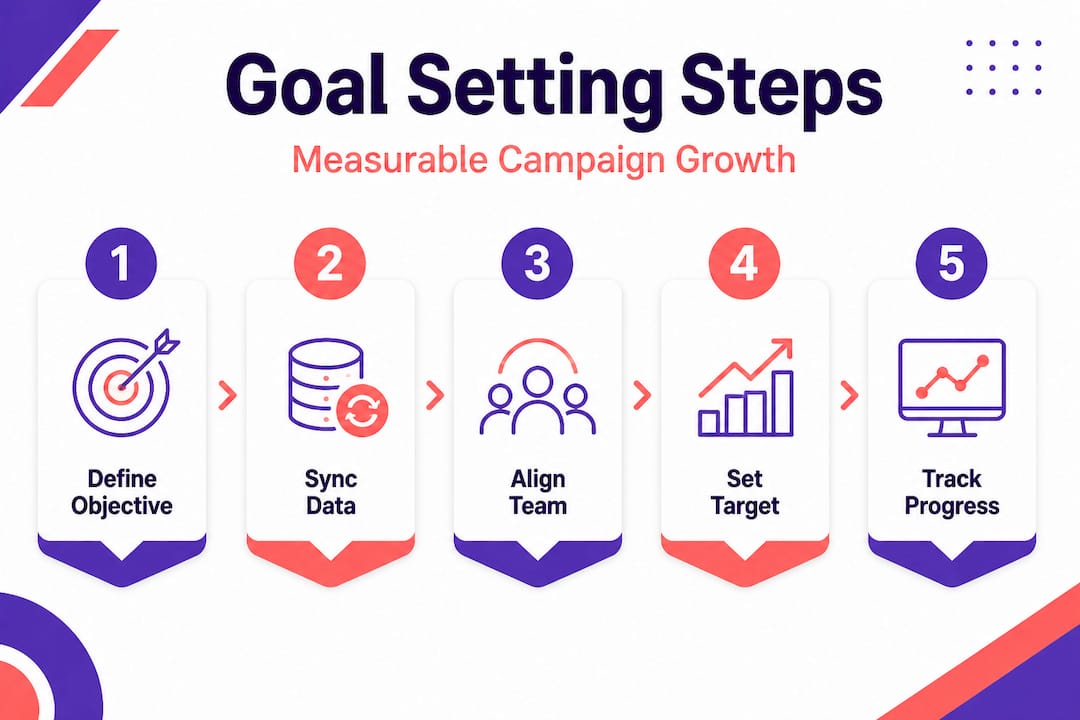
Identify which customer lifecycle stage you’re targeting. Are you focused on awareness, consideration, conversion, or retention? Each stage requires a different measurement framework. Don’t blend them in a single campaign if you want clean data.
-
Choose the corresponding goal type. Use the lifecycle stage to select the right goal category: acquisition for new customers, retention for existing ones, engagement for mid-funnel nurturing, or awareness for top-of-funnel brand building. As Google Ads guidance makes clear, these goals function differently within the platform’s bidding and targeting systems.
-
Select the platform metrics that actually represent the goal. This is where most teams get sloppy. “Conversions” on Google Ads can mean anything from a purchase to a button click, depending on how your account is configured. Choose the specific event or conversion action that represents the outcome you care about, and confirm it maps to a real business result.
-
Configure goals in your ad platform and your reporting system. Don’t just set the goal in one place. Your platform configuration, your BI or analytics tool, and your CRM should all be reflecting the same event with the same definition. Discrepancies here cause the reporting chaos that erodes executive trust.
-
Define explicit targets and review frequency. A goal without a number isn’t a goal. Set a specific CPA target, a ROAS floor, a volume threshold, or a retention rate percentage. Then decide if you’re reviewing performance weekly, monthly, or quarterly. Operationalizing goals with a defined time frequency, whether single, monthly, quarterly, or yearly, is what makes them manageable and auditable rather than aspirational.
Pro Tip: Document not just the goal itself, but the reasoning behind how success is quantified. Why is a $45 CPA the right target? What’s the underlying margin assumption? That context keeps the goal defensible when results get scrutinized, and it helps you course-correct faster when performance drifts.
Following this kind of disciplined approach to paid media optimization creates a feedback loop. Goals inform bidding. Bidding shapes audience signals. Audience signals improve efficiency over time. Break any link in that chain and you lose the compounding benefit.
How to validate your measurement and avoid common pitfalls
Setting goals isn’t enough. Verifying that your measurement is solid protects against costly mistakes and misleading performance reporting.
Even well-configured goals can generate false positives. The platforms themselves sometimes contribute to this problem. Here are the most dangerous pitfalls we see enterprise teams run into:
- In-platform conversion value vs. actual business value. What Google or Meta counts as a conversion value may not match your actual realized revenue. Confirm that the values being passed to the platform reflect true transaction amounts, not placeholder figures.
- Attribution distortion. Last-click attribution inflates the credit given to bottom-of-funnel campaigns and obscures the contribution of upper-funnel activity. Make sure your attribution model matches how your business actually acquires customers.
- Over-relying on platform-provided ROAS. This one deserves special attention. Platform ROAS looks great until you check it against your actual financials.
“ROAS-based bidding can be distorted when platforms layer predictive or estimated value on top of actual conversion value, particularly with high-value customer or retention goals. Before you declare ROAS success, validate your conversion value metric and confirm whether the platform is reporting actual revenue or a modeled projection.”
This is especially relevant if you’re using AI in PPC bidding, where smart bidding strategies can optimize toward predicted values that never materialize in your CRM. Automation amplifies both good decisions and bad data inputs. Feed it a flawed goal and it will pursue that goal relentlessly, at scale.
Here’s how to build a routine validation process:
- Cross-check platform conversions against CRM records at least monthly
- Audit your conversion actions quarterly to confirm they still reflect priority business events
- Test metric accuracy when you change campaign structures, introduce new platforms, or update your tracking setup
- Define reporting windows explicitly and ensure your attribution model supports them, as enterprise goal governance requires consistent, auditable measurement
And on the topic of ROAS specifically, it’s worth reading how we approach ROAS as a campaign metric before putting too much weight on a single number from your platform dashboard.
If validation reveals a measurement problem, don’t wait. Adjust the goal definition, fix the data source, or pause optimization until the signal is clean. Running on bad data while hoping for better outcomes is one of the most expensive habits in digital advertising.
Our take: The uncomfortable truths about campaign goal setting
By now, you know what it takes to set and operationalize campaign goals. But here’s what even seasoned teams consistently overlook.
Most teams dramatically overestimate how accurate their goal measurement actually is. We’ve audited accounts where the stated ROAS was 600%, but actual revenue reconciled from the CRM was 40% lower. The goal looked healthy on paper. The business was bleeding. This happens because confidence in the data builds gradually, people stop questioning it, and the number becomes its own reality. Don’t let that happen on your watch.
The “set it and forget it” mindset is genuinely dangerous in performance advertising. We understand the appeal. Goal setting is hard work, and once it’s done, it feels like the problem is solved. But goals become outdated fast. Business priorities shift, competitive dynamics change, platform algorithms evolve, and customer behavior moves in new directions. A goal that was appropriate in Q1 may be actively misleading you in Q3.
Here’s the contrarian insight: sometimes the bravest and smartest thing you can do is reject the standard platform metrics entirely. If your business model is built on contribution margin rather than revenue, tracking POAS instead of ROAS will give you a far more honest picture of campaign performance. Profit on ad spend, not revenue on ad spend, is what actually keeps the lights on. Many enterprise teams are optimizing toward a metric that looks good in a slide deck but has no direct relationship to their bottom line.
Pro Tip: Schedule quarterly goal audits where goals, measurement infrastructure, and outcomes are reviewed together as a team. Invite finance and sales into those sessions. You will catch problems before they compound, and you’ll build the cross-functional trust that makes performance marketing credible across the entire organization.
The teams that win at digital advertising aren’t the ones who set goals once and execute flawlessly. They’re the ones who treat goal validation as an ongoing discipline and stay honest about the gap between what the platform reports and what the business actually achieves.
Partner with us for smarter, measurable campaign results
Ready to prove that better campaign goals drive better results? Here’s how to take the next step for your business.
At AdVenture Media, we’ve engineered goal-driven campaigns across industries and budget levels, and the results speak for themselves. Our conversion rate case study shows what happens when goals, measurement, and creative all pull in the same direction. Our A/B testing success story demonstrates how disciplined goal setting enables smarter iteration and faster improvement. If you’re ready to move from vague objectives to a campaign framework that actually drives measurable business growth, we’d love to dig into your specific situation. Get in touch and let’s build a strategy that your finance team and your customers will both appreciate.
Frequently asked questions
What are the most important metrics for campaign goals?
The most important metrics depend entirely on your objective. Acquisition campaigns typically center on CPA and new customer conversion rate, while retention campaigns prioritize repeat purchase rate and lifetime value. The key is aligning metrics with how the platform measures them against your specific customer lifecycle stage.
How often should campaign goals be reviewed or updated?
Campaign goals should be reviewed at minimum quarterly, and also whenever business priorities, measurement infrastructure, or competitive conditions change significantly. Enterprise goal governance requires defining reporting windows explicitly so reviews happen on a predictable, auditable schedule.
Why might ROAS numbers differ across platforms or reports?
ROAS discrepancies often occur because platforms include predictive or modeled conversion value on top of actual transaction revenue. Always confirm what each tool defines as “conversion value” and validate your ROAS metric against your CRM before making optimization decisions.
What tools can help track and audit campaign goals?
HubSpot’s campaign goals tracker and Google Ads campaign objectives are both strong options for operationalizing goals with targets and defined reporting frequencies. The best tool is the one your whole team will actually use and review consistently.
Recommended


$120,000 Revenue In First Month for Ecommerce Brand Launch


Xebec Tri-Screen Completely SOLD OUT Earlier Than Expected


Qualified Leads Increase 238% for SaaS Company Using Machine Learning
Request A Marketing Proposal
We'll get back to you within a day to schedule a quick strategy call. We can also communicate over email if that's easier for you.
Visit Us
New York
1074 Broadway
Woodmere, NY
Philadelphia
1429 Walnut Street
Philadelphia, PA
Florida
433 Plaza Real
Boca Raton, FL
General Inquiries
info@adventureppc.com
(516) 218-3722
AdVenture Education
Over 300,000 marketers from around the world have leveled up their skillset with AdVenture premium and free resources. Whether you're a CMO or a new student of digital marketing, there's something here for you.
OUR BOOK
We wrote the #1 bestselling book on performance advertising
Named one of the most important advertising books of all time.
buy on amazon
OUR EVENT
DOLAH '24.
Stream Now.
Over ten hours of lectures and workshops from our DOLAH Conference, themed: "Marketing Solutions for the AI Revolution"
check out dolah
The AdVenture Academy
Resources, guides, and courses for digital marketers, CMOs, and students. Brought to you by the agency chosen by Google to train Google's top Premier Partner Agencies.
Bundles & All Access Pass
Over 100 hours of video training and 60+ downloadable resources
 view bundles →
.png)


