
.svg)

TL;DR:
- Traditional linear marketing funnels are outdated due to non-linear, AI-influenced customer journeys that span multiple channels and revisit stages. Modern frameworks like adaptive funnels, feedback loops, and flywheels provide dynamic, responsive systems that better reflect actual buyer behavior and improve measurable results. Implementing these models requires connecting data signals, continuously testing, and evolving strategies to stay aligned with changing digital marketplaces.
The marketing funnel you learned about in business school is no longer the reliable roadmap it once was. Non-linear, AI-influenced journeys have replaced the tidy Awareness, Consideration, Conversion sequence that marketers relied on for decades. Today’s enterprise buyer moves across channels, revisits stages, and gets nudged by algorithms before your team even recognizes the signal. If you’re a marketing director still running campaigns anchored to a static funnel model, you’re not just behind the curve. You’re actively leaving measurable results on the table.
Table of Contents
- Why the classic marketing funnel model falls short
- Modern marketing funnels: Loops, flywheels, and adaptive systems
- Mapping the modern enterprise buyer journey
- From theory to impact: Applying adaptive funnels for measurable results
- Perspective: Why the best marketing funnels never stand still
- Tap proven digital expertise to supercharge your modern marketing funnel
- Frequently asked questions
Key Takeaways
| Point | Details |
|---|---|
| Linear funnels are obsolete | Today’s buyer journeys are non-linear, requiring more adaptive models for enterprise marketing. |
| Embrace adaptive frameworks | Loops, flywheels, and real-time feedback significantly outperform static funnel designs. |
| AI drives personalization | AI and automation make it possible to tailor each journey at scale and improve funnel measurement. |
| Enterprise journeys are complex | Mapping multi-channel, multi-team touchpoints is essential for effective campaign strategy. |
| Evolve and optimize continuously | The highest-performing teams treat marketing funnels as living systems, not set-and-forget checklists. |
Why the classic marketing funnel model falls short
The traditional funnel made a seductive promise: move a prospect from awareness to purchase in a predictable, sequential path. Map your content to each stage, push the right message at the right time, and watch conversions roll in. Clean. Simple. Wrong.
Real digital buyer behavior has never actually worked this way, and the gap between theory and reality has only widened. A prospect today might discover your brand through a YouTube pre-roll, search your competitors on Google, read a LinkedIn post from your CMO, and then convert after seeing a retargeted ad on Instagram three weeks later. That is not a funnel. That is a web of interconnected signals, each one influencing the next in ways that a linear model simply cannot capture.
The reasons the classic model fails modern marketers are specific and structural:
- It assumes a single path. The funnel treats every buyer as if they travel the same route, ignoring the reality that different segments enter at different stages and exit unpredictably.
- It ignores feedback. Once a lead moves “down” the funnel, traditional models don’t account for signals flowing back upward, such as a post-purchase review influencing a brand-new prospect.
- It siloes channels. Paid search, organic content, social, and email each get assigned to a funnel stage instead of working as an interconnected system.
- It undervalues retention. The classic funnel ends at conversion. But in enterprise marketing, the relationship after the sale often drives more revenue than the initial close.
The rise of AI’s impact on the funnel has accelerated this fragmentation. AI-powered recommendation engines, predictive bidding, and dynamic creative optimization mean that a buyer’s journey can be compressed, extended, or completely rerouted based on machine-driven interventions your team never explicitly programmed.
“The marketing funnel as we knew it is outdated. Modern journeys are non-linear and multi-channel, shaped by AI and automation, and the shift toward adaptive systems, loops, and flywheels is no longer optional.”
Clinging to a static model in this environment isn’t just inefficient. It actively distorts how you allocate budget, evaluate performance, and build your team’s workflows.
Modern marketing funnels: Loops, flywheels, and adaptive systems
So if the linear funnel is obsolete, what replaces it? Three models have emerged as the frameworks most aligned with how enterprise buyers actually behave: adaptive funnels, feedback loops, and flywheels.
An adaptive funnel is not a fixed sequence. It is a dynamic system that adjusts messaging, channel priority, and content based on real-time behavioral signals. Think of it as a funnel that can reshape itself as the customer moves through it. Rather than pushing everyone down a predetermined path, it reads intent signals and responds accordingly.
A feedback loop is exactly what it sounds like. Information generated at any stage of the buyer journey feeds back into earlier stages to improve targeting, messaging, and creative. If your retargeted audience is clicking but not converting, that signal informs your top-of-funnel awareness campaigns, not just your landing page optimization. Loops turn your funnel into a learning machine.
A flywheel takes the concept even further. Popularized in part by HubSpot, the flywheel model replaces the funnel endpoint (conversion) with a continuous cycle of attract, engage, and delight. Each satisfied customer adds energy to the system, generating referrals, reviews, and repeat purchases that fuel new acquisition. The shift to adaptive systems is not a trend. It is a structural response to how modern markets operate.
Here is how the models stack up side by side:
| Characteristic | Linear funnel | Adaptive funnel / flywheel |
|---|---|---|
| Structure | Sequential, fixed stages | Dynamic, responsive pathways |
| Feedback | One-directional (top to bottom) | Continuous, multi-directional loops |
| Channel integration | Siloed by stage | Unified, cross-channel orchestration |
| Analytics focus | Stage completion rates | Multi-touch attribution, engagement depth |
| Customer post-sale | Outside the model | Core part of the growth system |
| AI compatibility | Limited | Native, real-time optimization |
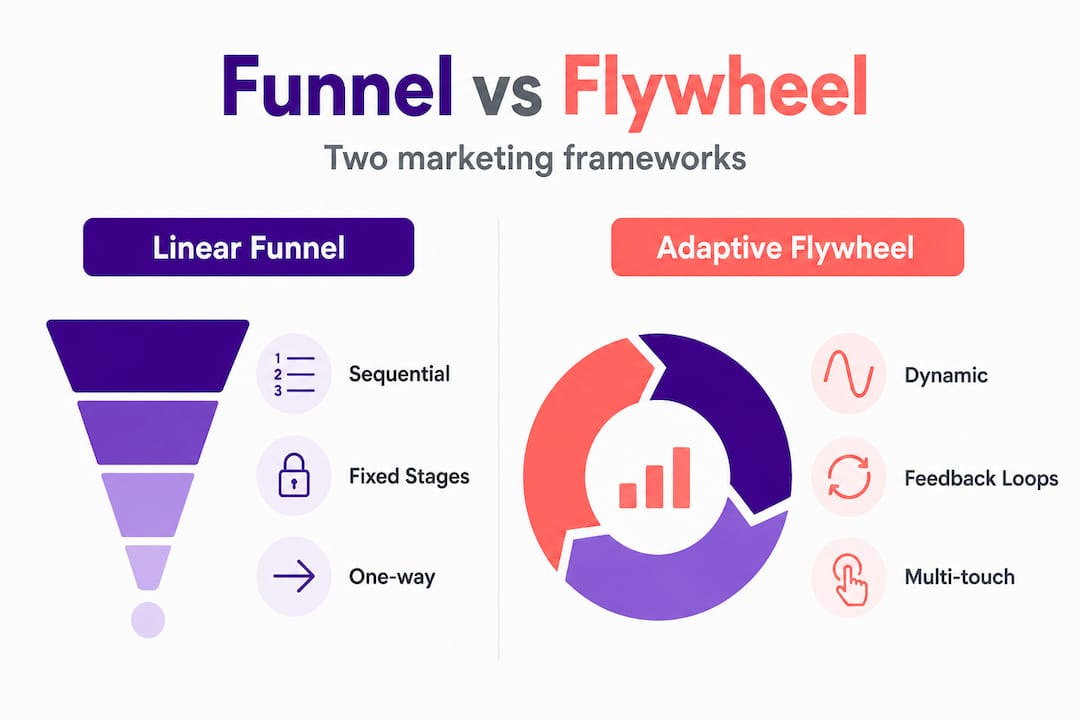
The practical benefits of adaptive frameworks are significant. You stop wasting budget on prospects who have already moved on. You start capturing re-engagement opportunities that a linear model would classify as lost. And you build a system where high-impact funnel strategy examples compound over time rather than resetting with every new campaign cycle.
Pro Tip: The fastest way to activate a feedback loop in your existing setup is to connect your CRM data to your paid media platforms. When closed-won and closed-lost signals feed directly into your Google or Meta audience lists, your campaigns self-optimize in ways that no amount of manual bid adjustment can replicate. This is the essence of an AI-powered approach to funnel management.
Mapping the modern enterprise buyer journey
Enterprise buyers don’t behave like consumers. The decision-making unit is larger, the sales cycle is longer, and the number of digital touchpoints involved before a deal closes can reach into the dozens. Mapping your adaptive funnel to this reality requires a fundamentally different view of what “the journey” actually looks like.

Here is a practical breakdown of a typical enterprise buyer journey in 2026:
| Stage | Primary touchpoint | Teams involved | Digital trigger |
|---|---|---|---|
| Problem recognition | Organic search, industry content | Marketing | Keyword query, content download |
| Vendor shortlisting | Paid search, LinkedIn ads | Marketing, Sales | Demo request, gated asset access |
| Evaluation | Website, case studies, reviews | Sales, Product | Multiple site visits, pricing page views |
| Internal consensus building | Email, webinars | Sales, Customer success | Stakeholder email opens, event registrations |
| Decision and negotiation | Direct outreach, proposal tools | Sales, Legal | Contract engagement, CRM stage change |
| Post-sale expansion | Customer portal, support content | Customer success | Feature adoption, upsell signals |
What makes enterprise journeys fundamentally distinct from SMB or consumer journeys?
- Multiple decision-makers. An enterprise deal typically involves 6 to 10 stakeholders, each with different concerns, information needs, and objections.
- Extended timelines. Sales cycles of 3 to 12 months are common, meaning your funnel must sustain engagement across a much longer window than most attribution models are built to handle.
- High-intent research behavior. Enterprise buyers conduct deep, detailed research before engaging a vendor. Your content strategy must serve that research, not just generate clicks.
- Risk aversion. The larger the deal, the more scrutiny every touchpoint receives. Weak creative or inconsistent messaging at any stage can stall a deal that took months to build.
- Channel diversity. From executive LinkedIn profiles to industry analyst reports to G2 reviews, the channels that influence enterprise decisions are far more varied than a standard paid media plan accounts for.
Buyer journeys now span multiple channels and touchpoints in ways that require your measurement strategy to evolve alongside your funnel. Understanding the role of data in real buyer journeys is no longer a nice-to-have. It is the foundation of any funnel that actually produces pipeline.
Pro Tip: Behavioral data signals, such as repeated pricing page visits, returning to a case study section, or multiple stakeholders from the same company engaging your LinkedIn content, are some of the most powerful indicators of deal velocity. Build audiences and triggers around these signals, and you will shorten complex journeys considerably. Pair this with analytics for funnel stages that account for multi-stakeholder engagement, not just individual lead activity.
From theory to impact: Applying adaptive funnels for measurable results
Frameworks are only useful if they translate into action. Here is a practical process for auditing your current funnel and rebuilding it around adaptive principles.
Step 1: Audit your current model. Map every active campaign to the stage it is supposed to serve. Ask honestly: do these campaigns know what the others are doing? If your awareness spend and your retargeting spend are operating in completely separate campaign structures with no shared data, you don’t have a funnel. You have isolated tactics.
Step 2: Identify your data gaps. Adaptive funnels require data flow between stages. Review your CRM, your ad platforms, and your analytics stack. Where are the connections missing? Where does customer behavior data stop informing campaign decisions?
Step 3: Connect your signals. Build audience lists that reflect real buyer behavior, not just page visits. Use purchase intent signals, CRM stage triggers, and engagement depth metrics to create dynamic audiences that update in real time.
Step 4: Restructure your measurement framework. Stop reporting on each channel in isolation. Adopt a multi-touch attribution model that distributes credit across the touchpoints that actually influenced the outcome. This is where advertising strategies for funnel success start to show dramatically different ROI numbers than single-touch models.
Step 5: Build feedback mechanisms. Create a regular cadence, weekly or bi-weekly, where performance data from conversion stages informs creative and targeting decisions at the top of the funnel. Treat this as a core operational process, not an afterthought.
The most common mistakes enterprise teams make when attempting this transition include:
- Over-relying on last-click attribution. It rewards the final touchpoint and ignores everything that built the case for conversion.
- Treating creative as static. Adaptive funnels require creative that evolves with the audience. A single ad set running for three months is not a funnel strategy.
- Skipping the retention layer. Post-sale customer behavior is one of the richest data sources you have. Most teams don’t connect it to acquisition campaigns at all.
- Optimizing stages in isolation. Improving your landing page conversion rate while ignoring the quality of traffic feeding it is a half-measure at best.
Multi-channel, AI-driven adaptive funnels consistently produce more measurable outcomes than linear models, but only when the team executing them has the discipline to connect the data and act on what it reveals. Analytics best practices designed for multi-channel environments are the backbone of this entire system.
Pro Tip: The most overlooked metric in adaptive funnel measurement is engagement depth across multiple sessions. A single session bounce tells you almost nothing. A prospect who visits five pages, returns two days later, and downloads a case study is showing you a pattern. That pattern is more valuable than any individual conversion metric your dashboard currently tracks.
Perspective: Why the best marketing funnels never stand still
Here is an uncomfortable truth we have observed working with enterprise marketing teams across dozens of industries. The teams that struggle most with funnel performance are rarely the ones with the wrong strategy. They are the ones that found a strategy that worked and stopped evolving it.
This is the trap. A funnel that drove strong results in Q1 of last year is already partially obsolete. Audience behaviors shift. Platform algorithms update. Competitor messaging saturates your previously clean positioning. The success comes from adapting the funnel to ever-changing user journeys rather than treating it as a rigid, locked process.
What we see enterprise teams get wrong most often is the instinct to protect what is working. They over-optimize a high-performing campaign to the point where the learning stops. They freeze creative because the current set is “performing well enough.” They build rigid stage definitions into their CRM that no longer reflect how buyers are actually moving through the evaluation process.
The contrarian view here is important. Over-optimization is its own form of risk. When you squeeze every last percentage point from a current configuration, you are also eliminating the exploratory space where the next breakthrough lives. The best funnels we have engineered are always in a state of structured experimentation. Some elements are locked and performing. Others are actively being tested and challenged.
Treat your funnel as a living system, not a finished product. Build in deliberate testing windows. Rotate creative with intent. Challenge your attribution model every quarter. This is what advanced enterprise strategies look like in practice. Not more complexity. More intentional adaptation.
Tap proven digital expertise to supercharge your modern marketing funnel
Understanding adaptive funnel models is one thing. Actually building one that produces measurable pipeline and revenue is a different challenge entirely, and it is one that requires the right combination of strategic thinking, technical execution, and creative precision. At AdVenture Media, we have spent years engineering performance-driven systems for enterprise clients across Google, Meta, and beyond. Our enterprise marketing capabilities are built around the exact principles covered in this article, connecting data, creative, and channel strategy into a unified growth system. See how this approach translates into real results through our conversion rate optimization case study, and let’s build a funnel that actually keeps up with how your buyers move.
Frequently asked questions
What is the marketing funnel and why does it matter today?
The marketing funnel is a framework for mapping the stages a prospect moves through to become a customer, but today’s journeys are non-linear and AI-driven, requiring adaptive approaches that reflect real buyer behavior rather than assumed linear progression.
How does AI change the way marketers use funnels?
AI enables real-time personalization, automates multi-channel touchpoints, and helps marketers move away from one-size-fits-all funnel stages. AI-influenced journeys mean your campaigns need to respond dynamically rather than following a fixed content calendar mapped to static funnel stages.
What is the difference between a funnel, a loop, and a flywheel?
A funnel is linear and endpoint-focused, while loops and flywheels are built on ongoing engagement and feedback, with each customer interaction feeding energy back into the system to drive continuous growth rather than a single conversion event.
How can I measure the effectiveness of my adaptive marketing funnel?
Track cross-channel touchpoints, feedback loop signals, and conversion metrics that span the full customer lifecycle. Adaptive funnels produce more measurable outcomes when you pair multi-touch attribution with engagement depth metrics rather than relying on last-click reporting alone.
Recommended


Performance Creative Drives 100% Increase in CTR for Luxury Homegoods Brand

.png)
Optimizing for Purchases and App Installs Leads to 69% Decrease in CPA for Woodspoon


AdVenture Media Helps Jive Software Decrease Cost / SQL by 827%
Request A Marketing Proposal
We'll get back to you within a day to schedule a quick strategy call. We can also communicate over email if that's easier for you.
Visit Us
New York
1074 Broadway
Woodmere, NY
Philadelphia
1429 Walnut Street
Philadelphia, PA
Florida
433 Plaza Real
Boca Raton, FL
General Inquiries
info@adventureppc.com
(516) 218-3722
AdVenture Education
Over 300,000 marketers from around the world have leveled up their skillset with AdVenture premium and free resources. Whether you're a CMO or a new student of digital marketing, there's something here for you.
OUR BOOK
We wrote the #1 bestselling book on performance advertising
Named one of the most important advertising books of all time.
buy on amazon
OUR EVENT
DOLAH '24.
Stream Now.
Over ten hours of lectures and workshops from our DOLAH Conference, themed: "Marketing Solutions for the AI Revolution"
check out dolah
The AdVenture Academy
Resources, guides, and courses for digital marketers, CMOs, and students. Brought to you by the agency chosen by Google to train Google's top Premier Partner Agencies.
Bundles & All Access Pass
Over 100 hours of video training and 60+ downloadable resources
 view bundles →
.png)


