
.svg)

TL;DR:
- Ad frequency capping limits how often an ad is shown to the same user within a set timeframe to prevent fatigue and negative brand perception. Its mismanagement drains budgets, lowers engagement, and reduces campaign effectiveness, especially as privacy shifts complicate enforcement. Testing, monitoring, and aligning caps with creative and audience strategies are essential for optimal ROI across platforms.
You’ve optimized your targeting, refined your creative, and set a healthy budget. But what if the biggest threat to your campaign performance isn’t your bidding strategy or your landing page? What if it’s the fact that you’re showing your ad to the same person seven times in a single day? Ad frequency capping is one of the most underutilized controls in a CMO’s toolkit, and mismanaging it quietly drains budgets, erodes brand equity, and pushes your best prospects away. In Google Ads, frequency capping limits impressions per user, though the mechanics shift depending on campaign type. This guide breaks down what frequency capping is, why it matters deeply, and exactly how to use it to protect and grow your ROI.
Table of Contents
- What is ad frequency capping?
- Why ad frequency matters for campaign performance
- How frequency capping works on major ad platforms
- Challenges and privacy shifts in frequency capping
- Best practices: Setting and testing successful frequency caps
- A seasoned marketer’s take: Rethinking ad frequency capping’s real value
- Take your ad strategy further with expert PPC support
- Frequently asked questions
Key Takeaways
| Point | Details |
|---|---|
| Frequency capping basics | Ad frequency capping limits how many times a single user sees your ad in a set period. |
| Platform rules vary | Google, Amazon, and other platforms each handle frequency enforcement differently based on user tracking and campaign setup. |
| No universal cap number | Optimal caps depend on audience, objectives, and content—ongoing testing is needed for best results. |
| Privacy impacts enforcement | New privacy frameworks mean marketers must adapt strategies for tracking and adjusting frequency in the absence of cookies or device IDs. |
| Testing beats assumptions | A/B testing and continuous monitoring deliver better results than relying on ‘industry standard’ cap settings. |
What is ad frequency capping?
Now that we’ve established the stakes, let’s clarify exactly what ad frequency capping is and how it works behind the scenes.
At its core, ad frequency capping is the practice of limiting how many times an ad is shown to the same person within a defined time period. The goal is to prevent overserving, reduce ad fatigue, and preserve the user experience. Think of it as setting a sensible boundary so your brand doesn’t become the guest who overstays their welcome.
The mechanics are straightforward in concept but nuanced in execution. You define a maximum number of impressions per user within a specific time unit, such as once per day, three times per week, or ten times per campaign. When a user reaches that threshold, the platform stops serving that ad to them for the remainder of the defined window. In Campaign Manager 360, the ad server actively checks recent impression history before each ad call and only serves the ad if the cap hasn’t been reached. This happens in real time, invisibly, at the server level.
Understanding ad frequency explained across platforms helps you appreciate why settings vary so much. Here’s a quick look at how common configurations differ:
| Platform | Cap type | User identifier | Time unit options |
|---|---|---|---|
| Google Ads (Display) | Impressions per user | Cookie / Signed-in user | Day, week, month |
| Google Ads (Video) | Views or impressions | Cookie / Google Account | Day, week, month |
| Amazon Ads | Impressions per user | Amazon ID / Device ID | Day, week |
| Campaign Manager 360 | Impressions per user | Cookie / Device ID | Minute, hour, day, week, lifetime |
“There is no single universal ‘perfect’ cap. The optimal level depends on audience, creative, channel, and campaign goals. Test and iterate.” — Amazon Ads guidance on frequency capping
That quote deserves to be pinned above every media planner’s monitor. Frequency capping isn’t a formula you solve once. It’s a dial you keep tuning.
Why ad frequency matters for campaign performance
Understanding the nuts and bolts is only half the story. Let’s look at why this technique is crucial for not just efficiency but also brand outcomes.
Here’s the reality: there’s a point at which additional ad exposure stops helping and starts hurting. That inflection point differs by brand, audience, and channel, but it always exists. Ignoring it is one of the costliest mistakes enterprise advertisers make.
The main effects of mismanaged frequency fall into five clear categories:
- Ad fatigue sets in. Users who see the same ad repeatedly stop engaging and start ignoring. Click-through rates drop, and you’re paying for impressions that produce zero value.
- Negative brand association builds. Overexposure creates irritation. Users begin to associate your brand with annoyance rather than relevance.
- Conversion rates fall. A prospect who has already decided not to convert doesn’t need the 12th reminder. Each additional impression at that stage is wasted spend.
- Budget efficiency collapses. When impressions pile up on users who are already saturated, you’re pulling budget away from fresh, reachable audiences.
- Negative reach emerges. This is the most underappreciated risk. A major study on negative reach from Omnicom Media found that overexposure actively reduces brand favorability and can undermine campaign performance across entire audience segments.
That last point is one we see get ignored constantly. Marketers focus on reach and frequency as neutral delivery metrics, but the Omnicom research reframes frequency overload as a negative force with measurable damage to campaign outcomes. This changes how you should think about caps entirely.
Pro Tip: Don’t wait for your analytics dashboard to surface the problem. Use custom ad fatigue monitoring scripts to proactively track impression-per-user patterns before they drag down your CTR and conversion metrics. The same principle applies to how you approach email marketing strategies, where send frequency directly shapes list health and engagement rates.
The strategic balance isn’t just about cutting exposure. It’s about delivering the right message at the right moment without burning goodwill. Too many impressions is damaging. But too few means you underinvest in awareness and lose the repetition that builds memory and trust. Finding that window is the real work.
How frequency capping works on major ad platforms
Knowing the “why” matters, but execution depends on details that change by platform. Here’s how setup actually differs and why it matters.

Google Ads handles capping differently depending on campaign type. For Display campaigns, frequency capping in Google Ads limits impressions per user per day, week, or month. For Video campaigns (YouTube), you can cap on impressions or views, and Smart campaigns may override manual settings based on Google’s optimization logic. That’s a critical nuance: if you’re running Performance Max or Smart Display, automated bidding can override your cap settings in certain scenarios. Know your campaign type before you assume your cap is working.
Campaign Manager 360 offers the most granular control, allowing caps down to the minute or hour level. This precision is valuable for time-sensitive campaigns or suppression lists where you want to pull back exposure immediately after a conversion event.
Amazon Ads uses Amazon IDs and device identifiers to enforce caps, which makes it more consistent across devices for users logged into Amazon accounts. For broader programmatic and RTB setups, some platforms offer hosted frequency capping that enforces limits without sharing user identifiers in bid requests, though enforcement is scoped only to impressions served by that specific platform.
Here’s a comparison to keep your setup aligned:
| Platform | Cap type | Identifier used | Key limitation |
|---|---|---|---|
| Google Ads | Impressions or views | Cookie / Google Account | Smart/PMax may override manual caps |
| Amazon Ads | Impressions | Amazon ID / Device ID | Limited cross-platform enforcement |
| Campaign Manager 360 | Impressions | Cookie / Device ID | Requires proper trafficking setup |
| RTB (hosted) | Impressions | Platform-scoped | Cap only applies within that platform |
Common pitfalls to watch for:
- Caps don’t apply when user identification fails, such as cookieless browsers or opted-out users
- Running campaigns across multiple platforms with no cross-platform coordination can result in the same user seeing 5 caps worth of ads from different sources
- Automated bidding in Google Ads may deprioritize cap settings in favor of conversion optimization
- Caps set at the campaign level may not override ad group or creative level settings depending on how your account is structured
When you’re working through setting campaign budgets alongside frequency settings, these platform-level differences become especially important. The budget you allocate assumes a certain impression-to-conversion ratio, and overserving a saturated audience throws that math off completely. The complete Google Ads setup guide walks through how these settings interact in practice.
Challenges and privacy shifts in frequency capping
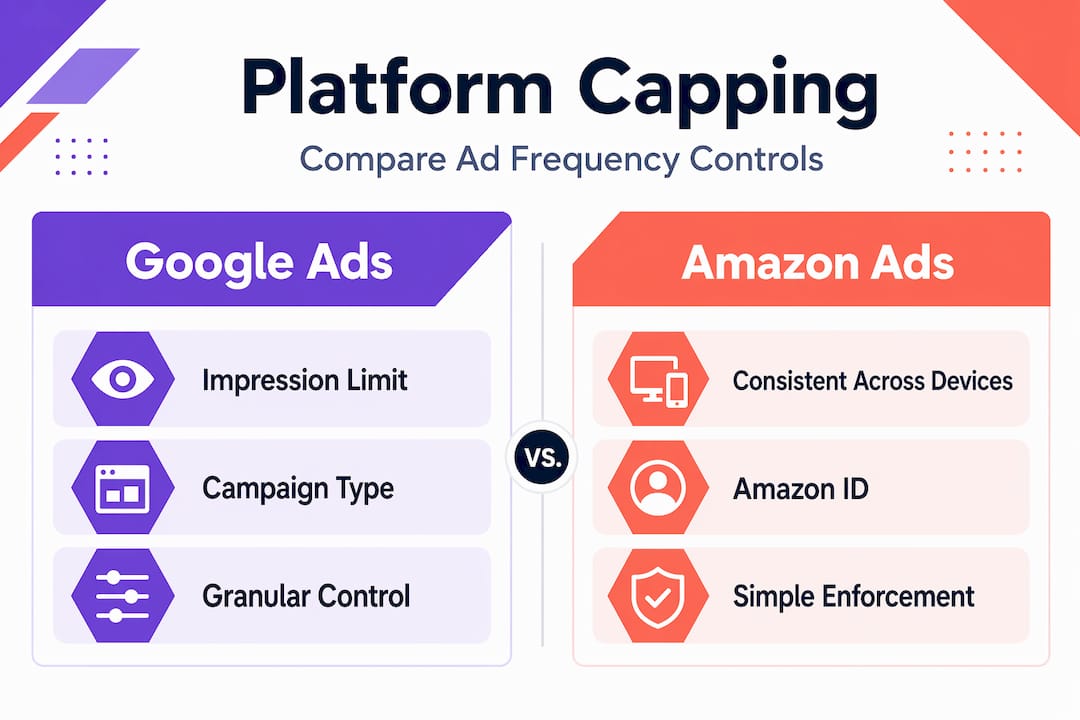
Each platform handles capping differently, but evolving privacy rules create new unknowns every marketer must face. Here’s what to watch out for.
Frequency capping has always depended on one thing: knowing who the user is. Traditionally, that meant cookies. As cookies erode and device IDs become restricted, the reliability of frequency enforcement drops significantly. This is a real problem today, not a hypothetical future concern.
Privacy Sandbox Protected Audience moves frequency cap enforcement to the device itself rather than the server. This client-side enforcement means the server no longer logs why an ad was filtered. From a diagnostics standpoint, you lose visibility. You can’t see whether your cap triggered or whether something else stopped the ad from serving. That gap in transparency complicates troubleshooting.
There’s also a known edge case in Google Ad Manager: in rare situations, such as a fresh Chrome session without existing cookies, the frequency cap may trigger one impression after the configured limit because the first impression is used to set the cookie. It’s a small discrepancy, but at scale across millions of impressions, it adds up.
Key privacy and enforcement challenges to stay ahead of:
- Cookie deprecation means frequency caps may not fire for anonymous or cookieless users
- Cross-device tracking gaps allow the same user to be counted as different users on phone, tablet, and desktop
- Client-side enforcement in Privacy Sandbox reduces server-side diagnostic visibility
- Users who opt out of tracking may receive uncapped ad exposure or no exposure at all, depending on platform logic
- GDPR and CCPA compliance requirements can restrict identifier availability in specific markets
Pro Tip: Build a monthly cross-platform exposure audit into your workflow. Use custom ad fatigue monitoring tools to surface anomalies in per-user impression patterns, especially for campaigns running simultaneously across Google, programmatic DSPs, and social. Waiting for performance signals is too late.
The uncomfortable reality is that privacy shifts are making frequency management harder to enforce precisely at the moment when audiences are most fragmented. The solution isn’t to abandon caps. It’s to layer in creative rotation, audience segmentation, and placement-level controls to compensate where identifier-based capping breaks down.
Best practices: Setting and testing successful frequency caps
With privacy and execution challenges in mind, here’s a tested approach to finding and iterating on your optimal cap for consistent results.
There’s no shortcut here, but there is a repeatable process. Follow this sequence when setting up or auditing frequency caps:
- Start with platform defaults or category benchmarks. According to Amazon Ads guidance, there is no universal perfect cap, so use starting points like 3 to 5 impressions per day for most display campaigns, then adjust from there.
- Segment by funnel stage. Awareness campaigns can tolerate higher frequency because you need repetition to build memory. Retargeting campaigns warrant tighter caps because the audience already knows you and you risk annoyance quickly.
- Monitor the right metrics. Watch CTR trend over time per user segment, not just aggregate CTR. A flat overall CTR can mask a sharp decline in your high-frequency bucket. Also track view-through conversion rate and brand sentiment signals if you have them.
- Run A/B tests on cap levels. Split audiences with a cap of 3 per day versus 7 per day and measure conversion rate, brand lift, and cost per acquisition over two to four weeks. The data will tell you more than any benchmark ever could.
- Refresh creative in sync with cap settings. A cap of 5 impressions per week with the same creative for three months still causes fatigue. Creative rotation is a natural extension of frequency management.
- Check for red flags weekly. Signs of overexposure include rising cost per click with flat or declining conversion rates, decreasing engagement rates over campaign life, and growing frequency with shrinking unique reach.
This is not a “set it and forget it” lever. We see brands configure a cap at campaign launch and never revisit it. Audiences shift, creative ages, and platform behavior changes. Maximizing campaign ROI with ad frequency is an ongoing practice, not a one-time checkbox.
A seasoned marketer’s take: Rethinking ad frequency capping’s real value
Here’s where we want to push back on the conventional wisdom a bit. Most conversations about frequency capping revolve around “the number.” Three per day. Seven per week. Five across the campaign. Marketers treat it like there’s a magic cap waiting to be discovered, and once you find it, performance unlocks.
That’s the wrong mental model entirely.
The number is just a guardrail. The real value lives in why you’re capping and what you’re doing around it. A brand-building campaign and a direct response retargeting campaign don’t just need different caps. They need different creative cadences, different channel mixes, and different user journey logic. Slapping the same cap on both and calling it a day is a missed opportunity.
What most marketers also miss is this: even a tightly managed cap fails if the creative is weak or the targeting is off. You can cap at 2 impressions per week, and if the ad is irrelevant or stale, you’ve still burned two chances to make a meaningful connection. Frequency capping without creative strategy is like fixing your roof when the foundation is cracked.
We’d argue that the real payoff from frequency management comes from treating it as part of a broader system: deep dive on frequency as a strategic variable rather than a technical setting. Segmentation, creative refresh cycles, audience suppression post-conversion, and cadence tuning across channels work together to create an experience that feels intentional rather than intrusive. That’s where the ROI lives. The number just keeps you from going too far in the wrong direction.
Take your ad strategy further with expert PPC support
Frequency capping is one lever in a complex machine, and getting it right across multiple platforms, audiences, and campaign types takes more than a blog post. When you’re ready to move from theory to real performance improvements, having an experienced team in your corner accelerates everything. At AdVenture Media, we’ve helped brands diagnose and fix exactly these kinds of invisible efficiency drains. Stories like the Survey Money Machines case study show what consistent, structured optimization can produce year over year. If your current capping setup hasn’t been audited recently, our PPC Tuneup service is built for this. Ready to talk specifics? Reach out to our team and let’s look at what’s really happening inside your campaigns.
Frequently asked questions
How does ad frequency capping differ across platforms?
Each major ad platform implements frequency capping based on its own user identification system and campaign architecture, so cap enforcement varies significantly across Google Ads, Amazon Ads, and Campaign Manager 360. Knowing those differences is essential before assuming your cap is working uniformly across channels.
What happens to frequency caps if user identifiers are blocked or unavailable?
When identifiers are unavailable due to cookie blocking or user opt-out, platforms often cannot enforce the configured cap, which may result in overserving or unpredictable delivery behavior. This is increasingly common as privacy regulations tighten globally.
Can frequency capping prevent all cases of ad fatigue?
No. Frequency caps reduce the risk of overexposure, but irrelevant creative, weak targeting, or poor audience segmentation can still generate fatigue and negative brand sentiment even when impression counts stay within the configured limit.
How should I choose my starting frequency cap?
Start with platform defaults or common industry benchmarks such as 3 to 5 daily impressions for display, then test different cap levels against performance metrics like CTR and conversion rate. As Amazon Ads emphasizes, the optimal cap depends on your audience, creative, channel, and campaign goals, so iteration is the only reliable method.
Recommended


Conversion Rate Optimization Transforms SaaS Content Into Profitable Advertising Collateral


Xebec Tri-Screen Completely SOLD OUT Earlier Than Expected

.svg.png)
Budget Optimization Leads to eCommerce Growth For Sennheiser
Request A Marketing Proposal
We'll get back to you within a day to schedule a quick strategy call. We can also communicate over email if that's easier for you.
Visit Us
New York
1074 Broadway
Woodmere, NY
Philadelphia
1429 Walnut Street
Philadelphia, PA
Florida
433 Plaza Real
Boca Raton, FL
General Inquiries
[email protected]
(516) 218-3722
AdVenture Education
Over 300,000 marketers from around the world have leveled up their skillset with AdVenture premium and free resources. Whether you're a CMO or a new student of digital marketing, there's something here for you.
OUR BOOK
We wrote the #1 bestselling book on performance advertising
Named one of the most important advertising books of all time.
buy on amazon
OUR EVENT
DOLAH '24.
Stream Now.
Over ten hours of lectures and workshops from our DOLAH Conference, themed: "Marketing Solutions for the AI Revolution"
check out dolah
The AdVenture Academy
Resources, guides, and courses for digital marketers, CMOs, and students. Brought to you by the agency chosen by Google to train Google's top Premier Partner Agencies.
Bundles & All Access Pass
Over 100 hours of video training and 60+ downloadable resources
 view bundles →
.png)


