
.svg)

More than 80 percent of American e-commerce businesses struggle to connect paid search spend with measurable sales growth. For digital marketing managers, every campaign dollar counts and precise targeting means higher returns. Whether you oversee a national brand or a growing online platform, understanding exactly who you want to reach and how to measure success will change how you plan, launch, and optimize campaigns. This guide gives you the latest techniques to define your audience and set benchmarks for real impact.
Table of Contents
- Step 1: Define Campaign Goals And Audience
- Step 2: Configure Account Structure And Tracking
- Step 3: Research And Select High-Intent Keywords
- Step 4: Craft Compelling Ad Copy And Creative
- Step 5: Launch Campaigns And Monitor Performance
- Step 6: Analyze Results And Optimize For Roi
Quick Summary
| Key Insight | Explanation |
|---|---|
| 1. Set Specific SMART Goals | Establish clear, measurable objectives based on SMART criteria to guide your campaign effectiveness. |
| 2. Organize Google Ads Structure | Create a hierarchical account setup for better targeting and tracking of campaign performance. |
| 3. Focus on High-Intent Keywords | Identify and prioritize keywords that demonstrate clear buying intent to improve conversion rates. |
| 4. Craft Targeted Ad Copy | Develop ad copy that resonates with audience motivations, addressing their pain points directly. |
| 5. Monitor and Optimize Continually | Regularly review performance metrics to make data-driven adjustments for improved ROI. |
Step 1: Define Campaign Goals and Audience
Successful paid search campaigns begin with crystal clear goals and a deep understanding of your target audience. You will map out precise objectives and create a detailed profile of who you want to reach.
Start by establishing SMART marketing goals that transform broad ambitions into actionable strategies. These goals should be specific (increase sales by X%), measurable (tracking conversion rates), achievable (realistic within budget), relevant to your business, and time-bound (within a specific quarter). For e-commerce businesses, this might mean increasing online revenue by 20% or improving average order value by 15% within the next 90 days.
Audience definition requires deep market research that goes beyond basic demographics. Analyze customer behaviors, purchasing patterns, pain points, and digital interactions. Create comprehensive audience personas that capture not just age and income, but motivations, challenges, and online browsing habits. Segment your audience into distinct groups based on their potential value and likelihood of conversion.
Pro tip: Use web analytics and customer survey data to refine your audience targeting and continuously update your customer personas with real-world insights.
Step 2: Configure Account Structure and Tracking
Configure your Google Ads account with a strategic structure that supports precise targeting and seamless performance tracking. This foundational step transforms your campaign from a simple advertising effort into a robust data driven marketing machine.
Begin by creating a logical account hierarchy that mirrors your business structure. Design campaigns and ad groups that reflect product categories, customer segments, or specific marketing objectives. Establish consistent file and tracking directories that enable clear data organization and easy performance analysis. Your account structure should allow granular tracking of each campaign component while maintaining an intuitive navigation framework.
Prioritize privacy compliant tracking configurations that balance data collection with user rights. Implement conversion tracking pixels strategically across your website to capture critical user interactions. Set up robust tracking mechanisms that respect evolving data protection regulations while providing comprehensive insights into campaign performance. Use tools like Google Tag Manager to centralize your tracking implementation and ensure accurate data collection without compromising user privacy.
Pro tip: Create a standardized naming convention for your campaigns and ad groups that includes key identifiers like product type, target audience, and marketing objective for instant visual recognition and easier reporting.
Here is a summary of campaign tracking features and their business impact:
| Tracking Feature | Purpose | Business Impact |
|---|---|---|
| Account Hierarchy | Organizes campaigns | Enables targeted management |
| Conversion Tracking Pixel | Monitors user actions | Measures true ROI |
| Centralized Tag Manager | Unifies tracking setup | Improves data accuracy |
| Privacy Compliance Tools | Adheres to regulations | Builds customer trust |
Step 3: Research and Select High-Intent Keywords
Keyword research is the strategic foundation that transforms your paid search campaign from generic advertising to precision targeted marketing. Your goal is to uncover the exact search terms potential customers use when looking to purchase products in your e-commerce ecosystem.

Keyword research involves identifying search terms that reveal user intent and purchasing potential. Start by generating seed keywords directly related to your product lines, then expand using comprehensive keyword research tools like Google Keyword Planner, SEMrush, or Ahrefs. Focus on long-tail keywords that demonstrate high commercial intent these are typically more specific phrases with lower search volume but significantly higher conversion rates. For instance instead of targeting broad terms like “running shoes” target more specific phrases like “lightweight trail running shoes for marathon training.”
Develop a sophisticated keyword strategy by categorizing keywords into different intent levels. Brainstorm and analyze keywords that reflect different stages of the customer journey, from informational searches to transactional queries. Prioritize keywords with clear buying signals such as “buy,” “price,” “best,” or “review.” Analyze competitor keyword strategies and identify gaps you can exploit to capture high-intent traffic that your competitors might be overlooking.
Pro tip: Regularly update your keyword list by monitoring search term reports in Google Ads to identify new high-performing keywords and negative keywords that prevent wasted ad spend.
Here’s a comparison of keyword intent categories for paid search advertising:
| Keyword Intent | Example Search Terms | Typical Conversion Rate | Best Use Case |
|---|---|---|---|
| Informational | “how to choose running shoes” | Low | Brand awareness campaigns |
| Navigational | “Nike running shoes online” | Moderate | Directing to website/store |
| Transactional | “buy lightweight running shoes” | High | Sales-focused campaigns |
| Commercial Investigation | “best shoes for marathon training” | Moderate to High | Competitive product research |
Step 4: Craft Compelling Ad Copy and Creative
Successful e-commerce paid search advertising hinges on creating ad copy that speaks directly to your target audience’s desires and pain points. Your creative must transform casual browsers into motivated buyers by delivering precisely targeted messaging that resonates emotionally and logically.
Crafting effective ad copy requires understanding strategic digital marketing techniques that blend data driven insights with compelling storytelling. Develop headlines that immediately capture attention by addressing specific customer challenges or highlighting unique product benefits. Your ad copy should communicate a clear value proposition using concise language that speaks directly to the searcher’s intent. Focus on creating multiple ad variations that test different emotional triggers and value propositions allowing you to optimize performance through continuous refinement.
Narrative advertisements become more persuasive when they create strong viewer connections and integrate the brand seamlessly into the story. Structure your ad creative to tell a mini narrative that transforms product features into meaningful customer experiences. Utilize specific language that demonstrates how your product solves real problems rather than simply listing generic attributes. Include social proof elements like customer ratings or unique selling points that differentiate your offering from competitors.
Pro tip: Develop at least three distinct creative variations for each ad group and use Google Ads rotation settings to systematically test and identify the most effective messaging combinations.
Step 5: Launch Campaigns and Monitor Performance
Successful paid search campaigns require strategic launch and continuous performance tracking. Your goal is to transform initial campaign setup into a dynamic system that generates consistent return on investment by making data driven adjustments.
Search analytics provides critical insights for understanding campaign performance by collecting and analyzing user interaction data across multiple platforms. Set up comprehensive tracking in Google Analytics and Google Ads to monitor key performance metrics like click through rates, conversion rates, cost per acquisition, and return on ad spend. Configure conversion tracking pixels precisely to capture every meaningful user interaction from initial click to final purchase. Implement geographic and device level tracking to understand nuanced performance variations across different audience segments.
Marketing performance measurement requires systematic monitoring and continuous optimization aligned with your strategic business objectives. Establish a regular performance review cadence where you analyze campaign metrics weekly and conduct deep dive assessments monthly. Create custom dashboards that provide immediate visibility into campaign health and highlight areas requiring strategic intervention. Develop benchmark performance targets for each key metric and be prepared to rapidly adjust bidding strategies, audience targeting, and creative elements based on emerging data signals.
Pro tip: Configure automated alerts in Google Ads to notify you immediately when campaign performance deviates significantly from expected benchmarks, enabling rapid response and minimizing potential revenue loss.
Step 6: Analyze Results and Optimize for ROI
Successful e-commerce paid search campaigns demand rigorous results analysis and strategic optimization. Your ultimate objective is transforming raw performance data into actionable insights that continuously improve advertising efficiency and profitability.
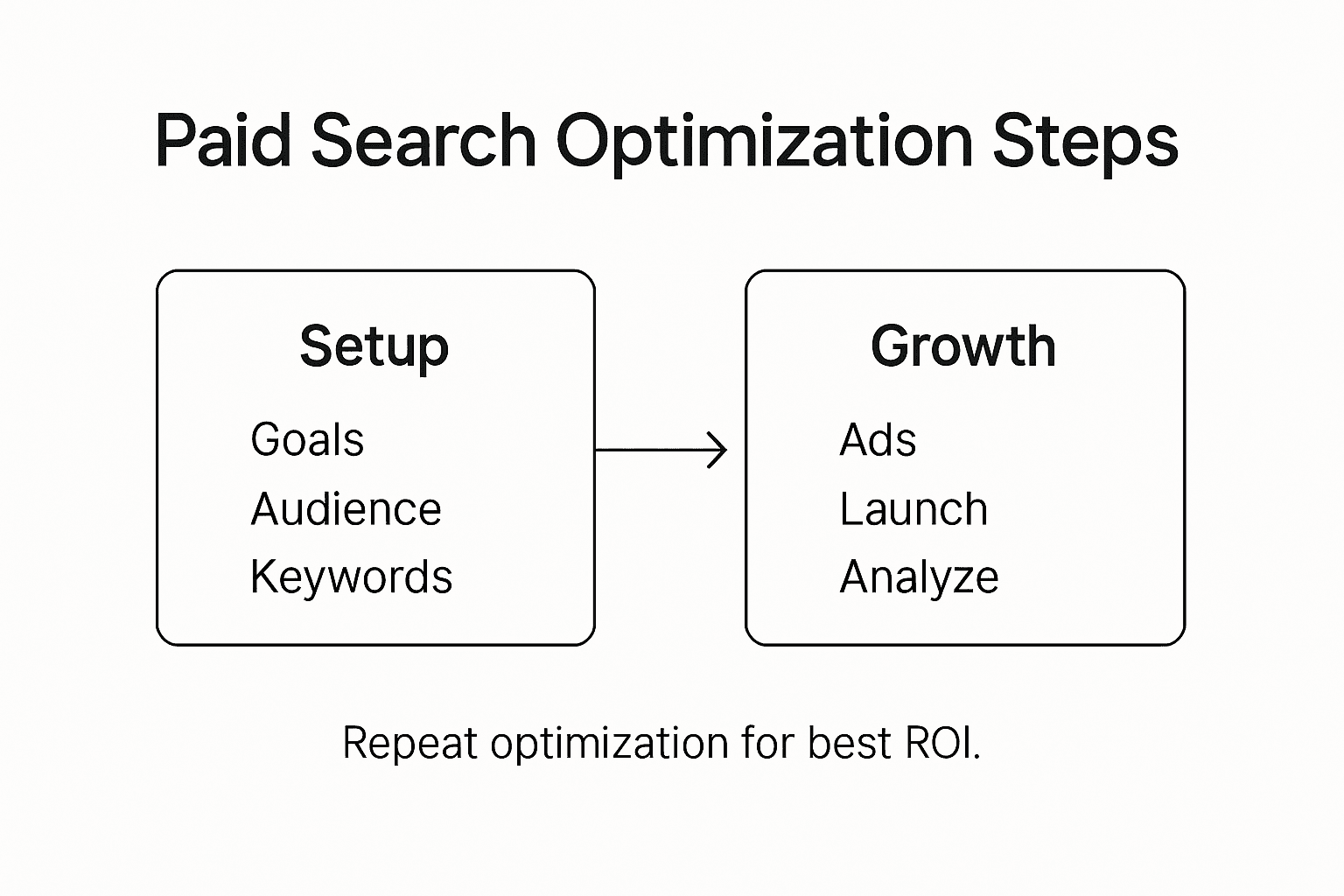
Analyzing ROI on sponsored search ads requires detailed tracking of keyword performance across multiple dimensions. Distinguish performance between branded and non-branded keywords and evaluate conversion data comprehensively. Calculate precise return on ad spend by tracking revenue generated against total advertising investment. Pay special attention to metrics like cost per acquisition, conversion rates, and average order value to understand the true financial impact of your campaigns.
Marketing ROI optimization requires establishing robust measurement systems that connect advertising activities directly to financial outcomes. Develop custom dashboards that provide immediate visibility into campaign performance metrics. Implement a systematic review process where you analyze data weekly and conduct comprehensive monthly assessments. Be prepared to make rapid adjustments to bidding strategies, audience targeting, and creative elements based on emerging performance signals. Continuously refine your approach by testing new targeting options and creative variations to incrementally improve campaign efficiency.
Pro tip: Create a standardized ROI tracking spreadsheet that automatically calculates key performance metrics and highlights areas requiring strategic intervention.
Drive E-Commerce Growth with Expert Paid Search Strategy
Your journey through paid search strategy for e-commerce success highlights the crucial need for clear goals, precise account structure, high-intent keyword targeting, and ongoing campaign optimization. These steps can feel overwhelming when trying to balance data privacy, campaign creativity, and continuous performance monitoring. At AdVenture Media, we understand these challenges and specialize in turning complex paid search strategies into measurable revenue growth using proven methods tailored to your unique business goals.
Take control of your advertising success today by partnering with a strategy-first agency that masters Google Ads, creative development, and ROI-driven marketing. From in-depth audience research to hands-on campaign optimization, we offer the expertise needed to ensure your paid search campaigns not only launch effectively but scale profitably. Ready to stop guessing and start growing? Connect with our team through the contact page and learn how our award-winning strategies can transform your e-commerce advertising. Every day you delay is lost potential—take action now to unlock your brand’s full digital potential.
Frequently Asked Questions
What are SMART marketing goals in the context of paid search campaigns?
SMART marketing goals are Specific, Measurable, Achievable, Relevant, and Time-bound objectives that guide your advertising efforts. For example, you might set a goal to increase online revenue by 20% within the next 90 days. Clearly define these goals to enhance focus and track progress effectively.
How can I create effective audience personas for my e-commerce paid search campaigns?
To create effective audience personas, conduct deep market research that goes beyond basic demographics. Analyze customer behaviors, motivations, and pain points to segment your audience into distinct groups that reflect their potential value and likelihood of conversion.
What is the importance of configuring account structure and tracking in Google Ads?
Configuring your Google Ads account with a logical structure and robust tracking enables precise targeting and effective performance analysis. Organize campaigns by categories and set up conversion tracking to monitor key metrics, which can enhance your management capabilities and improve your advertising ROI.
How do I select high-intent keywords for my e-commerce paid search strategy?
To select high-intent keywords, start by generating seed keywords related to your products and expand using keyword research tools. Focus on long-tail keywords that demonstrate clear buying signals, such as “buy” or “best,” to attract users who are more likely to convert into customers.
What steps should I take to craft compelling ad copy for my paid search campaigns?
Crafting compelling ad copy involves understanding your audience’s needs and using clear, concise language that conveys a strong value proposition. Create multiple variations of your ad copy to test different emotional triggers and refine them based on performance data to improve conversion rates.
How can I effectively monitor and optimize my paid search campaign performance?
To effectively monitor and optimize your campaign performance, set up comprehensive tracking systems and review key metrics regularly. Analyze performance weekly and be prepared to make adjustments to bidding strategies or audience targeting to continuously improve your ROI.
Recommended


Performance Creative Drives 100% Increase in CTR for Luxury Homegoods Brand
.avif)

VersaDesk Stands Up To Competition, Wins Back Bottom Funnel Traffic.

.svg.png)
Budget Optimization Leads to eCommerce Growth For Sennheiser
Request A Marketing Proposal
We'll get back to you within a day to schedule a quick strategy call. We can also communicate over email if that's easier for you.
Visit Us
New York
1074 Broadway
Woodmere, NY
Philadelphia
1429 Walnut Street
Philadelphia, PA
Florida
433 Plaza Real
Boca Raton, FL
General Inquiries
info@adventureppc.com
(516) 218-3722
AdVenture Education
Over 300,000 marketers from around the world have leveled up their skillset with AdVenture premium and free resources. Whether you're a CMO or a new student of digital marketing, there's something here for you.
OUR BOOK
We wrote the #1 bestselling book on performance advertising
Named one of the most important advertising books of all time.
buy on amazon
OUR EVENT
DOLAH '24.
Stream Now.
Over ten hours of lectures and workshops from our DOLAH Conference, themed: "Marketing Solutions for the AI Revolution"
check out dolah
The AdVenture Academy
Resources, guides, and courses for digital marketers, CMOs, and students. Brought to you by the agency chosen by Google to train Google's top Premier Partner Agencies.
Bundles & All Access Pass
Over 100 hours of video training and 60+ downloadable resources
 view bundles →
.png)


