
.svg)

More than half of American businesses invest in pay-per-click advertising to boost online visibility and sales. With competition growing every year, standing out in busy digital markets is tougher than ever. PPC offers precise control over who sees your message, helping American brands reach the right people and measure every dollar spent. Understanding the unique benefits and risks of PPC empowers you to make smarter marketing choices that lead to real business growth.
Table of Contents
- Defining PPC and Its Strategic Importance
- Major PPC Platforms and Advertising Types
- How PPC Campaigns Drive Conversions
- Metrics, Costs, and ROI Measurement
- Risks, Common Pitfalls, and How to Avoid Them
Key Takeaways
| Point | Details |
|---|---|
| PPC Definition and Importance | Pay Per Click (PPC) is a targeted digital advertising model that allows businesses to control marketing costs and measure ROI effectively. |
| Major PPC Platforms | Google Ads is the primary platform for PPC, complemented by Microsoft Advertising for broader reach across multiple networks. |
| Conversion Strategies | Focus on landing page optimization, compelling ad copy, and continuous A/B testing to maximize conversions from PPC campaigns. |
| Metrics and Risks | Key metrics like CPC and ROI are essential for evaluating campaign performance; proactive monitoring helps mitigate risks like click fraud. |
Defining PPC and Its Strategic Importance
Pay per Click (PPC) represents a powerful digital advertising model where businesses gain precise control over their online marketing efforts. Advertisers leverage platforms like Google Ads to strategically position their offerings and only pay when potential customers actively click their advertisements.
At its core, PPC operates as a targeted approach to digital marketing. Businesses bid on specific keyword phrases relevant to their target audience, enabling them to appear prominently in search results and partner networks. Unlike traditional advertising models, pay per click advertising provides immediate visibility and measurable outcomes, allowing companies to track precise return on investment with unprecedented granularity.
The strategic importance of PPC extends beyond simple visibility. By enabling hyper-targeted advertising, businesses can:
- Reach specific demographic segments
- Control advertising budgets with exceptional precision
- Generate immediate website traffic
- Test marketing messages rapidly
- Collect valuable data about customer engagement
Unlike broad marketing approaches, PPC allows businesses to experiment, optimize, and refine their digital strategies in real time. Marketers can adjust campaigns within minutes, scaling efforts that demonstrate strong performance and quickly eliminating ineffective approaches. This agility transforms PPC from a mere advertising technique into a sophisticated growth mechanism for modern businesses.
Major PPC Platforms and Advertising Types
Google Ads represents the cornerstone of pay-per-click advertising, offering businesses an expansive platform to reach potential customers across multiple digital channels. Google’s advertising platform provides advertisers with comprehensive targeting options, enabling precise audience segmentation through search, display, video, and shopping ad formats.

Beyond Google, Microsoft Advertising offers a robust alternative for businesses seeking to diversify their digital marketing strategies. This platform enables advertisers to display targeted advertisements across Bing, Yahoo!, DuckDuckGo, and an extensive network of partner websites. Marketers can seamlessly import existing Google Ads campaigns, streamlining cross-platform advertising efforts and expanding potential reach.
The primary types of PPC advertising include:
- Search Ads: Text-based advertisements appearing in search engine results
- Display Ads: Visual advertisements shown across websites and apps
- Shopping Ads: Product-specific listings with images and pricing details
- Video Ads: Promotional content displayed on video platforms
- Remarketing Ads: Targeted advertisements shown to previous website visitors
Successful PPC strategies require understanding the unique strengths of different platforms and ad types. PPC bidding strategies play a critical role in determining advertising effectiveness, allowing marketers to optimize their spending and target the most valuable audience segments with precision and efficiency.
How PPC Campaigns Drive Conversions
Conversion Rate Optimization (CRO) transforms PPC campaigns from simple advertising efforts into strategic growth mechanisms. Scientific research demonstrates that methodically improving user experience and webpage design can significantly enhance the likelihood of turning website visitors into paying customers.
PPC campaigns drive conversions through several critical mechanisms. Precise audience targeting allows businesses to connect with potential customers at the exact moment they are most likely to make a purchase. By leveraging advanced demographic, geographic, and behavioral targeting options, marketers can create hyper-relevant ad experiences that speak directly to specific consumer needs and pain points.
Key strategies for maximizing PPC conversion potential include:
- Landing Page Optimization: Creating dedicated, highly focused pages that match ad messaging
- Compelling Ad Copy: Developing clear, persuasive language that resonates with target audiences
- Strategic Keyword Selection: Identifying high-intent search terms with strong conversion potential
- Continuous A/B Testing: Systematically experimenting with different ad elements to improve performance
- Remarketing Techniques: Reconnecting with users who have previously shown interest
Metrics that drive meaningful insights play a crucial role in understanding and improving conversion performance. Successful marketers continuously analyze key performance indicators, adjusting their strategies to maximize return on advertising spend and transform potential leads into loyal customers.
Metrics, Costs, and ROI Measurement
Pay-per-click (PPC) advertising requires sophisticated measurement strategies to evaluate true campaign performance. Key metrics in the PPC model provide advertisers with critical insights into campaign effectiveness, including Cost Per Click (CPC), Click-Through Rate (CTR), and Return on Investment (ROI).
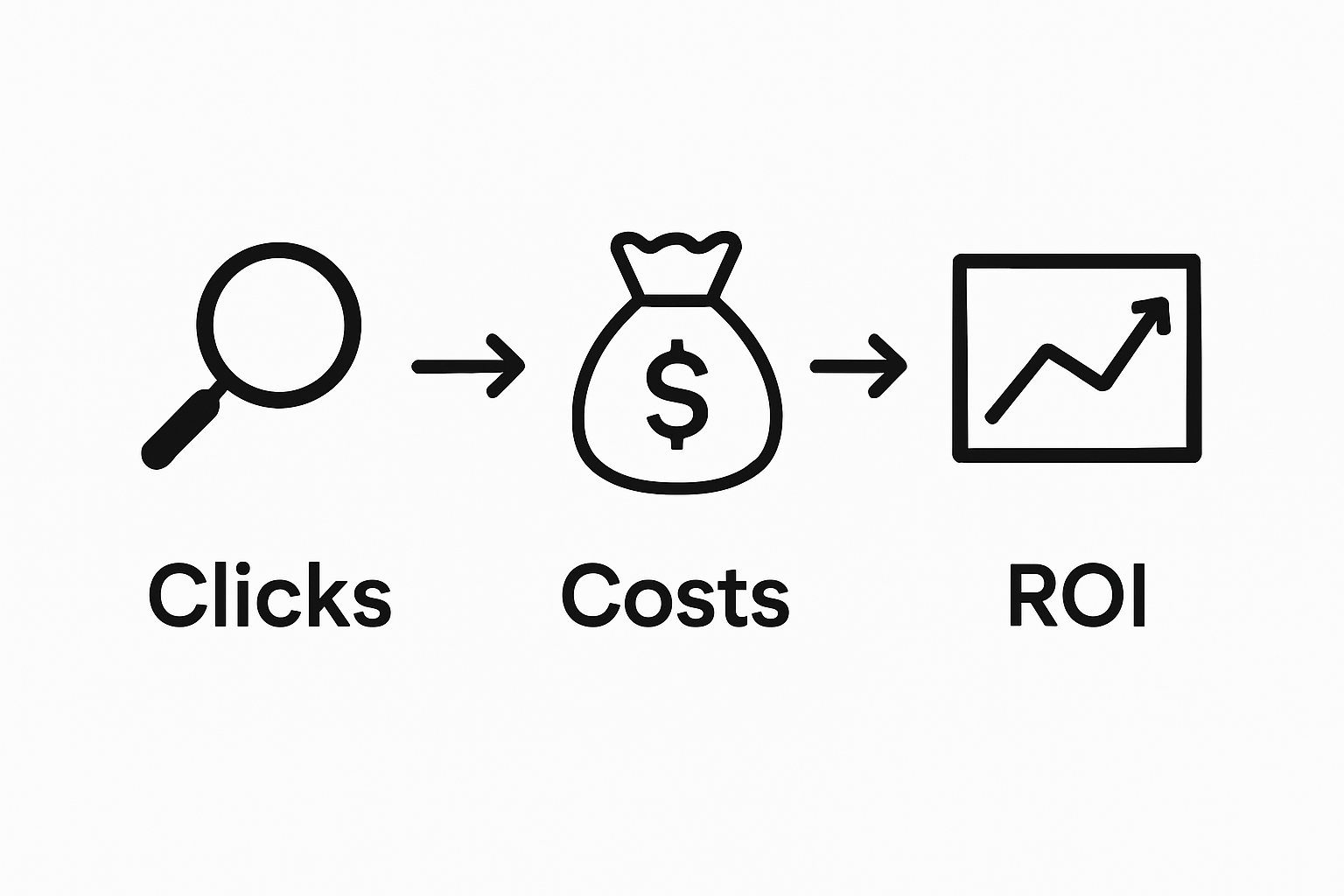
Understanding the financial impact of advertising requires moving beyond simple surface-level metrics. Strategic performance analysis enables businesses to develop predictive models that connect advertising spend directly to bottom-line outcomes. Advanced marketers recognize that ROI is not just about immediate conversions but about long-term customer value and strategic positioning.
Critical metrics for comprehensive PPC performance evaluation include:
- Cost Per Click (CPC): Average expense for each ad click
- Click-Through Rate (CTR): Percentage of impressions resulting in clicks
- Conversion Rate: Proportion of clicks transforming into desired actions
- Cost Per Acquisition (CPA): Total cost of acquiring a single customer
- Return on Ad Spend (ROAS): Revenue generated per advertising dollar invested
Rethinking traditional advertising metrics represents a critical evolution in digital marketing strategy. Successful businesses now prioritize nuanced, holistic measurement approaches that connect advertising efforts directly to meaningful business growth, moving beyond simplistic tracking toward comprehensive performance analysis.
Risks, Common Pitfalls, and How to Avoid Them
Pay-per-click advertising introduces complex challenges that can rapidly drain marketing budgets if not managed strategically. PPC advertising carries significant risks such as click fraud, where automated scripts generate fake clicks to artificially increase advertising expenses, potentially compromising campaign performance and financial efficiency.
The most prevalent pitfalls in PPC campaigns often stem from inadequate planning and reactive management. Marketers frequently encounter challenges like poor audience targeting, ineffective keyword selection, and insufficient conversion tracking. These issues can transform potentially profitable advertising efforts into expensive experiments with minimal return on investment.
Critical strategies for mitigating PPC risks include:
- Robust Monitoring Systems: Implement advanced tracking to detect suspicious activity
- Precise Audience Segmentation: Create highly targeted audience profiles
- Regular Campaign Audits: Continuously review and optimize advertising performance
- Comprehensive Keyword Research: Select high-intent, relevant search terms
- Sophisticated Fraud Detection: Use advanced tools to identify and block fraudulent clicks
Give your PPC campaigns a comprehensive tune-up by developing a proactive approach that anticipates potential challenges. Successful digital marketers treat PPC not as a set-it-and-forget-it strategy, but as a dynamic system requiring constant refinement and strategic oversight.
Unlock Measurable Growth with Expert PPC Management
The article highlights the critical challenges businesses face in optimizing PPC campaigns—from precise audience targeting and conversion rate optimization to mitigating risks like click fraud. If you are seeking to transform your advertising spend into predictable growth while navigating these complexities, adopting a strategy-first approach is essential. At AdVenture Media, we specialize in performance-driven PPC management across Google, Meta, and other major platforms, helping clients reach the right audiences with powerful messaging and continuously improve campaign ROI.
Take control of your digital advertising by partnering with a team experienced in crafting highly targeted campaigns, optimizing landing pages, and leveraging advanced data insights. Discover how our proven strategies—illustrated through client success stories like Grown Brilliance and Slinger Bag—can deliver the measurable results your business needs. Ready to maximize your PPC performance today? Contact us at AdVenture Media to start building campaigns that produce real conversions and sustainable growth.
Explore how our comprehensive PPC audit can identify opportunities and risks by visiting The PPC Audit Necessity. Learn which metrics drive meaningful insights so you can make smarter marketing decisions. Don’t wait—visit our contact page and take the first step toward mastering your PPC advertising strategy.
Frequently Asked Questions
What is PPC and how does it work?
PPC, or Pay Per Click, is a digital advertising model where advertisers pay only when a user clicks on their ad. Advertisers bid on keywords relevant to their target audience, ensuring their ads appear in search results and partner networks.
What are the main types of PPC advertising?
The primary types of PPC advertising include search ads, display ads, shopping ads, video ads, and remarketing ads. Each type serves a different purpose in reaching potential customers across various digital channels.
How can PPC campaigns drive conversions?
PPC campaigns drive conversions by targeting specific audiences at key moments in their buying journey. Strategies like landing page optimization, compelling ad copy, and continuous A/B testing help maximize conversion potential and improve return on investment.
What metrics are important to measure PPC performance?
Key metrics for evaluating PPC performance include Cost Per Click (CPC), Click-Through Rate (CTR), Conversion Rate, Cost Per Acquisition (CPA), and Return on Ad Spend (ROAS). These metrics help businesses understand campaign effectiveness and optimize their advertising strategies.
Recommended

.webp)

Targeting High Value Customers Leads to 80% Revenue Drive for Michael Aram


$120,000 Revenue In First Month for Ecommerce Brand Launch


Baketivity YoY Growth Soars after Analyzing Customer LTV's
Request A Marketing Proposal
We'll get back to you within a day to schedule a quick strategy call. We can also communicate over email if that's easier for you.
Visit Us
New York
1074 Broadway
Woodmere, NY
Philadelphia
1429 Walnut Street
Philadelphia, PA
Florida
433 Plaza Real
Boca Raton, FL
General Inquiries
info@adventureppc.com
(516) 218-3722
AdVenture Education
Over 300,000 marketers from around the world have leveled up their skillset with AdVenture premium and free resources. Whether you're a CMO or a new student of digital marketing, there's something here for you.
OUR BOOK
We wrote the #1 bestselling book on performance advertising
Named one of the most important advertising books of all time.
buy on amazon
OUR EVENT
DOLAH '24.
Stream Now.
Over ten hours of lectures and workshops from our DOLAH Conference, themed: "Marketing Solutions for the AI Revolution"
check out dolah
The AdVenture Academy
Resources, guides, and courses for digital marketers, CMOs, and students. Brought to you by the agency chosen by Google to train Google's top Premier Partner Agencies.
Bundles & All Access Pass
Over 100 hours of video training and 60+ downloadable resources
 view bundles →
.png)


