
.svg)

TL;DR:
- In 2025, SEO must now include Generative Engine Optimization (GEO), targeting AI citation and answer visibility alongside traditional rankings. With over half of searches ending without clicks due to AI and SERP features, brands need structured, authoritative content that AI systems can easily extract and cite. Enterprises investing early in AI-readable, expert content aligned with both organic and paid strategies will build lasting competitive advantages.
Search is no longer a simple input-output machine. The SEO trends in 2025 expose a landscape where AI systems are answering questions before users ever visit a website, 58.5% of Google searches end without a single click, and the old metric of “we rank number one” tells an increasingly incomplete story. For marketing managers and CMOs at enterprises running significant paid search budgets, the pressure is real: your organic strategy and your paid strategy are now colliding with an AI layer neither was built to navigate. This guide cuts through the noise and gives you a clear picture of what changed, why it matters, and exactly what to do about it.
Table of Contents
- Understanding SEO and GEO: The new dual focus of search in 2025
- Navigating the rise of zero-click searches and AI Overviews
- Google’s March 2025 core update and the rise of helpful, expert content
- Practical strategies to optimize SEO for AI and paid search in 2025
- Why the future of SEO demands mastering AI visibility, not just traditional ranking
- Enhance your SEO and paid search with expert AI-driven strategies
- Frequently asked questions
Key Takeaways
| Point | Details |
|---|---|
| SEO + GEO integration | In 2025, effective search strategies combine traditional SEO with Generative Engine Optimization targeting AI visibility. |
| Zero-click paradigm | Over half of US Google searches end without clicks, requiring new metrics like brand impressions and AI citations. |
| E-E-A-T focus | Google’s algorithm favors content with demonstrated expertise, authority, trustworthiness, and human experience. |
| AI Overview optimization | Structured, expert content with proper schema increases likelihood of being cited by AI-generated search answers. |
| Holistic paid search | Paid search strategies must adapt by analyzing AI and SERP feature data, not solely organic rank and CTR. |
Understanding SEO and GEO: The new dual focus of search in 2025
The most important shift in search engine optimization 2025 is not an algorithm tweak. It is an entirely new discipline sitting alongside traditional SEO. That discipline is called Generative Engine Optimization, or GEO. Where SEO targets rankings on Google’s blue-link results pages, GEO targets visibility inside AI-generated answers, such as Google’s AI Overviews, ChatGPT, Perplexity, and similar systems. SEO execution is now treated as “SEO + GEO,” with teams managing both traditional rankings and generative AI answer visibility in parallel.
Why does this distinction matter for enterprises? Because AI systems do not rank pages. They cite sources. If your brand is not recognized as an authoritative, citable entity within your topic space, you are invisible to a growing segment of users who never make it to a traditional results page at all. GEO-focused content must be structured so AI systems can retrieve it easily. Think direct, declarative answers, clear entity relationships, and content that reads well both to humans and to machine retrieval systems.
The new Google SERP features have also transformed what “ranking” even looks like. Featured snippets, People Also Ask boxes, knowledge panels, and AI Overviews now dominate above-the-fold real estate. Enterprise content teams that still measure success purely by position one rankings are measuring the wrong thing.
Here is what GEO-ready content actually requires:
- Atomic answers: Short, self-contained paragraphs that answer one question completely, making it easy for AI systems to extract and cite your content
- Entity clarity: Explicitly name your brand, product category, and topic associations in ways that help AI systems understand what you are authoritative about
- Citation-worthy sourcing: Original research, proprietary data, and expert quotes that give AI systems a reason to reference you over generic content
- Structured markup: Schema.org implementations that communicate content type, author expertise, and factual relationships to both search and AI crawlers
Pro Tip: Audit your top-performing content pages and ask one question about each: can an AI system extract a complete, useful answer from this page without reading the rest of it? If the answer is no, that page is not GEO-ready.
The opportunity for enterprises is real. AI-driven SEO trends show that brands investing in dual SEO + GEO strategies early are capturing AI citation slots that function like earned media, driving downstream brand recognition and assisted conversions that traditional click-through metrics never capture. The AI-mediated discovery era is here, and the brands building for it now will be very difficult to displace later.
Navigating the rise of zero-click searches and AI Overviews
If GEO is the strategic response, zero-click search is the problem that demands it. Zero-click rates have reached 58.5% in the US, meaning most Google searches now end on the results page itself. Users get what they need from SERP features, AI answers, or knowledge panels and move on without clicking anything. For paid search managers watching CPCs climb while organic CTRs fall, this is not a theoretical concern. It is an immediate budget efficiency issue.
The situation is intensifying. Google’s AI Overviews reached 2 billion monthly users in 2025, triggering a measurable decline in organic click-through rates for informational queries. On queries where AI Overviews appear, zero-click rates push toward 83%. That is not a rounding error. It is a fundamental redistribution of attention.
Here is a look at how zero-click behavior has evolved and what drives it:
| SERP feature | Zero-click contribution | Content that triggers it |
|---|---|---|
| Featured snippets | High | Concise, direct Q&A format |
| AI Overviews | Very high | Authoritative, well-structured long-form |
| Knowledge panels | Moderate | Entity-rich, schema-marked brand pages |
| People Also Ask | Moderate | Conversational, specific sub-topic answers |
| Local packs | High (local queries) | Google Business Profile + location content |
What does this mean for your paid search strategies? A few things are shifting. First, organic traffic volume declines should no longer trigger panic. They require reframing. Brand impressions, assisted conversion data, and AI Overview appearances are now the signals worth tracking. Second, paid search campaigns on informational keywords are becoming less efficient because AI Overviews absorb user attention before the ad is even seen. The budget reallocation case for mid to lower funnel, high-intent keywords has never been stronger.
Key attribution shifts you need to make now:
- Track AI Overview appearances for your brand and key product categories using Search Console impression data
- Measure assisted conversions, not just last-click, to capture value from users who encountered your brand in an AI answer and converted later
- Monitor branded search volume as a proxy for awareness driven by AI and zero-click SERP visibility
- Evaluate AI impact on CTR by query type to identify which keyword clusters are losing paid efficiency to AI Overviews
Pro Tip: Use Google Search Console’s “Search type” filters alongside third-party rank trackers to flag high-impression, low-click keywords. These are prime candidates for GEO optimization since they are clearly surfacing in SERP features but failing to pull users through. Review SEO best practices for AI environments to prioritize your content investments.
Google’s March 2025 core update and the rise of helpful, expert content
Zero-click trends tell you where users are going. Google’s March 2025 core update tells you what content gets visibility in the first place. The update placed a hard emphasis on E-E-A-T: Experience, Expertise, Authoritativeness, and Trustworthiness. Google’s March 2025 core update explicitly rewards content demonstrating real human expertise and penalizes pages built primarily for search engines rather than actual readers.

The practical consequence is this: content produced at scale using AI tools with no human editorial layer is losing ground. Fast. Thin pages that hit keyword targets without offering genuine insight are being demoted. What earns visibility now is content with a clear author perspective, original observations, and answers grounded in first-hand experience or documented expertise.
What Google’s update actually rewards in practice:
- Original research and proprietary data: Industry studies, internal benchmark reports, or survey findings your team generated, not recycled statistics from other sites
- First-person practitioner perspective: Content written by or in close collaboration with someone who has actually done the thing they are writing about
- Context-rich answers: Responses that explain the “why” behind a claim, not just the claim itself
- Clear authorship signals: Author bios, professional credentials, and linked professional profiles that help Google verify expertise
The temptation for enterprise content teams is to use AI generation to hit publishing velocity. That is not inherently wrong. But the update makes human editorial oversight non-negotiable. AI-assisted drafts reviewed, enriched, and signed off by genuine subject matter experts still perform well. AI-generated content published without that layer is now a liability. See how we think about the AI in content strategy balance for more on building a publishing process that holds up under algorithmic scrutiny.
Pro Tip: Map every content piece to a named internal expert or external contributor. Even one paragraph of genuine practitioner insight in an otherwise well-structured piece significantly improves E-E-A-T signals. This is not window dressing. Google’s systems are getting better at detecting the difference between cited expertise and manufactured authority. Building your search intent strategies around what users actually need, answered by people who actually know, is the cleanest path forward.
Practical strategies to optimize SEO for AI and paid search in 2025
Knowing the trends is one thing. Having a playbook is another. Here is how to act on these emerging SEO techniques in a way that moves both organic and paid performance.
Step-by-step content audit for AI citation potential:
- Pull your top 50 pages by impression volume from Search Console
- Identify which pages appear on queries where AI Overviews are active (use a rank tracker with SERP feature detection)
- For each flagged page, assess whether it contains a clear, extractable answer within the first 200 words
- Add schema markup (FAQ, HowTo, Article, or Organization schema) to pages lacking structured data
- Strengthen authorship signals with author schema and linked credentials
- Rewrite introductions to include direct answers first, then supporting context
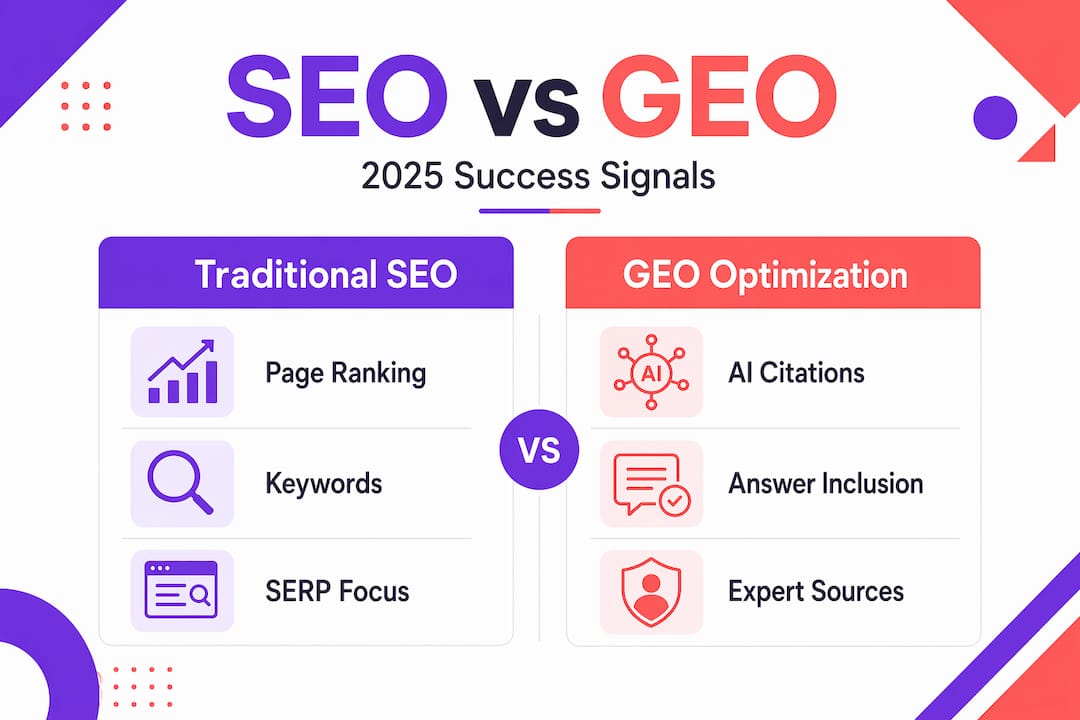
Here is a side-by-side look at where the signals differ between traditional SEO and GEO:
| Signal | Traditional SEO | GEO focus |
|---|---|---|
| Primary goal | Page ranking | AI citation and answer inclusion |
| Content structure | Keyword density and headings | Atomic answers and entity clarity |
| Success metric | Organic clicks and position | AI appearance, brand impressions |
| Link signals | Backlink authority | Citation by authoritative AI sources |
| Markup priority | Title tags, meta descriptions | Schema.org, entity markup |
| Content tone | Search-optimized language | Conversational, machine-readable clarity |
Brands cited within AI Overviews earn more organic and paid clicks than brands absent from AI answers, which means GEO is not just a branding play. It directly feeds paid search efficiency by warming audiences before they reach the paid auction.
For paid search specifically, use SERP feature data as a campaign diagnostic tool. If your branded terms are triggering AI Overviews with competitors cited, that is a signal to increase branded bid coverage and review your Google AI Max insights for audience expansion. If informational head terms are generating high impressions but low paid CTR, shift budget toward transactional and lower-funnel terms where AI Overviews appear less frequently.
Strategic SEO + GEO design includes building “atomic answer” content, short, focused content blocks optimized for AI retrieval that also strengthen paid search quality scores by improving landing page relevance. When you explore AI search advertising comparison across platforms, you see this dual optimization benefit consistently. The brands showing up in AI answers convert paid traffic at higher rates because users already recognize them.
Pro Tip: Keep an eye on 2026 advertising trends as you plan budget allocation. The intersection of AI visibility and paid efficiency is where enterprise performance is being won and lost right now.
Why the future of SEO demands mastering AI visibility, not just traditional ranking
Here is the perspective most SEO articles will not give you: the brands still fighting to protect page one rankings as their primary goal are running a race that the course has quietly rerouted around them.
We have worked with enough enterprise marketing teams to recognize the pattern. Significant resources go into tracking keyword positions, celebrating ranking wins, and attributing revenue to organic traffic as measured by last-click clicks. All of that made perfect sense in 2020. In 2025, it is leaving real performance on the table.
The uncomfortable truth is that traditional ranking preservation without an AI citation strategy is a losing proposition. You can hold position one on a high-volume informational query while an AI Overview directly above your listing answers the question so thoroughly that 80% of users never scroll to your result. Position one with near-zero clicks is not a win. It is a warning sign.
What we believe the next 12 to 18 months will reveal is that the enterprises investing now in becoming authoritative entities recognized by AI systems will compound their advantage rapidly. AI systems learn from content that gets cited. Brands that show up early in AI answers get cited more. That cycle builds a visibility moat that purely rank-focused competitors will struggle to bridge later.
For paid search managers, the strategic implication is equally clear. SERP feature diagnostics and AI visibility data should be feeding your campaign structure decisions, your keyword tiering, and your audience targeting choices. If AI Overviews are absorbing informational query intent, your paid dollars belong further down the funnel where intent is commercial and AI answers are thinner.
The brands navigating this well are not treating SEO and paid search as separate channels reacting to the same algorithm. They are treating them as a unified visibility system, where AI-mediated brand positioning informs where paid spend goes, and paid performance data informs what content to build for GEO. That is the future SEO strategy that actually holds up.
Enhance your SEO and paid search with expert AI-driven strategies
Understanding these shifts is the first step. Translating them into measurable campaign performance is where most enterprises need a partner who has already done the work. At AdVenture Media, we built our approach around exactly this intersection: organic visibility, AI citation strategy, and paid search efficiency working as one system. Our PPC Tuneup Service is designed for marketing teams that need an honest audit of where their paid strategy is misaligned with today’s SERP reality, with a clear path to fixing it. Clients like Survey Money Machines achieved year-over-year conversion rate growth by restructuring their paid approach around search behavior data, and the International Culinary Center A/B test results show how evidence-based creative and targeting decisions compound over time. If you are ready to align your 2025 and 2026 strategy with where search is actually headed, let us show you what that looks like in practice.
Frequently asked questions
What is Generative Engine Optimization (GEO) and how is it different from traditional SEO?
GEO is the practice of structuring content so AI systems recognize your brand as an authoritative, citable source within a topic, going beyond keyword rankings to focus on entity authority and machine readability. Traditional SEO targets position on a results page, while GEO targets inclusion in AI-generated answers that appear before those results.
How do zero-click searches affect organic and paid search strategies in 2025?
With 58.5% of US Google searches ending without a click, marketers must prioritize SERP feature visibility, brand impression measurement, and AI answer appearances to capture value that never shows up in click-based attribution. Paid search budgets should shift toward high-intent, transactional queries where AI Overviews are less dominant.
What role does content quality play after Google’s March 2025 core update?
Google’s March 2025 update rewards content showing real expertise and actively demotes search-engine-focused pages lacking genuine human insight, making editorial oversight and practitioner-driven content non-negotiable for enterprise content teams. Thin, AI-generated content without human review is now a ranking liability.
How can brands improve their chances of being cited in AI Overviews?
Structured content, expert commentary, and original research increase the likelihood of AI Overview citations, alongside schema markup that communicates content type and author expertise clearly to AI retrieval systems. Building a reputation as a primary source in your category, not just a page that covers the topic, is the long-term driver.
Are traditional SEO rankings still important in 2025?
Yes, traditional rankings remain relevant, but GEO expands the goal to AI-generated answer visibility alongside rankings, meaning enterprises that treat ranking as their only success metric are missing a growing share of search-driven brand exposure. The most effective enterprise strategies treat both as parallel objectives measured by different but complementary metrics.
Recommended


.svg.png)
Budget Optimization Leads to eCommerce Growth For Sennheiser

.png)
119% increase in conversions for Red and White Shop after Google Ads account rebuild


Performance Creative Drives 100% Increase in CTR for Luxury Homegoods Brand
Request A Marketing Proposal
We'll get back to you within a day to schedule a quick strategy call. We can also communicate over email if that's easier for you.
Visit Us
New York
1074 Broadway
Woodmere, NY
Philadelphia
1429 Walnut Street
Philadelphia, PA
Florida
433 Plaza Real
Boca Raton, FL
General Inquiries
[email protected]
(516) 218-3722
AdVenture Education
Over 300,000 marketers from around the world have leveled up their skillset with AdVenture premium and free resources. Whether you're a CMO or a new student of digital marketing, there's something here for you.
OUR BOOK
We wrote the #1 bestselling book on performance advertising
Named one of the most important advertising books of all time.
buy on amazon
OUR EVENT
DOLAH '24.
Stream Now.
Over ten hours of lectures and workshops from our DOLAH Conference, themed: "Marketing Solutions for the AI Revolution"
check out dolah
The AdVenture Academy
Resources, guides, and courses for digital marketers, CMOs, and students. Brought to you by the agency chosen by Google to train Google's top Premier Partner Agencies.
Bundles & All Access Pass
Over 100 hours of video training and 60+ downloadable resources
 view bundles →
.png)


