
.svg)

TL;DR:
- Social proof reduces consumer resistance and boosts ad conversions when used intentionally with the right format.
- Video UGC and authentic testimonials are the most effective formats for driving conversions and building trust.
- Continuous testing and tailoring social proof to audience and funnel stage are essential for maximizing performance.
Social proof in ads: How to increase trust and conversions
Most marketing managers assume that dropping a few star ratings into an ad is enough to move the needle. It isn’t. Social proof is one of the most powerful forces in consumer psychology, but it only works when deployed with intention. Video outperforms text by 80% in conversion impact, yet most enterprise campaigns still lead with generic written testimonials that audiences barely register. This article breaks down what social proof actually is, why the science behind it matters for your ad budget, which formats drive real performance, and how to build a testing system that keeps your campaigns honest.
Table of Contents
- Defining social proof in advertising
- The science behind social proof effectiveness
- Formats of social proof: What works and what doesn’t
- Integrating and testing social proof for maximum ad performance
- Why most marketers misuse social proof—and how to fix it
- Leverage proven social proof strategies with AdventurePPC
- Frequently asked questions
Key Takeaways
| Point | Details |
|---|---|
| Video-based proof drives conversions | Video testimonials outperform text by 80% and are most effective for ads. |
| Authenticity matters more than polish | User-generated content yields higher trust and impact than studio-produced material. |
| Test for context | Social proof can backfire if misapplied, so always A/B test for effectiveness. |
| Choose format for audience | Select social proof type based on target segment and ad channel. |
Defining social proof in advertising
Social proof, at its core, is the psychological mechanism by which people look to the behavior and opinions of others to guide their own decisions. In the context of digital advertising, it becomes a creative lever. When your audience sees that real people, people who look and sound like them, have chosen your product or service, their resistance to conversion drops. That is not a theory. It is a well-documented pattern of human behavior that skilled advertisers can engineer directly into their campaigns.
But social proof is not one thing. It shows up in several distinct formats, each with its own strengths:
- User reviews and ratings: Star ratings embedded in display ads or Google Shopping formats signal that a large group of real buyers has validated the product.
- Video testimonials: Customers speaking on camera about their experience. Authentic, unscripted, and highly persuasive when done right.
- Influencer endorsements: A trusted voice in your niche recommending your brand. Works best when the influencer’s audience closely matches your target customer.
- User-generated content (UGC): Organic posts, unboxing videos, or customer photos repurposed as ad creative. Often the most credible format because it was never intended to be an ad.
- Expert endorsements and certifications: Third-party validation from recognized authorities or industry bodies. Particularly effective in regulated categories like finance, health, or legal services.
- Statistics and social numbers: “Over 50,000 businesses trust us” or “Rated #1 by Forbes” type messaging. Strong when the numbers are genuinely impressive and verifiable.
Understanding which format fits which context is where strategy begins. Many campaigns we review throw a mix of all of these into their creative without any coherent logic. The result is noise, not persuasion.
There is also a nuanced edge case worth addressing: future social proof. For new product launches where you don’t yet have reviews or a large customer base, Robert Cialdini advocates using projected growth trends and forward-looking endorsements to create anticipation and credibility before the product hits scale. Think pre-order demand signals, waitlist numbers, or early-adopter testimonials. This approach works because audiences respond to momentum, not just mass consensus.
“People follow the lead of similar others.” The implication for advertisers is clear: the more your social proof reflects your specific audience, the more persuasive it becomes.
When we look at social media ad results across platforms like Meta and TikTok, campaigns anchored by authentic social proof consistently outperform those relying solely on product-centric messaging. The underlying reason is simple. Buyers trust people more than brands. Your ads should reflect that reality.
The science behind social proof effectiveness
Here is something counterintuitive: social proof does not always work. In fact, applied incorrectly, it can actively suppress conversions. Understanding the science means understanding both when it works and when it doesn’t.
At its psychological foundation, social proof operates as a cognitive shortcut. When a buyer faces uncertainty, the behavior of others serves as a proxy for quality or safety. This is efficient thinking, not lazy thinking. In high-stakes or complex purchase decisions, especially at the enterprise level, this shortcut becomes even more powerful because the cognitive load of evaluating every option is enormous.
The conversion impact of different formats is not equal. Research and platform data consistently show that video testimonials outperform static text alternatives by approximately 80% in terms of conversion uplift. Why? Because video activates more cognitive channels simultaneously. Viewers process tone of voice, facial expression, body language, and verbal content all at once. A written review, no matter how glowing, cannot replicate that.
| Social proof format | Relative conversion impact | Best use case |
|---|---|---|
| Video UGC | Very high | Paid social, YouTube pre-roll |
| Written testimonials | Moderate | Landing pages, display ads |
| Star ratings | Moderate to high | Google Shopping, search ads |
| Influencer endorsements | Variable | Brand awareness, top-of-funnel |
| Expert certifications | High in regulated categories | Finance, health, legal verticals |
| Social statistics | High when credible | Awareness and trust campaigns |
The table above reflects directional performance patterns, not absolutes. Context matters enormously.
So when does social proof fail? The answer surprises a lot of marketers. Social proof can hurt conversions in low-uncertainty contexts, meaning when buyers already feel confident about their decision, adding social proof may actually introduce doubt or feel redundant. It can signal that you are overselling. Similarly, audiences are now sophisticated enough to detect fake or incentivized reviews, and when they do, trust collapses. A single obviously staged testimonial can undermine an entire campaign.
Pro Tip: Before adding social proof to any ad set, ask yourself what level of uncertainty your audience is experiencing at that funnel stage. High uncertainty? Lead with strong social proof. Low uncertainty? Let the product and offer speak for themselves.
This is also why rigorous ad copy testing for ROI is non-negotiable. Assumptions about what social proof will work for your audience are exactly that: assumptions. The data will tell a different story more often than you expect. Building a testing discipline around your social proof creative is what separates campaigns that scale from those that plateau. Understanding the full picture of maximizing digital ROI means treating every creative element, including social proof, as a variable worth measuring.
Formats of social proof: What works and what doesn’t
Not all social proof formats are created equal, and the gap in performance between the best and worst options is significant. Let’s get specific about what to use, what to avoid, and why.
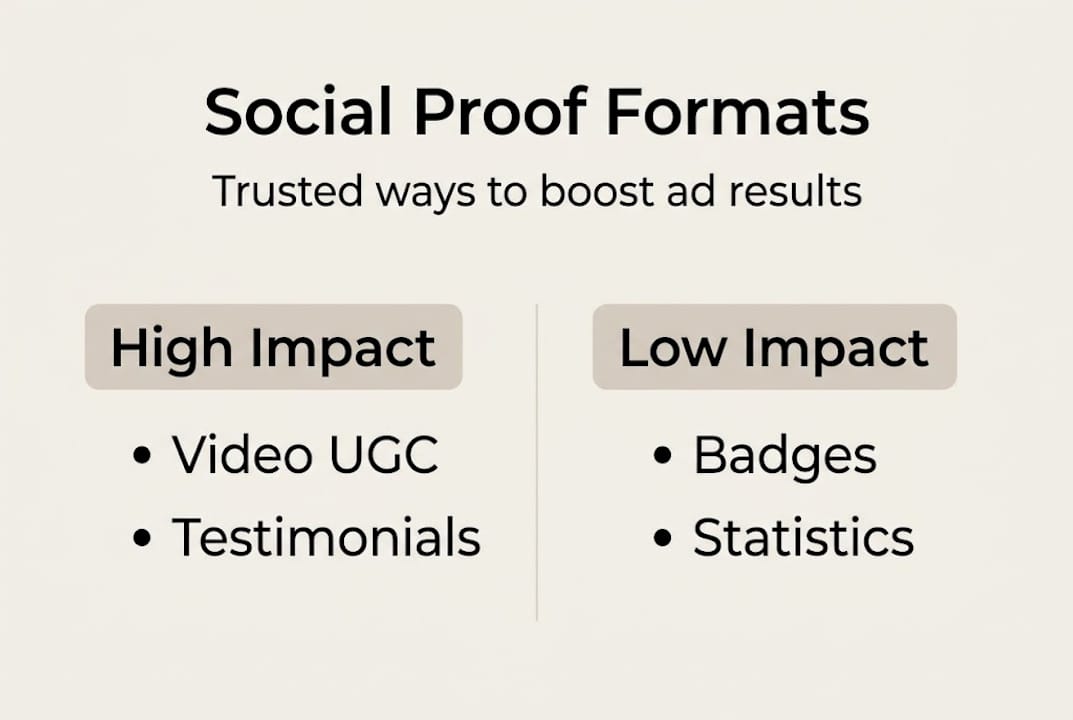
Video UGC is the gold standard. When a real customer films themselves talking about a product, without a script, in their own environment, that content carries a level of authenticity that no agency production can replicate. Audiences recognize it immediately, and that recognition builds trust faster than any polished studio spot. The authenticity of UGC consistently outperforms studio-produced video, and the reason is credibility, not production value.

Written testimonials have their place, but they’re weak as standalone ad creative. They work better as supporting elements on landing pages than as primary ad content. In a feed environment on Meta or TikTok, a block of text saying “This product changed my life” is easy to scroll past. It lacks the dimensionality of video.
Influencer endorsements are volatile. They can deliver exceptional results when the influencer’s audience is a precise match for your target customer. They can also feel deeply inauthentic when the partnership is clearly transactional or when the influencer has no genuine relationship with the product category. Micro-influencers with highly engaged niche audiences often outperform macro-influencers with broader, less engaged followings.
Social statistics and badges work best for trust, not conversion. “ISO certified” or “Trusted by 10,000+ companies” is reassuring, but it rarely closes the deal on its own. Use these formats to support conversion-focused creative, not replace it.
Here is a direct comparison to guide your format selection:
| Format | Conversion strength | Trust building | Cost to produce | Risk level |
|---|---|---|---|---|
| Video UGC | Very high | Very high | Low | Low |
| Studio video testimonial | Moderate | Moderate | High | Low |
| Written review | Low to moderate | Moderate | Very low | Low |
| Micro-influencer | High | High | Moderate | Moderate |
| Macro-influencer | Variable | High | Very high | High |
| Social badges/stats | Low | High | Very low | Low |
A few critical rules to follow:
- Never fabricate or exaggerate testimonials. Your audience will detect it, and the algorithm will eventually punish it.
- Avoid stacking too many forms of social proof in a single ad. It creates clutter and signals desperation rather than confidence.
- Match the format to the platform. What works on social media ads may not translate to display advertising without creative adaptation.
- Refresh your UGC regularly. Audiences develop banner blindness to the same testimonial after repeated exposure.
The brands that win with social proof treat it as a creative system, not a single creative asset. They are constantly collecting, testing, and rotating new authentic content.
Integrating and testing social proof for maximum ad performance
Knowing which formats work is only half the equation. The other half is knowing where to place social proof within your ad architecture and how to measure whether it is actually moving your numbers.
Here is a practical integration framework we use when building social proof into enterprise ad campaigns:
- Identify the uncertainty level of your audience segment. Are they completely cold to your brand, or have they already engaged with your content? Cold audiences need more social proof upfront. Warmer audiences need less reassurance and more specificity.
- Choose the placement point strategically. Social proof in the headline captures attention. Social proof in the visual builds immediate credibility. Social proof in the call-to-action reduces the final friction point before the click. Each placement serves a different cognitive function.
- Match the proof to the claim. If your headline says “The fastest enterprise onboarding in the industry,” your social proof should specifically validate speed, not just general satisfaction. Mismatched proof weakens both the claim and the testimonial.
- Build a structured A/B test. Run your ad with social proof against an identical version without it. Measure click-through rate, conversion rate, and cost per acquisition. Do not just measure one metric. Social proof can improve CTR while hurting conversion rate if it attracts the wrong audience.
- Set a test duration and sample size before you start. Making decisions on 200 impressions is how campaigns get optimized in the wrong direction. Give tests enough data to reach statistical significance.
- Rotate creative consistently. Even high-performing social proof creative has a lifespan. Monitor frequency metrics and swap in fresh testimonials before audience fatigue sets in.
Pro Tip: Build a library of social proof assets by format, product line, and audience segment. This makes it much faster to pull the right asset for a new test without starting from scratch every time.
One of the most common mistakes we see in enterprise campaigns is treating social proof as a one-time decision. “We have testimonials in our ads, done.” That mindset leaves significant performance on the table. As Cialdini’s research makes clear, social proof can fail or actively hurt conversions in low-uncertainty contexts. Without a rigorous ad campaign optimization process, you will never know which side of that line your campaigns are sitting on.
Using an ads testing framework that systematically cycles through social proof variables, from format and placement to specificity and volume, is what turns a good campaign into a consistently great one.
Why most marketers misuse social proof—and how to fix it
Here is the uncomfortable truth we have observed across hundreds of ad accounts: most marketing teams treat social proof as a checkbox, not a strategy. “We have a testimonial in the creative. That box is checked.” The problem is that a checkbox mentality produces checkbox results.
What we have actually seen drive outcomes is audience-specific proof. A generic five-star rating from an anonymous customer means almost nothing to a seasoned procurement manager evaluating an enterprise software solution. But a specific video testimonial from someone in the exact same industry, describing the exact same problem your product solves? That moves deals.
We also see marketers ignore the negative effects entirely. They assume more social proof is always better, so they stack ratings, quotes, and UGC into a single creative. The result is visual noise, and it signals that the brand is trying too hard. Restraint is a creative choice. Sometimes one precise, credible testimonial outperforms three generic ones.
The fix is straightforward: stop treating social proof as a single lever and start treating it as a system that needs to be calibrated to audience, channel, and funnel stage. Apply the same rigor you would to any other UX strategy for advertising by constantly asking whether your creative is reducing friction or creating it.
Test for negative effects. If your conversion rate drops when you add social proof to a specific ad set, that is data. Act on it.
Leverage proven social proof strategies with AdventurePPC
Social proof done right is not just a creative embellishment. It is a performance driver. At AdVenture Media, we engineer it into campaign architecture from the ground up, aligned to audience psychology, funnel stage, and platform behavior. If you want to see what that looks like in practice, explore our creative transformation case study or the conversion rate growth results we achieved for a performance-focused client. Our A/B testing case study shows how systematic testing compounds results over time. Ready to build a social proof system that actually performs? Connect with our team to talk through your campaign goals.
Frequently asked questions
How can I tell if social proof is helping my ad campaigns?
Run structured A/B tests comparing ads with and without social proof, then measure conversion rate, CTR, and cost per acquisition. Rigorous testing is essential because social proof can actually hurt performance in low-uncertainty contexts, so data beats assumptions every time.
What type of social proof works best in digital ads?
Video UGC and authentic customer testimonials consistently deliver the strongest conversion results. Video outperforms text by approximately 80%, and authenticity matters more than production quality.
Can social proof ever reduce ad effectiveness?
Yes. When audiences are already confident in their decision, adding social proof can feel redundant or even raise suspicion. Fake or overloaded testimonials are particularly damaging and can lower trust significantly.
Is social proof important for launching new products?
Absolutely. For new launches without an existing customer base, future social proof like projected growth trends, waitlist numbers, or early-adopter endorsements can generate credibility and momentum before you reach scale.
Recommended


Qualified Leads Increase 238% for SaaS Company Using Machine Learning


Baketivity YoY Growth Soars after Analyzing Customer LTV's

.png)
Campaign Consolidation and Smart Bidding Helps Local Business Expand Into New Territories
Request A Marketing Proposal
We'll get back to you within a day to schedule a quick strategy call. We can also communicate over email if that's easier for you.
Visit Us
New York
1074 Broadway
Woodmere, NY
Philadelphia
1429 Walnut Street
Philadelphia, PA
Florida
433 Plaza Real
Boca Raton, FL
General Inquiries
info@adventureppc.com
(516) 218-3722
AdVenture Education
Over 300,000 marketers from around the world have leveled up their skillset with AdVenture premium and free resources. Whether you're a CMO or a new student of digital marketing, there's something here for you.
OUR BOOK
We wrote the #1 bestselling book on performance advertising
Named one of the most important advertising books of all time.
buy on amazon
OUR EVENT
DOLAH '24.
Stream Now.
Over ten hours of lectures and workshops from our DOLAH Conference, themed: "Marketing Solutions for the AI Revolution"
check out dolah
The AdVenture Academy
Resources, guides, and courses for digital marketers, CMOs, and students. Brought to you by the agency chosen by Google to train Google's top Premier Partner Agencies.
Bundles & All Access Pass
Over 100 hours of video training and 60+ downloadable resources
 view bundles →
.png)


