
.svg)

TL;DR:
- Successful enterprise marketing requires a rigorous, unified growth process beyond just budget and creative.
- Precise audience segmentation, message funnel mapping, and optimized landing pages are crucial for campaign effectiveness.
- Continuous measurement, cross-channel attribution, and disciplined optimization drive scalable ROI.
Your latest campaign stalled. The budget was solid, the creative looked sharp, and the audience targeting felt dialed in. Yet the results? Flat ROAS, rising cost per acquisition, and a leadership team asking uncomfortable questions in the Monday morning review. This scenario plays out in enterprise marketing departments more often than anyone wants to admit. The real culprit is almost never the budget. It’s the absence of a rigorous, repeatable process that connects every lever, from audience segmentation to landing page experience to attribution, into a unified growth machine. That’s exactly what this guide gives you.
Table of Contents
- What you need before you start: Key tools, data, and prerequisites
- Step-by-step ad strategy for enterprise: From goal setting to creative execution
- Optimize your landing pages for conversions
- Tracking, attribution, and ongoing optimization: Getting the numbers right
- Why conventional ad strategy fails (and what actually drives ROI today)
- See step-by-step strategy in action: Proven case studies & next steps
- Frequently asked questions
Key Takeaways
| Point | Details |
|---|---|
| Start with clean data | Great results depend on accurate, privacy-compliant first-party data and clear campaign goals. |
| Follow each execution step | Detailed segmentation, messaging, and structure drive stronger ad performance and scalability. |
| Optimize landing pages | Align landing page experience with ad intent and mobile best practices to maximize conversions. |
| Measure and automate | Robust attribution, regular reviews, and automation rules sustain performance and enable learning. |
| Unify channels and adapt | Cross-platform synergy and phased automation unlock the highest enterprise ROI in 2026. |
What you need before you start: Key tools, data, and prerequisites
Before you write a single ad headline, you need to audit your organizational readiness. We’ve seen companies pour six-figure budgets into campaigns built on broken tracking, misaligned teams, and stale audience data. That’s not a creative problem. It’s a foundation problem.
Start by checking three things: your tracking setup, your creative capacity, and your team roles. Tracking should be verified end-to-end, meaning every platform pixel fires correctly, conversion events map to real business outcomes, and your CRM is connected to your ad platforms. Creative capacity means you have the bandwidth and assets to produce channel-specific content. Team roles means someone owns each function: paid search, paid social, creative, analytics, and landing page development. No overlaps, no gaps.
On the advertising planning process side, the data sources you feed your campaigns matter enormously. You need clean first-party CRM data, web analytics (Google Analytics 4 or equivalent), validated customer personas, and, for B2B teams, firmographic data like company size, industry, and revenue range. Conduct thorough audience research and segmentation using first-party data, personas, and firmographics before any media dollar is committed. Privacy compliance is not optional. With third-party cookie deprecation accelerating, first-party data is the only durable signal you own.
Here’s a core tech stack to have in place before launch:
| Function | Tool examples |
|---|---|
| Ad platforms | Google Ads, Meta Ads Manager, LinkedIn Campaign Manager |
| Web analytics | Google Analytics 4, Adobe Analytics |
| CRM | Salesforce, HubSpot |
| Attribution | Northbeam, Triple Whale, or platform-native |
| Creative management | Figma, Canva for Teams, Adobe Creative Cloud |
| Reporting | Looker Studio, Supermetrics, or custom dashboard |
Every tool in this stack needs to communicate with the others. An attribution platform that can’t read your CRM data is just noise.
Pro Tip: Before your team touches creative development, run a full data flow validation. Have your analytics engineer confirm that every conversion event passes the correct parameters, that revenue data matches what’s in your CRM, and that audiences are syncing between your CRM and ad platforms correctly. This single step prevents weeks of wasted spend.
Step-by-step ad strategy for enterprise: From goal setting to creative execution
With the foundation locked in, you’re ready to build the actual strategy. This is where most teams rush, and rushing here costs real money. Work through these steps sequentially.
Step 1: Define measurable outcomes and KPIs. Vague goals produce vague results. Instead of “drive more leads,” define the specific outcome: a target ROAS of 4.2, 500 net new MQL per quarter, or a 15% lift in branded search volume. Each campaign should have a primary KPI and one or two supporting metrics. ROAS works for e-commerce. Cost per qualified lead works for B2B. Brand lift scores work for upper-funnel awareness plays. Write these down. Share them with every stakeholder before a single ad goes live.
Step 2: Segment your audiences with precision. Generic targeting is how you burn budget. Using first-party data and persona-driven segmentation lets you build audience layers that reflect real buyer behavior. For enterprise accounts, this typically means at least three tiers: cold prospecting audiences built from lookalikes or in-market signals, warm retargeting audiences of engaged site visitors and video viewers, and hot audiences of past customers or CRM-matched high-intent leads.

Step 3: Map messaging to funnel stage and channel. This step is where most enterprise teams break down. They run the same ad across cold and warm audiences, and wonder why retargeting underperforms. A cold prospect needs to understand why your solution matters. A warm audience needs a reason to act now. A past customer needs a reason to upgrade or return. The social ad strategies you deploy on Meta will differ structurally from what you run on LinkedIn or YouTube. Channel context shapes how people receive messages.
Step 4: Structure campaigns for control and scalability. Your campaign management workflow architecture matters more than most teams realize. Keep campaigns segmented by objective, match type, and audience temperature. Within ad groups, build around themes rather than individual keywords. This approach directly supports a stronger Quality Score. A Quality Score of 7 to 9 is the practical optimization target for most accounts. Chasing a perfect 10 often requires sacrificing scale. Focus on thematic coherence, and the score will follow.
Here’s how detailed targeting stacks up against broad, creative-led targeting:
| Factor | Detailed targeting | Broad, creative-led targeting |
|---|---|---|
| Best suited for | Niche B2B, high-ticket offers | Large audiences, DTC e-commerce |
| Creative demand | Moderate | High (creative is the targeting signal) |
| Platform dependency | Higher (relies on signal quality) | Lower (algorithm finds the audience) |
| Optimization speed | Slower (smaller audiences) | Faster (more data volume) |
| Risk level | Lower CPM waste | Higher creative fatigue risk |
The biggest mistake enterprise teams make is treating campaign structure as an afterthought. Structure is strategy. When your architecture is clean, every optimization decision becomes faster and more defensible.
Pro Tip: Build ad groups around a single dominant theme, not around keyword match types. Group “enterprise HR software demo” and “best HR platform for large companies” together, not apart. Thematic coherence drives relevance, and relevance drives Quality Score improvements that compound over time.
Optimize your landing pages for conversions
Driving traffic is only half the job. The landing page is where the campaign either pays off or falls apart. We see this constantly: beautifully engineered ads driving users to generic website pages that have no connection to the ad message. Clicks evaporate. Conversion rates crater.
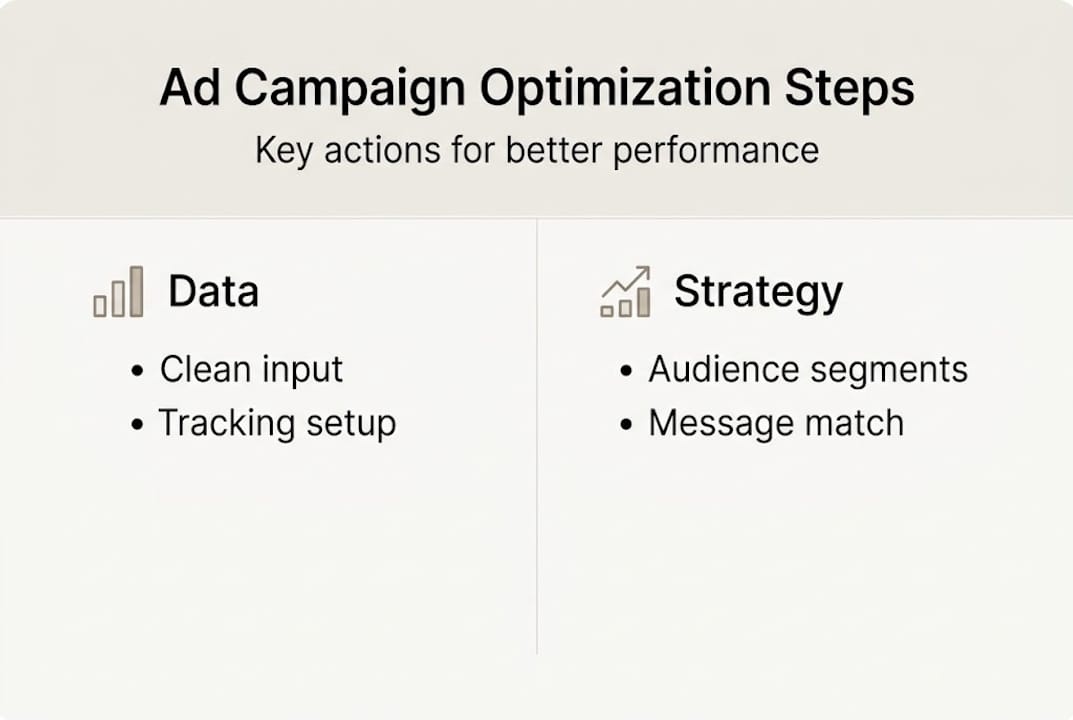
Message match is the single most powerful lever on a landing page. When someone clicks an ad that promises “free demo for enterprise HR teams,” the landing page headline should reflect that exact promise. Any gap between ad copy and page copy creates friction, and friction kills conversions. Optimize landing pages for message match, speed, mobile usability, and clear calls to action. These aren’t nice-to-haves. They’re table stakes.
Speed matters more than most marketing leaders give it credit for. A page that loads in under two seconds consistently outperforms one that takes four seconds, especially on mobile, where patience is measured in fractions of a second. Mobile usability goes beyond responsive design. Tap targets need to be large enough. Forms need to be short. The CTA needs to be visible without scrolling.
Here are the critical landing page elements to audit for every campaign:
- Headline: Does it directly reflect the ad’s core promise?
- Subheadline: Does it expand on the benefit without introducing new concepts?
- Hero image or video: Does it visually reinforce the message?
- Social proof: Are there testimonials, client logos, or case study snippets above the fold?
- CTA button: Is it specific (“Get my free audit” vs. “Submit”), visible, and repeated lower on the page?
- Form length: Is it as short as the sales process allows?
- Page speed: Is the page loading under two seconds on mobile?
The average Google Ads conversion rate across industries in 2025 sat around 3 to 4% for search campaigns, with top performers reaching 8 to 12%. If your landing pages aren’t clearing 4%, the ad creative is not the problem.
Pro Tip: Use dynamic keyword insertion on landing page headlines to match the exact search query that triggered the click. Pair this with conditional display logic to show different testimonials or CTAs based on the traffic source. The incremental conversion rate lift from this alone often justifies the development investment within a single quarter.
Tracking, attribution, and ongoing optimization: Getting the numbers right
Once your ads are live, the real work begins. Measurement done right is the difference between a campaign that scales confidently and one that bleeds budget while the team debates what’s actually working.
Set up your measurement infrastructure in this order:
- Install and verify platform pixels. Every ad platform needs its tracking tag verified through the platform’s own diagnostic tools. Ghost conversions and duplicate events are common and consistently inflate performance data.
- Define conversion events by business value. Not all conversions are equal. Weight them accordingly, assigning higher values to demo requests and lower values to newsletter signups.
- Connect your CRM to close the loop. Offline conversion imports from Salesforce or HubSpot let you pass actual closed revenue back to Google and Meta, allowing smart bidding to optimize toward real buyers rather than form fills.
- Build a unified reporting dashboard. Pull data from every platform into a single view. Without this, you’re making decisions based on incomplete information. Omnichannel attribution models that stitch cross-channel touchpoints together dramatically reduce the risk of misattributing revenue to the wrong source.
- Implement automation rules for continuous optimization. Weekly automation rules can pause underperforming ads, scale budgets on high-ROAS days, and flag search terms for negative keyword review.
Implement robust tracking and attribution with pixels and smart bidding strategies to connect exposure to revenue accurately. Continuously monitor KPIs and optimize with A/B tests and negative keyword management to maintain efficiency as markets shift.
Here’s a reference table for key performance benchmarks across common enterprise KPIs:
| KPI | Baseline benchmark | Strong performance |
|---|---|---|
| Search conversion rate | 3 to 5% | 8%+ |
| Click-through rate (Search) | 4 to 6% | 9%+ |
| ROAS (e-commerce) | 3x | 6x+ |
| Cost per MQL (B2B SaaS) | $150 to $300 | Under $100 |
| Landing page bounce rate | 55 to 65% | Under 40% |
For bid management strategies, the guiding rule is to let data accumulate before switching to automated bidding. Manual CPC gives you control while the account builds conversion history. Once you’re seeing at least 30 conversions per month consistently, Target ROAS or Target CPA smart bidding can compound efficiency gains rapidly.
“What gets measured gets managed” is a cliché for a reason. But in paid advertising, what gets accurately measured gets scaled. Measurement precision is competitive advantage.
Pro Tip: Set up weekly automated rules to add converting search terms as exact match keywords and flag terms with zero conversions after 50 impressions for negative review. This alone can recover 10 to 15% of wasted spend in competitive accounts without requiring manual review every day.
Why conventional ad strategy fails (and what actually drives ROI today)
Here’s the uncomfortable truth. Most step-by-step ad strategy guides, including the vast majority published by platforms themselves, describe a linear process that assumes clean data, unified teams, and predictable buyer journeys. Real enterprise organizations have none of that by default.
Siloed campaign management is where the most money gets lost. When your paid search team, paid social team, and creative team operate independently, you end up with audiences that overlap, messaging that contradicts itself across channels, and attribution models that each claim credit for the same conversion. Omnichannel synergy consistently outperforms siloed campaigns. Unified data and cross-platform attribution aren’t a nice-to-have feature for large organizations. They’re the structural requirement for accurate, scalable growth.
The second failure point is uncritical AI adoption. Automation and machine learning are genuinely powerful, but they amplify whatever inputs you give them. A poorly structured campaign handed to Performance Max or Advantage+ without guardrails doesn’t get smarter. It gets expensive in new ways. AI automation requires human oversight and phased adoption to prevent data fragmentation. We recommend a staged model: start with rule-based automation, validate the outputs, then introduce machine learning bidding only after you trust the conversion data feeding the algorithm.
The third failure point, and the one most enterprise teams underestimate in 2026, is underinvesting in creative. Targeting has become increasingly democratized. Platforms are getting better at finding audiences. What they cannot do is create a message that resonates. We’re at a moment where creative strength is the primary differentiator between campaigns that scale and campaigns that plateau. Budget alone won’t fix a weak message. The omnichannel perspective we apply to every client account reflects this reality: when you unify your data and let creative do the heavy lifting, you stop competing on targeting precision and start competing on brand resonance. That’s a much harder advantage to replicate.
See step-by-step strategy in action: Proven case studies & next steps
The framework in this guide works because we’ve applied it, refined it, and proven it across real accounts with real budgets and real pressure to deliver. Our ad creative transformation case study shows exactly how aligned creative and structured campaign architecture produce measurable brand lift. And our year-over-year growth case study demonstrates how continuous optimization cycles compound into significant conversion rate improvements across industries. If your team is ready to move beyond guesswork and build a campaign system that performs predictably, we’d welcome the conversation. Let’s build your growth machine together.
Frequently asked questions
What is the most important first step for building a winning ad strategy?
Start by defining measurable end goals and aligning your tracking and data sources to these KPIs from day one. Without this foundation, even the most thorough audience research and segmentation using first-party data will produce results you can’t trust or scale.
How does unified, omnichannel data improve ad campaign ROI?
Unifying data across platforms enables more accurate attribution, reduces silos, and allows for smarter optimization that increases return on investment. Omnichannel synergy consistently outperforms siloed campaigns because decisions are made from a complete picture rather than fragmented platform reports.
How often should enterprise teams review and optimize live campaigns?
Weekly KPI and search term reviews, plus ongoing A/B tests and automation rules, are best practice for maintaining high performance. Continuous optimization with disciplined negative keyword management and creative rotation prevents performance decay in competitive markets.
Is manual or smart bidding better for new ad accounts?
Start with manual bidding while data accumulates, then shift to smart bidding after at least 15 to 20 conversions per month. According to 2026 Google Ads trends, manual bidding for initial control followed by smart bidding after sufficient conversion volume produces the best long-term efficiency gains.
Recommended


AdVenture Media Helps Insurance Company Scale Campaigns To All-Time Highs


20% Increase in Subscribers for Forbes Magazine

.png)
119% increase in conversions for Red and White Shop after Google Ads account rebuild
Request A Marketing Proposal
We'll get back to you within a day to schedule a quick strategy call. We can also communicate over email if that's easier for you.
Visit Us
New York
1074 Broadway
Woodmere, NY
Philadelphia
1429 Walnut Street
Philadelphia, PA
Florida
433 Plaza Real
Boca Raton, FL
General Inquiries
info@adventureppc.com
(516) 218-3722
AdVenture Education
Over 300,000 marketers from around the world have leveled up their skillset with AdVenture premium and free resources. Whether you're a CMO or a new student of digital marketing, there's something here for you.
OUR BOOK
We wrote the #1 bestselling book on performance advertising
Named one of the most important advertising books of all time.
buy on amazon
OUR EVENT
DOLAH '24.
Stream Now.
Over ten hours of lectures and workshops from our DOLAH Conference, themed: "Marketing Solutions for the AI Revolution"
check out dolah
The AdVenture Academy
Resources, guides, and courses for digital marketers, CMOs, and students. Brought to you by the agency chosen by Google to train Google's top Premier Partner Agencies.
Bundles & All Access Pass
Over 100 hours of video training and 60+ downloadable resources
 view bundles →
.png)


