
.svg)

Nearly every American tech company aims to drive more leads through digital channels, yet myths about Google Ads often hold teams back. For digital marketing managers, understanding what truly powers effective PPC campaigns is no longer optional. With over 80 percent of American internet users reached by Google Ads each month, a smart strategy can give your brand measurable traction while others waste budget on outdated assumptions. This guide helps you separate fact from fiction and tap into the real business growth potential of paid search.
Table of Contents
- Defining Google Ads And Common Myths
- Key Google Ads Campaign Types Explained
- How The Google Ads Auction System Operates
- Budgeting, Costs, And Performance Measurement
- Common Pitfalls And Alternatives To Google Ads
Key Takeaways
| Point | Details |
|---|---|
| Google Ads is not just for big businesses | Small and medium-sized businesses can effectively use Google Ads by understanding key strategies and optimization techniques. |
| Ad relevance is crucial in the auction system | Google prioritizes ad quality and relevance over monetary bids, allowing well-crafted ads to succeed with moderate spending. |
| Tracking performance is essential | Regularly monitoring key performance metrics enables advertisers to optimize their campaigns for better results and ROI. |
| Explore alternative advertising platforms | Diversifying with platforms like Facebook Ads or LinkedIn can enhance targeting and reduce costs, complementing Google Ads strategies. |
Defining Google Ads and Common Myths
Google Ads is Google’s powerful online advertising platform designed to help businesses connect with potential customers across digital channels. At its core, the platform enables advertisers to display targeted digital advertisements through precise bidding and targeting mechanisms, including search results, websites, mobile apps, and video platforms.
The platform operates primarily on a pay-per-click (PPC) model, which means advertisers only pay when someone actually clicks their advertisement. This approach provides a direct, measurable way for businesses to reach potential customers. Contrary to popular misconceptions, Google Ads isn’t just for large corporations with massive marketing budgets. Small and medium-sized businesses can also leverage these tools effectively by understanding key strategies and optimization techniques.
Several persistent myths about Google Ads can prevent businesses from fully utilizing this powerful marketing tool. One common misconception is that only the highest bidder wins ad placements. In reality, Google’s auction system prioritizes ad relevance and quality, not just monetary spend. This means a well-crafted, highly relevant ad with a moderate bid can outperform a more expensive but less targeted advertisement. Another myth suggests that click fraud dominates the platform, but Google has sophisticated fraud detection systems that continuously monitor and filter invalid clicks.
Pro tip: Start with a small budget and carefully track your Google Ads performance, gradually increasing investment as you understand which keywords and targeting strategies deliver the best results for your specific business.
Key Google Ads Campaign Types Explained
Google Ads offers multiple campaign types designed to meet diverse marketing objectives, each with unique targeting capabilities and strategic advantages. These campaign types provide advertisers with flexible options for reaching potential customers across different digital platforms, enabling precise audience targeting and measurable results.
The primary campaign types include Search Campaigns, which display text advertisements directly in search results when users query relevant keywords. Display Campaigns allow businesses to show visual ads across websites, mobile apps, and YouTube, utilizing graphic banners and responsive image formats. Shopping Campaigns are specifically designed for ecommerce businesses, showcasing product images, prices, and merchant information directly in search results, making them ideal for retail and product-focused marketing strategies.
Additional specialized campaign types include Video Campaigns for YouTube advertising, App Campaigns to promote mobile applications, and Performance Max campaigns that leverage Google’s automated systems to optimize ad placement across multiple networks. Each campaign type offers distinct advantages for different marketing goals and industry contexts, allowing businesses to craft highly targeted advertising approaches that align with their specific objectives.
Pro tip: Start by testing multiple campaign types with small budgets to determine which delivers the most cost-effective results for your specific business model and target audience.
Here’s a summary of the primary Google Ads campaign types and their unique business benefits:
| Campaign Type | Main Channel | Ideal For | Distinct Advantage |
|---|---|---|---|
| Search Campaign | Google Search | Lead Generation | Reaches users with high intent |
| Display Campaign | Websites & Apps | Brand Awareness | Broad visual exposure |
| Shopping Campaign | Google Search | E-commerce & Retail | Showcases product images & prices |
| Video Campaign | YouTube | Engagement & Storytelling | Captivates users via video content |
| App Campaign | Mobile Platforms | App Installs | Drives downloads across networks |
| Performance Max | Multiple Channels | Versatile Objectives | Automated cross-channel reach |
How the Google Ads Auction System Operates
Ad Ranking is the complex process that determines which advertisements appear in search results and their specific placement. Google’s auction system operates in real-time, evaluating multiple factors beyond simple monetary bids, creating a sophisticated marketplace where ad quality and relevance are just as crucial as financial investment.

The auction fundamentally considers three primary components: Maximum Bid, Quality Score, and Expected Impact. Advertisers set a maximum bid, which represents the highest amount they’re willing to pay for a click. Quality Score evaluates the overall quality and relevance of an ad, examining elements like click-through rates, ad text alignment with keywords, and landing page experience. The intricate calculation of Ad Rank involves weighing these elements to determine not just placement, but also actual cost per click.
Interestingly, the auction doesn’t simply reward the highest bidder. A lower-cost ad with exceptional relevance and quality can outperform a more expensive competitor. The system considers contextual factors like user location, device type, search intent, and time of day, ensuring that the most appropriate and valuable advertisements receive prime visibility. This approach incentivizes advertisers to create genuinely useful, targeted content rather than relying solely on aggressive spending.
Pro tip: Focus on improving your ad’s Quality Score by creating highly relevant ad copy, optimizing landing pages, and maintaining strong click-through rates to reduce your actual cost per click.
Budgeting, Costs, and Performance Measurement
Successful Google Ads campaigns require strategic financial planning and rigorous performance tracking. Comprehensive campaign quality analysis reveals that budget allocation and cost controls are fundamental to achieving optimal advertising outcomes, making it crucial for businesses to understand the nuanced metrics that drive digital advertising success.
Key Performance Metrics include conversion rates, return on investment (ROI), cost per acquisition (CPA), and click-through rates. Advertisers should establish clear financial boundaries by setting daily and total campaign budgets, which Google allows to be adjusted dynamically. The platform provides granular control mechanisms, enabling businesses to allocate spending across different campaign types, target audiences, and geographic regions, ensuring efficient resource utilization.
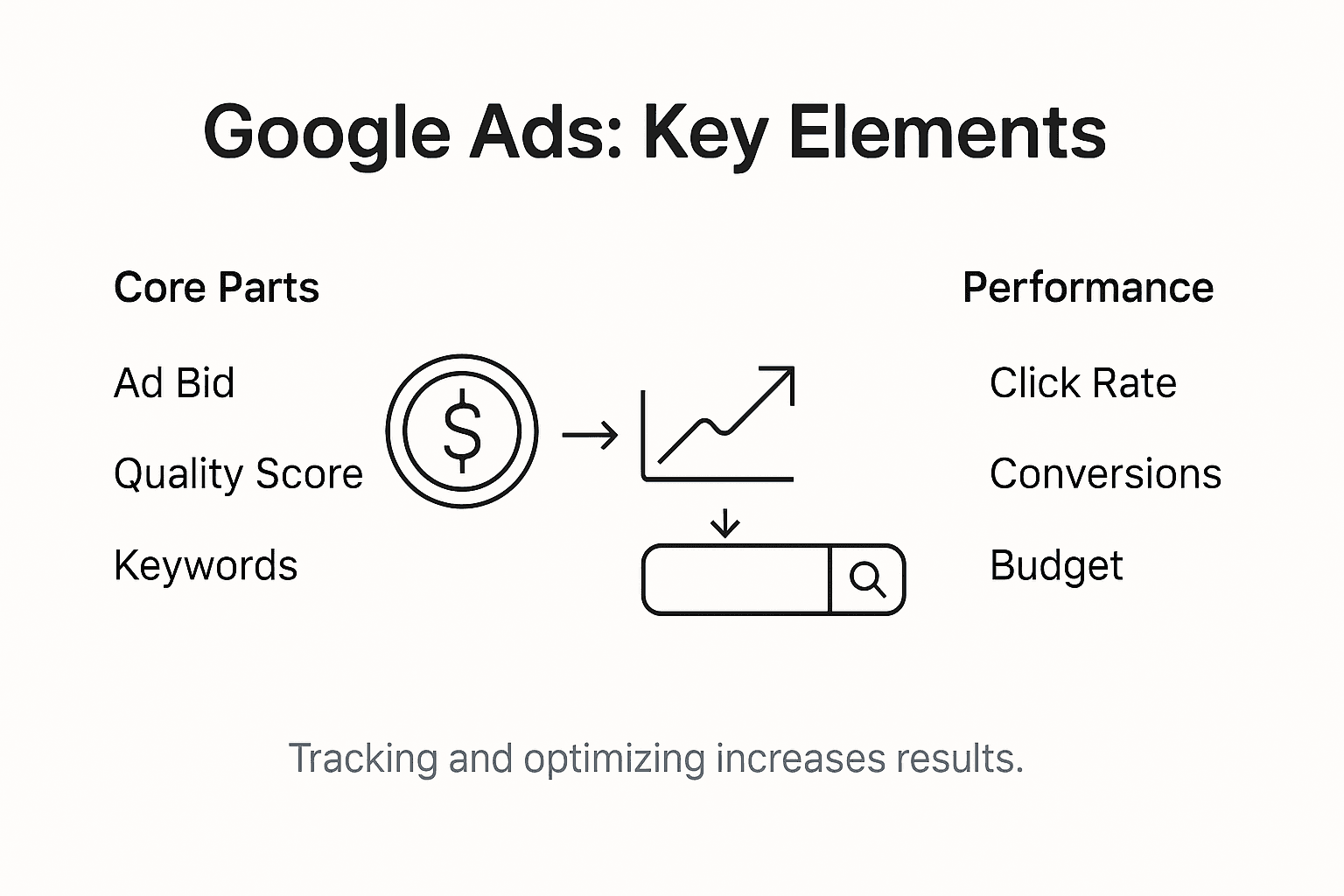
Understanding the relationship between spending and performance requires continuous monitoring and analysis. Businesses can leverage Google Ads’ robust reporting tools to track real-time performance, identifying which keywords, ad variations, and targeting strategies generate the most cost-effective results. This data-driven approach allows for rapid optimization, enabling advertisers to reallocate budgets from underperforming segments to high-performing channels, maximizing overall campaign effectiveness.
Pro tip: Start with conservative budget allocations and use Google Ads’ built-in performance tracking to incrementally adjust spending based on actual conversion data and ROI.
Common Pitfalls and Alternatives to Google Ads
Navigating the digital advertising landscape requires understanding both the strengths and potential limitations of Google Ads. While the platform offers robust advertising capabilities, businesses must be aware of common pitfalls that can drain marketing budgets and reduce campaign effectiveness. Exploring alternative advertising strategies becomes crucial for comprehensive marketing approaches.
Key Pitfalls in Google Ads include overspending through inefficient keyword targeting, neglecting negative keyword strategies, failing to optimize landing pages, and misunderstanding audience segmentation. Many businesses inadvertently waste significant resources by targeting overly broad keywords, not implementing precise audience targeting, or creating landing pages that do not align with advertisement promises. These mistakes can result in high click costs with minimal conversion potential.
Alternative advertising platforms provide diverse options for businesses seeking different marketing channels. Social media advertising platforms like Facebook Ads, LinkedIn Advertising, and Twitter Ads offer unique targeting capabilities that might complement or replace certain Google Ads strategies. Programmatic advertising networks, native advertising platforms, and industry-specific advertising channels can provide more focused reach for niche markets. Each alternative platform presents distinct advantages, such as more granular demographic targeting, potentially lower cost per click, or more specialized audience engagement.
Compare common Google Ads pitfalls with effective alternative platforms:
| Challenge in Google Ads | Typical Impact | Example Alternative Platform | Alternative’s Strength |
|---|---|---|---|
| Inefficient keyword targeting | Wasted spend, poor conversion | Facebook Ads | Granular demographic targeting |
| Neglecting negative keywords | Irrelevant traffic, high costs | LinkedIn Advertising | Precise professional segmentation |
| Weak landing page experience | Low quality score, missed leads | Programmatic Advertising | Automated audience optimization |
| Poor audience segmentation | Minimal ROI, broad reach | Native Advertising Platforms | Contextual ad placements |
Pro tip: Develop a multi-channel advertising strategy that includes Google Ads alongside alternative platforms, continuously testing and comparing performance metrics to optimize your overall marketing investment.
Maximize Your Google Ads Success with Expert Support
If you find yourself struggling with complicated Google Ads concepts like Quality Score, bid strategies, or campaign types mentioned in the article “What Is Google Ads and Why It Matters” you are not alone. Many businesses experience wasted spend from inefficient keyword targeting or low conversion rates because they lack the specialized knowledge to optimize their campaigns effectively. Your goal should be to move beyond trial and error toward a measurable and performance-driven advertising strategy that drives real growth.
At AdVenture Media, we specialize in crafting customized Google Ads strategies that improve ad relevance, optimize bids, and raise conversion rates through hands-on campaign management and expert creative strategy. Our team helps businesses understand complex auction mechanics and turn performance data into actionable improvements across platforms, including search, display, and video campaigns. If you want to avoid the common pitfalls and unlock your Google Ads potential while benefiting from a multi-channel approach including social media advertising and conversion rate optimization explore how we can help by visiting our contact page. Take the next step now and transform your online advertising into a powerful engine for growth.
Frequently Asked Questions
What is Google Ads and how does it work?
Google Ads is an online advertising platform by Google that allows businesses to create ads that appear in Google’s search results and across other websites. It primarily operates on a pay-per-click (PPC) model, where advertisers only pay when someone clicks on their ad. Ads are displayed based on a combination of bid amounts, ad relevance, and quality scores.
What are the different types of Google Ads campaigns?
Google Ads offers several campaign types, including Search Campaigns for text ads in search results, Display Campaigns for visual ads on websites and apps, Shopping Campaigns for e-commerce, Video Campaigns for YouTube ads, App Campaigns for promoting mobile apps, and Performance Max campaigns for optimized cross-channel ad placement.
How does the Google Ads auction system determine ad placement?
The Google Ads auction system determines ad placement based on three main components: Maximum Bid, Quality Score, and Expected Impact. Advertisers set bids, and the Quality Score evaluates the relevance and performance of the ad. The system aims to show ads that are most relevant to users, not just those with the highest bids.
What are common pitfalls to avoid when using Google Ads?
Common pitfalls include inefficient keyword targeting, not using negative keywords, poor landing page optimization, and inadequate audience segmentation. These issues can lead to wasted spending and low conversion rates, so businesses should focus on targeted strategies and continuous optimization.
Recommended


.svg.png)
Budget Optimization Leads to eCommerce Growth For Sennheiser

.png)
Optimizing for Purchases and App Installs Leads to 69% Decrease in CPA for Woodspoon


Slinger Bag becomes #1 tennis launcher in the US, with 12.6X Facebook ROAS
Request A Marketing Proposal
We'll get back to you within a day to schedule a quick strategy call. We can also communicate over email if that's easier for you.
Visit Us
New York
1074 Broadway
Woodmere, NY
Philadelphia
1429 Walnut Street
Philadelphia, PA
Florida
433 Plaza Real
Boca Raton, FL
General Inquiries
info@adventureppc.com
(516) 218-3722
AdVenture Education
Over 300,000 marketers from around the world have leveled up their skillset with AdVenture premium and free resources. Whether you're a CMO or a new student of digital marketing, there's something here for you.
OUR BOOK
We wrote the #1 bestselling book on performance advertising
Named one of the most important advertising books of all time.
buy on amazon
OUR EVENT
DOLAH '24.
Stream Now.
Over ten hours of lectures and workshops from our DOLAH Conference, themed: "Marketing Solutions for the AI Revolution"
check out dolah
The AdVenture Academy
Resources, guides, and courses for digital marketers, CMOs, and students. Brought to you by the agency chosen by Google to train Google's top Premier Partner Agencies.
Bundles & All Access Pass
Over 100 hours of video training and 60+ downloadable resources
 view bundles →
.png)


