
.svg)

Marketing automation is often misunderstood as simple email scheduling, but this narrow view misses the bigger picture. Modern marketing automation integrates AI, data governance, and human oversight to deliver measurable results for enterprises. This article explains what marketing automation really is, its benefits, challenges, and practical applications for 2026. Designed for marketing professionals seeking efficiency and better ROI, you’ll discover how to balance automation with strategic oversight to maximize campaign performance and drive sustainable growth.
Table of Contents
- Understanding Marketing Automation: Definition, Scope, And Benefits
- Common Challenges And Nuances In Marketing Automation Today
- AI And The Evolving Landscape Of Marketing Automation In 2026
- Implementing Marketing Automation Effectively At Scale
- Discover Expert Marketing Automation Solutions Tailored For Your Business
- Frequently Asked Questions About Marketing Automation
Key takeaways
| Point | Details |
|---|---|
| Strong ROI potential | Marketing automation delivers $5.44 per dollar spent with 40% faster campaign deployment |
| Balance is critical | Human oversight prevents over-automation and maintains personalization at scale |
| AI transforms complexity | AI-driven automation handles complex scenarios when supported by quality data and governance |
| Data quality matters | Clean data and compliance documentation are essential for automation success |
| Hybrid approach wins | Combining AI with traditional automation maximizes efficiency and customer engagement |
Understanding marketing automation: definition, scope, and benefits
Marketing automation uses software to automate repetitive marketing tasks such as emails, social posting, lead nurturing, and tracking. This technology enables marketing teams to execute complex, multi-channel campaigns without manual intervention at every step. For medium to large enterprises, automation transforms how teams scale personalized communication while maintaining consistent brand messaging across thousands of customer touchpoints.
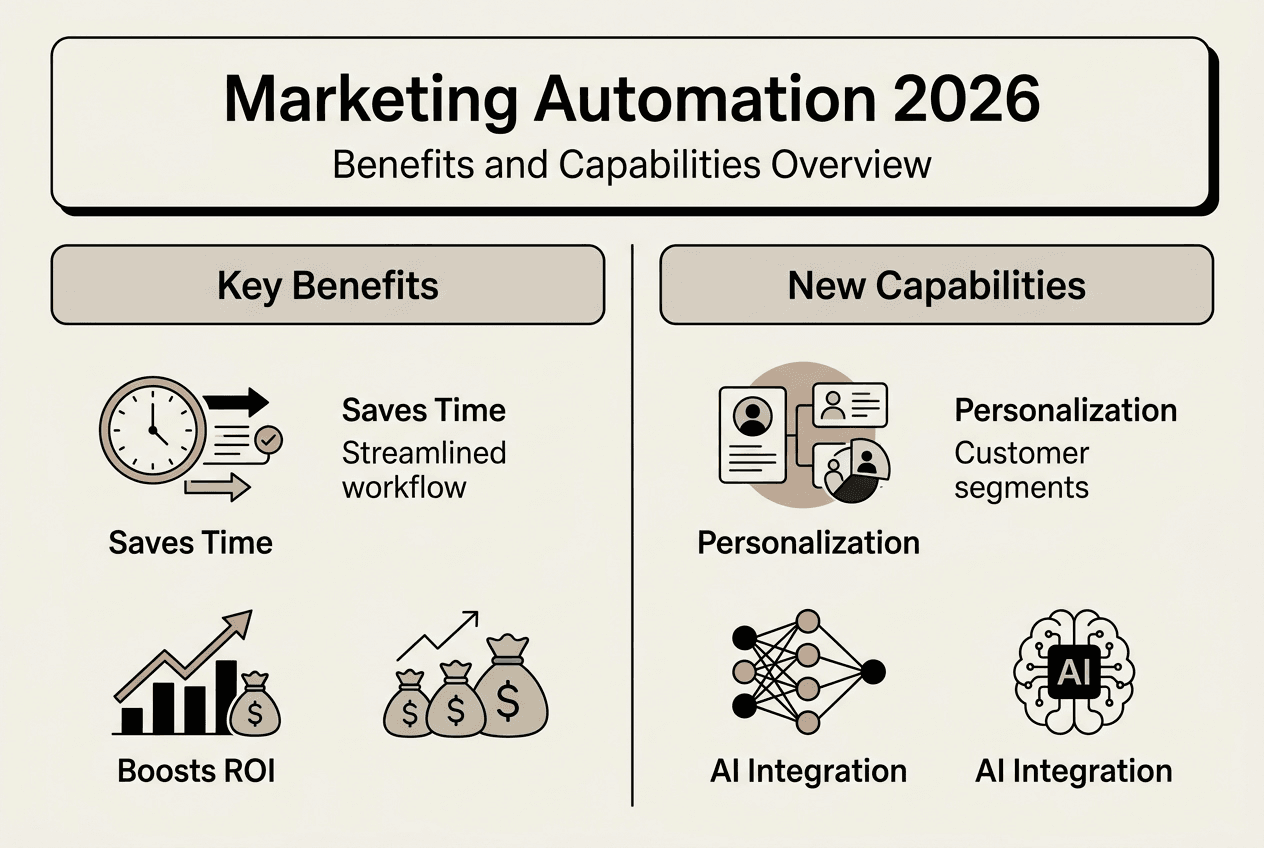
The financial benefits are substantial. Marketing automation produces $5.44 ROI per dollar spent over three years and enables 40% faster campaigns with 60% less admin time. These numbers translate to real business impact. One enterprise reported $141,000 in additional revenue after implementing automation, accompanied by higher engagement rates across email channels. The efficiency gains free marketing teams to focus on strategy and creative development rather than manual task execution.
Modern marketing automation platforms encompass several interconnected components:
- Lead scoring systems that prioritize prospects based on behavior and engagement
- Email workflow automation that triggers personalized messages based on customer actions
- Multi-channel orchestration coordinating campaigns across email, social, SMS, and web
- Analytics dashboards tracking performance metrics and attribution across touchpoints
- CRM integration syncing customer data between marketing and sales systems
These capabilities enable enterprises to deliver personalized experiences at scale in 2026. A well-implemented automation strategy reduces manual workload while increasing campaign sophistication. Marketing teams can segment audiences more precisely, test messaging variations systematically, and respond to customer behaviors in real time. The result is improved digital marketing ROI measurement and more efficient resource allocation across campaigns.
For marketing professionals evaluating automation investments, the value proposition extends beyond time savings. Automation creates consistency in campaign execution, reduces human error in repetitive tasks, and generates detailed performance data for continuous optimization. The technology serves as a force multiplier, allowing small teams to execute enterprise-scale campaigns while maintaining quality and personalization standards that drive customer engagement.
Common challenges and nuances in marketing automation today
Implementing marketing automation introduces technical complexities that can undermine campaign performance if not properly managed. UTM tag overwriting represents a common technical pitfall where automation workflows inadvertently replace existing tracking parameters, causing misattribution in analytics reports. This creates blind spots in understanding which channels drive conversions, leading to misguided budget allocation decisions.

The risk of over-automation poses another significant challenge. Common marketing automation mistakes include overwriting tracking parameters, over-automation leading to impersonal interactions, data quality issues, and compliance risks. When companies automate too many touchpoints without human oversight, customers receive generic, robotic communications that damage brand perception. A fully automated email sequence might send promotional messages to recently bereaved customers or ignore context-specific situations requiring empathy and judgment.
Data governance emerges as a critical foundation for successful automation. Marketing teams must maintain audit logs documenting every automated decision, establish consent fields tracking customer communication preferences, and implement systems ensuring compliance with privacy regulations like GDPR and CCPA. Without these safeguards, enterprises face regulatory penalties and reputational damage from privacy violations.
B2B and B2C contexts require different automation approaches:
- B2B workflows typically involve longer sales cycles with multiple decision-makers requiring nurture sequences spanning months
- B2C automation focuses on faster purchase decisions with emphasis on promotional timing and behavioral triggers
- B2B lead scoring weighs firmographic data like company size and industry alongside individual engagement
- B2C scoring prioritizes browsing behavior, purchase history, and engagement frequency
These distinctions affect workflow design, content strategy, and success metrics. A B2B enterprise selling enterprise software needs different automation logic than a B2C retailer promoting seasonal products.
Pro Tip: Continually test your automation workflows with edge cases like duplicate records, incomplete data fields, and unusual customer behaviors. Maintain human oversight for exceptions requiring judgment calls that automation cannot handle effectively.
The automation impact in advertising extends beyond email marketing into paid media optimization, but similar challenges apply. Marketing teams must balance efficiency gains against the need for strategic human oversight that prevents costly mistakes and maintains authentic customer relationships.
AI and the evolving landscape of marketing automation in 2026
Traditional marketing automation relies on rule-based logic where marketers define specific conditions and corresponding actions. If a prospect downloads a whitepaper, send email sequence A. If they visit the pricing page three times, notify sales. This deterministic approach works well for predictable scenarios but struggles with complexity and ambiguity.
AI-driven automation introduces agentic capabilities that handle nuanced situations requiring interpretation. Traditional rules-based automation handles predictable tasks well, however AI-driven automation excels on complexity and ambiguity but requires strong data pillars and governance. An AI system can analyze thousands of customer data points to predict optimal send times, generate personalized content variations, and identify patterns humans might miss.
| Characteristic | Traditional Automation | AI-Driven Automation |
|---|---|---|
| Predictability | High, follows explicit rules | Variable, learns from patterns |
| Complexity handling | Limited to predefined scenarios | Manages ambiguous situations |
| Data requirements | Structured fields and tags | Large datasets with quality signals |
| Human oversight | Periodic review of workflows | Continuous monitoring of decisions |
| Setup complexity | Moderate, rule configuration | High, model training and tuning |
Despite enthusiasm around AI capabilities, adoption challenges persist. The majority of companies increase AI budgets in 2026, but 80% experience no immediate bottom-line impact. This gap between investment and returns stems from insufficient data infrastructure, lack of governance frameworks, and unrealistic expectations about AI capabilities without proper implementation.
Successful AI adoption in marketing automation requires several prerequisites:
- Pilot projects testing AI on contained use cases before enterprise-wide deployment
- CRM data integration ensuring AI systems access complete customer profiles
- Continuous optimization cycles refining models based on performance feedback
- Cross-functional collaboration between marketing, data science, and IT teams
- Clear governance policies defining acceptable AI decision boundaries
The AI impact on marketing CTR growth demonstrates measurable improvements when properly implemented, but success requires patience and systematic iteration.
Pro Tip: Adopt a hybrid approach using AI for complex customer journey orchestration while maintaining traditional automation for routine, predictable tasks. This strategy delivers efficiency gains without over-relying on AI for situations where simple rules work better.
Marketing teams should view AI as augmenting rather than replacing human expertise. The AI answer stack framework provides structure for determining which tasks benefit from AI versus traditional automation. Understanding the role of data in marketing 2026 helps teams build the foundation necessary for AI success rather than deploying technology without adequate preparation.
Implementing marketing automation effectively at scale
Successful marketing automation deployment at enterprise scale requires systematic planning and execution. Follow these steps to implement automation that delivers results:
- Audit current marketing processes to identify repetitive tasks consuming significant team time and map existing customer touchpoints across all channels
- Map complete customer journeys documenting every interaction from awareness through post-purchase, identifying automation opportunities at each stage
- Integrate data sources connecting CRM, analytics platforms, advertising systems, and customer service tools to create unified customer profiles
- Pilot automation workflows starting with high-volume, low-complexity scenarios to validate technical implementation and measure initial impact
- Monitor performance metrics continuously, analyzing both quantitative results and qualitative customer feedback to identify optimization opportunities
Successful AI-CRM integration requires pilots, data analysis, and CRM-specific steps to boost digital marketing capability and firm performance. This research-backed approach reduces implementation risk while building organizational confidence in automation capabilities.
Critical success factors separate effective automation from failed implementations:
- Human oversight maintaining strategic control over automated decisions and intervening when situations require judgment
- Compliance documentation recording consent, preferences, and automated actions for regulatory audits
- Edge case testing validating how automation handles unusual scenarios like duplicate records or incomplete data
- Continuous learning establishing feedback loops where campaign results inform workflow refinements
- Cross-functional collaboration ensuring marketing, sales, IT, and customer service teams align on automation goals
The most effective approach combines traditional automation with AI capabilities in a hybrid strategy. Use rule-based automation for straightforward scenarios with clear logic, deploy AI for complex pattern recognition and personalization at scale, and reserve human decision-making for high-stakes situations requiring empathy and strategic thinking.
Training investments prove essential for long-term success. Marketing teams need ongoing education on automation platform capabilities, data governance best practices, and analytical skills for interpreting performance metrics. Organizations that treat automation as a technology implementation rather than a capability-building initiative typically achieve disappointing results.
Governance frameworks maintain data quality and compliance over time. Establish clear policies defining who can create workflows, how customer data gets used, what automated decisions require human approval, and how the organization monitors for errors or unintended consequences. These guardrails prevent automation from creating problems faster than teams can solve them.
Marketing professionals should embrace automation strategically in 2026, viewing it as a tool for maximizing efficiency and ROI rather than a replacement for human creativity and judgment. The data-driven marketing 2026 growth opportunity requires combining technological capabilities with strategic thinking that only experienced marketers provide.
Practical applications like performance max campaigns tips demonstrate how automation principles apply across different marketing channels. The key lies in thoughtful implementation that balances efficiency with personalization, automation with oversight, and technology with human expertise.
Discover expert marketing automation solutions tailored for your business
Implementing marketing automation successfully requires both technical expertise and strategic thinking. AdVenture Media specializes in helping enterprises design and deploy automation solutions that drive measurable results. Our team combines deep platform knowledge with performance marketing experience to create systems that scale efficiently while maintaining personalization.
Explore how strategic testing and automation delivered impressive results in our year over year growth case study, where systematic optimization improved conversion rates substantially. The A/B testing conversion case study demonstrates how data-driven experimentation enhances campaign performance across channels.
Ready to optimize your marketing efficiency in 2026? Contact our marketing automation experts to discuss tailored solutions for your business needs. We’ll help you navigate the complexity of modern automation while avoiding common pitfalls that undermine results.
Frequently asked questions about marketing automation
What exactly is marketing automation?
Marketing automation is software that executes repetitive marketing tasks automatically based on predefined rules or AI-driven logic. It handles email sequences, lead scoring, social media posting, and campaign tracking without manual intervention. This technology enables teams to scale personalized communication while reducing administrative workload and improving campaign consistency.
How much ROI can I expect from marketing automation?
Marketing automation typically delivers $5.44 in returns per dollar spent over three years, with campaigns launching 40% faster and requiring 60% less administrative time. Actual results vary based on implementation quality, data infrastructure, and how well automation aligns with business processes. Enterprises with mature data practices and strategic oversight achieve the highest returns.
What are the biggest risks of marketing automation?
Over-automation creates impersonal customer experiences that damage brand perception and engagement. Technical issues like UTM tag overwriting cause attribution errors that mislead optimization decisions. Poor data governance leads to compliance violations under privacy regulations like GDPR and CCPA. These risks require continuous monitoring, testing edge cases, and maintaining human oversight for complex situations.
How does AI change marketing automation capabilities?
AI enables automation to handle complex scenarios requiring pattern recognition and interpretation rather than just following explicit rules. It can predict optimal send times, generate personalized content variations, and identify customer segments humans might miss. However, AI requires substantial quality data, governance frameworks, and continuous optimization to deliver bottom-line impact rather than just technological novelty.
Should I use traditional automation or AI-driven systems?
A hybrid approach works best for most enterprises in 2026. Use traditional rule-based automation for predictable, straightforward tasks where explicit logic works well. Deploy AI for complex customer journey orchestration, personalization at scale, and pattern recognition across large datasets. Reserve human decision-making for high-stakes situations requiring empathy, judgment, and strategic thinking that technology cannot replicate.
What steps ensure successful marketing automation implementation?
Start by auditing current processes and mapping complete customer journeys to identify automation opportunities. Integrate data sources to create unified customer profiles across systems. Pilot workflows on high-volume, low-complexity scenarios before expanding. Monitor performance continuously and establish governance frameworks defining acceptable automated decisions. Invest in team training so marketers can effectively manage and optimize automation over time.
Recommended


Baketivity YoY Growth Soars after Analyzing Customer LTV's


Unique Campaign Structure Saves Leading Logistics Company $27K Month Over Month


Implementation of Google’s Latest Targeting Features Increases a Telehealth Company’s YoY New Users by 96%
Request A Marketing Proposal
We'll get back to you within a day to schedule a quick strategy call. We can also communicate over email if that's easier for you.
Visit Us
New York
1074 Broadway
Woodmere, NY
Philadelphia
1429 Walnut Street
Philadelphia, PA
Florida
433 Plaza Real
Boca Raton, FL
General Inquiries
info@adventureppc.com
(516) 218-3722
AdVenture Education
Over 300,000 marketers from around the world have leveled up their skillset with AdVenture premium and free resources. Whether you're a CMO or a new student of digital marketing, there's something here for you.
OUR BOOK
We wrote the #1 bestselling book on performance advertising
Named one of the most important advertising books of all time.
buy on amazon
OUR EVENT
DOLAH '24.
Stream Now.
Over ten hours of lectures and workshops from our DOLAH Conference, themed: "Marketing Solutions for the AI Revolution"
check out dolah
The AdVenture Academy
Resources, guides, and courses for digital marketers, CMOs, and students. Brought to you by the agency chosen by Google to train Google's top Premier Partner Agencies.
Bundles & All Access Pass
Over 100 hours of video training and 60+ downloadable resources
 view bundles →
.png)


