
.svg)
What Is Omnichannel Marketing? Benefits, Strategy & Real Results

TL;DR:
- True omnichannel integrates all customer touchpoints sharing data, messaging, and context for a seamless experience.
- Building omnichannel requires organizational alignment, data infrastructure, and pilot testing, not just technology.
- Effective omnichannel strategies significantly improve customer retention, loyalty, and revenue growth.
Most enterprise marketing teams believe they’re doing omnichannel. They’re on email, paid search, social, and in-store. But using multiple channels is not the same as integrating them. True omnichannel marketing means every touchpoint shares data, messaging, and context, so the customer experience feels continuous regardless of where someone shows up. The gap between those two realities is where loyalty is won or lost. This article breaks down what omnichannel actually means, why the distinction matters enormously for your bottom line, and how to build, measure, and scale a strategy that delivers real results.
Table of Contents
- What is omnichannel marketing?
- Omnichannel vs. multichannel: Key differences and why it matters
- Building an omnichannel strategy: Practical steps for enterprise teams
- Measuring omnichannel marketing ROI: Metrics, attribution, and optimization
- Omnichannel marketing in action: Real enterprise results
- A hard-won perspective: Why true omnichannel is so rare—and how to get there
- Take the next step with omnichannel expertise
- Frequently asked questions
Key Takeaways
| Point | Details |
|---|---|
| Omnichannel defined | It is seamless integration across all customer touchpoints, not just many channels. |
| Business impact | Omnichannel strategies drive higher retention and revenue growth for enterprises. |
| Execution steps | Success requires aligned teams, integrated data, and ongoing measurement across channels. |
| Common pitfalls | Most failures stem from siloed operations and lack of leadership commitment. |
| Proof in practice | Case studies show omnichannel cuts costs and boosts marketing ROI for real businesses. |
What is omnichannel marketing?
Omnichannel marketing is the practice of connecting every customer touchpoint, online and offline, into a single, coherent experience. It’s not about being everywhere. It’s about making everywhere feel like one place.
Here’s the clearest way to think about it: a customer sees your ad on Instagram, clicks through to your website, abandons their cart, gets a personalized email the next morning, walks into your store that afternoon, and the associate already knows their preferences. That’s omnichannel. Each channel feeds the next. No resets, no repeated introductions, no friction.
As Salesforce explains, omnichannel “creates a unified and personalized experience for customers across all touchpoints.” The emphasis on personalized matters. It’s not just consistency of branding. It’s consistency of context.
Contrast that with multichannel, where each channel operates independently. Your email team doesn’t know what your paid search team is doing. Your in-store experience doesn’t reflect what happened on your app. Customers feel it, even if they can’t name it.
Typical enterprise touchpoints that need to be integrated in an omnichannel model include:
- Paid search and display advertising
- Social media (organic and paid)
- Email and SMS marketing
- Mobile apps
- Physical retail locations
- Call centers and live chat
- Direct mail
- E-commerce platforms
The business case is straightforward. When customers experience cross-channel advertising that feels connected, engagement goes up, loyalty increases, and attribution becomes far more accurate. You stop guessing which channel drove the sale and start understanding the full journey.
Single-channel marketing is a relic. Multichannel is the current default for most enterprises. Omnichannel is where the real competitive advantage lives, and the gap between knowing that and executing it is exactly what this article is built to close.
Omnichannel vs. multichannel: Key differences and why it matters
The difference between omnichannel and multichannel isn’t just philosophical. It has direct consequences for retention, revenue, and your ability to personalize at scale.
| Feature | Multichannel | Omnichannel |
|---|---|---|
| Channel integration | Siloed | Fully connected |
| Customer data | Fragmented | Unified |
| Messaging consistency | Inconsistent | Seamless |
| Personalization | Limited | Context-aware |
| Attribution | Difficult | More accurate |
| Customer experience | Disjointed | Continuous |
The numbers make the case bluntly. Businesses with strong omnichannel strategies retain an average of 89% of their customers, compared to just 33% for companies with weak omnichannel engagement. That’s not a marginal improvement. That’s a structural advantage.
Weak multichannel approaches create real risks that compound over time:
- Disjointed experiences that frustrate customers and erode trust
- Poor tracking that makes it impossible to understand the true customer journey
- Lower retention because customers don’t feel recognized across channels
- Wasted spend on channels that duplicate effort rather than build on each other
- Attribution gaps that cause teams to over-invest in last-click channels
The seamlessness of omnichannel also directly impacts performance-driven marketing outcomes. When data flows between channels, you can suppress ads to recent purchasers, re-engage cart abandoners with the right message at the right time, and allocate budget based on actual customer behavior rather than siloed channel metrics.
Pro Tip: A quick way to tell if your enterprise is stuck in multichannel mode is to ask one question: can your call center representative see what a customer clicked on in your last email? If the answer is no, your data isn’t integrated, and your customer experience is paying the price.
The distinction matters because fixing it requires more than adding a new platform. It requires rethinking how your teams, data, and technology work together.
Building an omnichannel strategy: Practical steps for enterprise teams
Building a real omnichannel strategy is less about buying the right software and more about aligning the right people around the right processes. Here’s a practical framework to get there.
- Audit your current channels. Map every touchpoint your customers interact with. Identify which ones share data and which operate in isolation. Be honest about the gaps.
- Map the customer journey. Document the actual paths customers take from awareness to purchase to retention. Include offline touchpoints. Most enterprise journey maps underweight in-store and call center interactions.
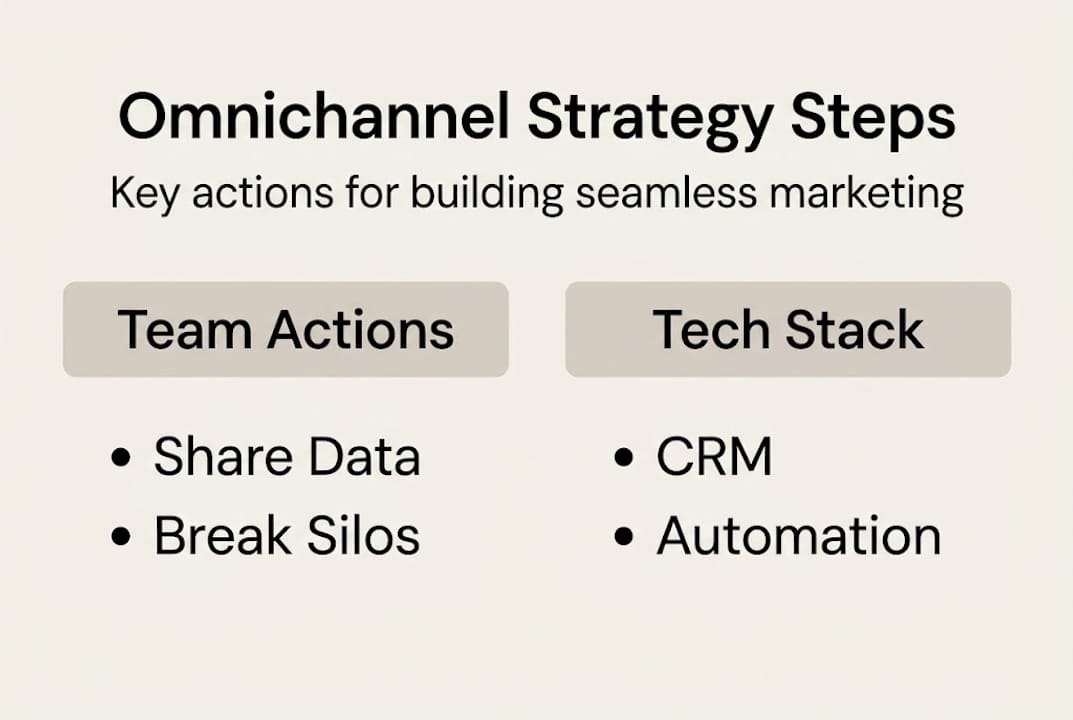
- Integrate your data infrastructure. A unified customer data platform (CDP) or CRM is non-negotiable. Without a single source of truth for customer data, personalization at scale is impossible.
- Align stakeholders across departments. Marketing, sales, IT, customer service, and operations all touch the customer experience. Omnichannel requires shared ownership, not territorial channel management.
- Run a pilot program. Choose one or two high-impact channel combinations, such as paid search and email, and build a truly integrated experience. Measure everything before expanding.
- Establish measurement frameworks. Define your KPIs upfront. Know how you’ll track cross-channel attribution before you launch, not after.
The internal silo problem is the most underestimated obstacle. Teams optimizing for their own channel metrics will naturally resist integration because it complicates their reporting. Leadership has to set the expectation that the customer journey is the unit of measurement, not individual channel performance.
On the technology side, your stack should include a CRM, a marketing automation platform, analytics tools capable of cross-channel attribution, and ideally a CDP. These aren’t optional layers. They’re the connective tissue of your strategy.
Pro Tip: Don’t try to integrate every channel at once. Start with the two channels where your customers are most active and where the data handoff is most broken. Nail that integration first. The experience gap is real: 71% of consumers want a consistent experience across all channels, but only 29% say they actually get it. Closing that gap incrementally beats a failed big-bang rollout every time.
For more context on how this plays out in practice, reviewing marketing strategy examples from enterprises that have done this well can sharpen your thinking considerably.
Measuring omnichannel marketing ROI: Metrics, attribution, and optimization
You can’t optimize what you can’t measure. And omnichannel measurement is genuinely harder than single-channel tracking. Here’s how to approach it.
| KPI | What it tells you |
|---|---|
| Customer lifetime value (CLTV) | Long-term revenue impact per customer |
| Retention rate | Whether the experience keeps customers coming back |
| Net Promoter Score (NPS) | Customer satisfaction and advocacy |
| Revenue per customer | Cross-sell and upsell effectiveness |
| Cross-channel attribution | Which channel combinations drive conversions |
| Cost per acquisition (CPA) | Efficiency of your full-funnel spend |
Attribution is where most enterprise teams struggle. Last-click attribution is simple but misleading in an omnichannel environment. A customer who converts after clicking a paid search ad may have been influenced by three prior touchpoints. Data-driven attribution models, which assign fractional credit based on actual contribution, are far more accurate but require clean, integrated data to function.
Common pitfalls in omnichannel measurement include:
- Measuring channels in isolation rather than looking at journey-level performance
- Ignoring offline touchpoints like store visits and call center interactions
- Over-relying on last-click attribution, which inflates the value of bottom-funnel channels
- Failing to connect ad spend data to CRM outcomes, leaving revenue impact invisible
The ROI case for getting this right is compelling. Companies with robust omnichannel strategies see a 9.5% year-over-year revenue increase, compared to 3.4% for those with weak strategies. That’s nearly three times the growth rate.
Optimization works best when you treat data as a feedback loop. Review cross-channel performance weekly. Identify where customers drop off between touchpoints. Test messaging changes in one channel and measure the downstream effect on others. For a deeper look at how to approach this, our guides on digital marketing ROI and measuring ad performance offer practical frameworks you can apply immediately.
Omnichannel marketing in action: Real enterprise results
Theory is useful. Results are better. Here’s what omnichannel looks like when it’s executed well.
Retail and e-commerce: A major retailer unified its email, paid search, and in-store data to create personalized re-engagement sequences triggered by in-store browsing behavior. The result was a significant lift in repeat purchase rate and a measurable reduction in customer acquisition costs.

Financial services: A financial services firm connected its call center data with its digital ad targeting. Customers who called but didn’t convert were removed from generic acquisition campaigns and entered a nurture sequence tailored to their specific inquiry. Conversion rates on that segment improved substantially.
Performance advertising: In one of our own omnichannel case studies, an enterprise client cut CPA by 41% by integrating paid search, social, and email into a coordinated funnel rather than running each channel independently.
What these organizations did differently:
- They treated the customer journey as a single system, not a collection of separate campaigns
- They invested in data infrastructure before launching integrated campaigns
- They aligned internal teams around shared KPIs tied to customer outcomes, not channel metrics
- They iterated quickly, using real data to refine messaging and channel sequencing
“The shift from multichannel to omnichannel isn’t a campaign change. It’s an organizational change. The brands that win are the ones that build the internal capability to act on unified customer data in real time.”
The replicable lesson here is that omnichannel success isn’t reserved for companies with unlimited budgets. It’s available to any enterprise willing to prioritize integration over expansion.
A hard-won perspective: Why true omnichannel is so rare—and how to get there
Here’s the uncomfortable truth we’ve observed working with enterprise clients: most omnichannel strategies fail not because of technology, but because of people and process. Teams buy the CDP, implement the automation platform, and then continue operating in silos because no one changed the incentive structures or the reporting lines.
Real integration is behavioral before it’s technical. It requires a CMO who insists that channel leads share data and credit. It requires IT and marketing to speak the same language. It requires customer service to be treated as a marketing touchpoint, not a cost center.
Our honest advice: pilot one true omnichannel experience before scaling. Pick two channels, integrate them completely, and measure the outcome rigorously. That proof of concept will do more to build internal buy-in than any strategy deck.
Also, revisit your customer journey map every quarter. Customer behavior shifts. Pain points migrate. A journey map built in 2024 may not reflect how your customers move in 2026. For enterprises ready to go deeper, exploring advanced enterprise strategies can accelerate that process considerably.
Pro Tip: Form a cross-departmental experience task force. Include marketing, sales, IT, and customer service. Meet monthly. Review one customer journey segment per session. This group will surface the friction points that no single team can see on its own.
Take the next step with omnichannel expertise
Building a true omnichannel strategy is one of the highest-leverage moves an enterprise marketing team can make. But it’s also one of the most complex. If you want to see what’s possible, start with real results. Our Survey Money Machines case study shows how integrated channel strategy drives year-over-year conversion growth. The International Culinary Center case study demonstrates what omnichannel looks like in an education context. If you’re ready to move from strategy to execution, contact our team and let’s map out what’s possible for your organization.
Frequently asked questions
How is omnichannel marketing different from multichannel?
Omnichannel marketing integrates data, messaging, and experience seamlessly across channels, while multichannel simply means using multiple independent channels. As Salesforce notes, omnichannel delivers a unified experience that multichannel approaches cannot.
What are the benefits of omnichannel marketing for large enterprises?
Omnichannel marketing boosts customer retention, enhances engagement, and delivers higher ROI compared to traditional approaches. Companies with strong omnichannel strategies retain 89% of customers, versus just 33% for weakly integrated ones.
Which metrics are most important for tracking omnichannel success?
Key metrics include customer lifetime value, retention rate, NPS, revenue per customer, and cross-channel attribution. HBR research confirms that tracking CLTV and retention alongside revenue growth is essential for measuring long-term omnichannel value.
What is the biggest challenge in adopting omnichannel marketing?
Siloed teams and poor data integration make building seamless customer experiences difficult. Only 29% of consumers say they actually receive the consistent cross-channel experience that 71% expect.
Recommended


Implementation of Google’s Latest Targeting Features Increases a Telehealth Company’s YoY New Users by 96%


20% Increase in Subscribers for Forbes Magazine

.svg.png)
Budget Optimization Leads to eCommerce Growth For Sennheiser
Request A Marketing Proposal
We'll get back to you within a day to schedule a quick strategy call. We can also communicate over email if that's easier for you.
Visit Us
New York
1074 Broadway
Woodmere, NY
Philadelphia
1429 Walnut Street
Philadelphia, PA
Florida
433 Plaza Real
Boca Raton, FL
General Inquiries
info@adventureppc.com
(516) 218-3722
AdVenture Education
Over 300,000 marketers from around the world have leveled up their skillset with AdVenture premium and free resources. Whether you're a CMO or a new student of digital marketing, there's something here for you.
OUR BOOK
We wrote the #1 bestselling book on performance advertising
Named one of the most important advertising books of all time.
buy on amazon
OUR EVENT
DOLAH '24.
Stream Now.
Over ten hours of lectures and workshops from our DOLAH Conference, themed: "Marketing Solutions for the AI Revolution"
check out dolah
The AdVenture Academy
Resources, guides, and courses for digital marketers, CMOs, and students. Brought to you by the agency chosen by Google to train Google's top Premier Partner Agencies.
Bundles & All Access Pass
Over 100 hours of video training and 60+ downloadable resources
 view bundles →
.png)


