
.svg)

TL;DR:
- Conversion rate optimization (CRO) is a data-driven process that improves the percentage of visitors completing desired actions without relying on guesswork or extensive redesigns. It uses analytics, user research, and controlled experiments to identify friction points and validate fixes, generating knowledge that compounds over time. Implementing CRO on high-traffic pages can produce faster, more sustainable results than costly site overhauls or continuous traffic campaigns.
Pouring more budget into paid traffic or commissioning another expensive site overhaul feels like taking action. But if your conversion rate is weak, you’re essentially filling a leaky bucket. CRO, or conversion rate optimization, is the data-driven process of increasing the percentage of visitors who complete a desired action, whether that’s a purchase, a demo request, or a form submission, without relying on gut instinct or sweeping redesigns. For marketing directors and e-commerce managers who need measurable outcomes, CRO is the lever that turns existing traffic into real revenue growth.
Table of Contents
- What is conversion rate optimization and how does it work?
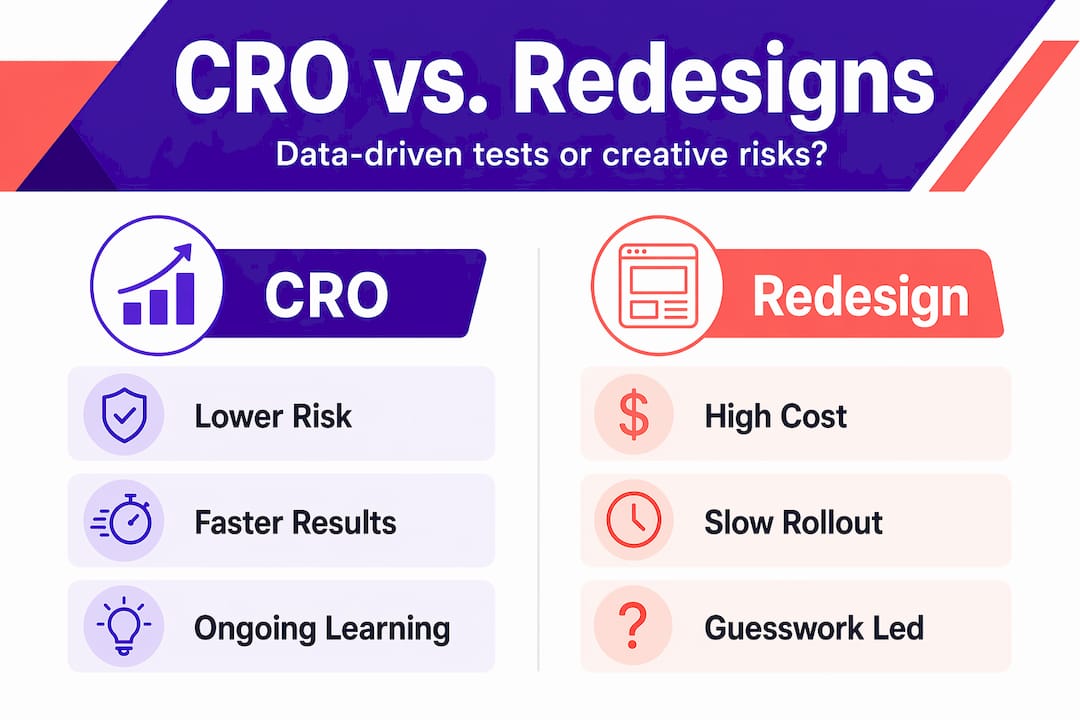
- Why CRO is more effective than redesigns or pure traffic growth
- The science behind CRO: Why controlled experiments matter
- When and where to use CRO for maximum impact
- The uncomfortable truth: What executives get wrong about CRO decisions
- See how leading brands achieve more with CRO
- Frequently asked questions
Key Takeaways
| Point | Details |
|---|---|
| Iterative wins vs. big risks | CRO replaces risky redesigns with ongoing, lower-risk improvements for better ROI. |
| Science beats opinions | Controlled experiments and analytics turn guesswork into measured growth. |
| Target high-impact funnel points | Optimizing key steps in your funnel drives the largest returns on investment. |
| Statistical discipline required | Valid results depend on careful test design and data interpretation. |
What is conversion rate optimization and how does it work?
CRO isn’t guesswork dressed up in a dashboard. At its core, CRO uses analytics and user research combined with controlled experiments like A/B tests to pinpoint friction in your user journey and validate fixes before you commit to them at scale. That distinction matters enormously. You’re not redesigning a page because it “feels dated.” You’re testing a specific hypothesis, measuring the outcome against a control, and only shipping the winner.
The practical workflow looks something like this:
- Audit: Pull quantitative data from your analytics platform. Where are users dropping off? What pages have high traffic but low conversion?
- Research: Layer in qualitative data. Session recordings, heatmaps, and on-site surveys reveal why users behave the way they do.
- Hypothesis formation: Translate findings into testable ideas. “Users abandon the checkout page because shipping costs appear too late” is a testable hypothesis. “The page looks bad” is not.
- Experiment design: Run an A/B test or multivariate test with a clearly defined control group, success metric, and required sample size.
- Analysis: Measure results with statistical significance before declaring a winner.
- Implementation and iteration: Roll out the winning variant and feed insights into the next test cycle.
“The most effective CRO programs treat optimization as a system, not a one-off project. Each test generates knowledge that informs the next, compounding your gains over time.”
This systematic approach is what separates CRO from a cosmetic website refresh. When you combine it with disciplined optimizing of landing pages and a clear framework for using data in your ad strategy, the results compound fast. Teams that adopt analytics for better ROI consistently outperform those that rely on periodic redesigns and hope for the best.
Why CRO is more effective than redesigns or pure traffic growth
Understanding what makes CRO unique leads to the natural question: Is optimization truly better than a major redesign or just driving more traffic?
Short answer: almost always, yes. Here’s why.
| Approach | Cost | Time to results | Risk level | Knowledge generated |
|---|---|---|---|---|
| Full site redesign | Very high | 6 to 18 months | High (untested assumptions) | Low, hard to attribute changes |
| Traffic campaigns | Medium to high, ongoing | Fast but unsustained | Medium | Low (volume without insight) |
| CRO program | Medium, scalable | 4 to 12 weeks per cycle | Low (validated changes only) | High, compounds over time |
Site redesigns often rely on assumptions and the creative preferences of whoever holds the most authority in the room. CRO flips that dynamic entirely. Every change earns its place through evidence.

Consider a practical scenario. A mid-sized e-commerce brand is averaging a 1.8% conversion rate on its product category pages. Leadership wants to greenlight a $300,000 site overhaul. A CRO-led approach, by contrast, might run five targeted tests over three months, starting with the highest-traffic, lowest-converting pages. Test one simplifies the product filter UI. Test two adds social proof near the add-to-cart button. Test three adjusts the primary CTA copy. Total spend: a fraction of the redesign budget. Outcome: a 0.4-point lift in conversion rate that translates to tens of thousands in additional monthly revenue, with zero risk of breaking what already works.
Here’s how to prioritize when you’re building out a CRO roadmap:
- Rank pages by revenue potential. Multiply page traffic by average order value and current conversion rate to identify where a small lift creates the largest absolute gain.
- Score by ease of testing. Simple copy and CTA changes are faster to ship than structural layout tests. Start there to build momentum.
- Audit for obvious friction. Form fields that ask for unnecessary information, surprise fees at checkout, and slow page load times are low-hanging fruit.
- Align tests with your ad strategy. Pages receiving paid traffic deserve priority because improvements there directly lower your customer acquisition cost.
Pro Tip: Before launching any test, define what a “win” looks like in hard numbers. A 5% lift in conversion on a page generating $50,000 per month is worth far more than a 20% lift on a page generating $5,000. Math first, always.
The data-driven marketing benefits here are real and compounding. When you also harness analytics systematically across your funnel, you start seeing patterns that no single redesign could ever surface. For e-commerce teams specifically, optimizing product pages using CRO principles can be one of the fastest paths to improved margin without touching the ad budget at all.
The science behind CRO: Why controlled experiments matter
Having established CRO’s edge over traditional approaches, it’s essential to understand why scientific methods set the winners apart.
Here’s a reality check that most guides skip over. CRO is genuinely difficult to execute because only a subset of your visitors are “marginal users,” meaning people whose behavior can actually be shifted by the changes you’re testing. The majority of your users have already decided. They’re either going to convert or they’re not, regardless of whether you change a button color or rewrite a headline. Only that marginal segment is sensitive to your optimization efforts.
This is not a reason to avoid CRO. It’s a reason to run it rigorously.
| Test type | What it measures | Ideal use case | Risk of false positive |
|---|---|---|---|
| A/B test (single variable) | Impact of one specific change | CTA copy, headline, single image swap | Low if sample size is sufficient |
| Multivariate test | Interaction between multiple changes | Complex page layouts with many elements | Medium to high without proper controls |
| Split URL test | Entirely different page versions | Major layout or flow variations | Low, but slower to reach significance |
| Bandit testing | Dynamic traffic allocation to winners | High-velocity environments needing speed | Medium, less statistical rigor |
Controlled experiments require correct design, specifically testing one change at a time, ensuring you have a sufficient sample size before reading results, and never pulling the plug early just because early numbers look promising. Peeking at results before statistical significance is reached is one of the most common mistakes enterprise teams make, and it leads to false positives that cost money downstream.
Key principles to anchor your testing program:
- Establish a solid baseline. Run your analytics long enough to understand seasonal and weekly fluctuation before setting benchmarks.
- Define significance thresholds upfront. Most teams use 95% confidence as the standard. Commit to it before the test starts, not after.
- Respect the sample size calculator. If your page gets 2,000 visitors per month, you cannot validly test a change that produces a 2% lift in a single week. The math doesn’t work.
- Isolate variables religiously. Running a promotion during a test, or launching a new ad campaign targeting the same page, will contaminate your results.
Understanding data-driven ad strategies is directly connected here. Ad campaigns funnel specific audience segments to specific pages. If your test and control groups are receiving traffic from different campaigns with different intent signals, your experiment is already compromised. Coordination between your paid media team and your CRO team isn’t optional. It’s structural.
The role of data in marketing extends well beyond reporting. When you treat data as a driver for growth, you start building institutional knowledge rather than just running one-off experiments that get forgotten when team members leave.
When and where to use CRO for maximum impact
Now that you grasp how rigorous CRO works, the question becomes: Where should you deploy these methods for the smartest, fastest returns?
The answer starts with volume and friction. CRO’s impact is maximized by focusing on friction points within your highest-volume funnels, because more traffic means faster test cycles and more statistically meaningful results. You’re not going to get actionable data from a page that sees 300 visitors per month. But a checkout flow handling 50,000 sessions per month? That’s a CRO gold mine.
Here are the highest-ROI opportunities for most enterprise and e-commerce operations:
- Product and category pages. These are often where purchase intent either crystallizes or evaporates. Image quality, pricing clarity, social proof placement, and filter usability all matter here.
- Cart and checkout flow. This is where the money actually changes hands. Friction at checkout, whether it’s forced account creation, unexpected shipping costs, or a confusing progress indicator, is revenue walking out the door.
- Landing pages tied to paid campaigns. Every dollar you spend on paid search or social is wasted if the destination page doesn’t convert. This is one of the highest-leverage CRO opportunities because improvements here simultaneously lift revenue and lower cost per acquisition.
- Lead generation forms. For B2B or service-oriented businesses, form length, field labels, and trust signals near the submit button can dramatically affect submission rates.
- Homepage and navigation. These are top-of-funnel touchpoints. Small clarity improvements here can improve engagement across the entire site.
Pro Tip: If your traffic is too thin to run statistically valid experiments on a specific page, don’t force it. Shift your energy toward qualitative research: user interviews, session replay analysis, and expert UX audits. These generate hypotheses you can test once traffic grows, or apply directly as informed iterations without formal testing.
Our CRO success case in SaaS marketing illustrates exactly this principle. By identifying the content-to-conversion gap and engineering targeted optimizations, the program transformed organic content traffic into a profitable, measurable advertising channel. Pairing that kind of structured thinking with strong CTA strategies throughout your funnel is where the real leverage lives. Our creative services for CRO play a significant role here too, because creative execution and conversion strategy are inseparable at the highest level.
The uncomfortable truth: What executives get wrong about CRO decisions
Here’s a hard-won lesson we’ve observed across dozens of enterprise engagements: CRO fails most often not because of poor testing mechanics, but because of organizational culture.
Executives want guarantees. CRO offers learning. That tension is where programs go off the rails.
The most common mistake we see is treating CRO as a “silver bullet” project rather than an ongoing system. A company runs three tests, gets one winner, and then leadership asks why the next test didn’t produce the same lift. The expectation of a constant upward curve misunderstands what CRO actually is. Tests fail. Null results are data too. A program where 30% of tests produce significant wins is a high-performing program, not a broken one.
The second mistake is abandoning a structured program prematurely in favor of the next shiny tactic. We’ve seen teams pivot away from a disciplined CRO program with proven momentum just because a new platform or trend captured attention. Meanwhile, the compounding knowledge base they’d built through six months of rigorous experimentation quietly disappears.
What high performers do differently is treat CRO as infrastructure, not initiative. They harness analytics for enterprise CRO as a standing capability, not a Q3 project. They hire or retain people who understand statistical validity and won’t call a test early. And they create organizational permission to have tests fail, because without that psychological safety, teams start cherry-picking results to justify their hypotheses rather than learning from them.
The most effective programs we’ve worked with share one trait above everything else: executive patience. Not passivity. Patience. They understand that CRO is a compounding asset, and they protect the program from quarterly pressure cycles that would otherwise gut it.
See how leading brands achieve more with CRO
If you’re ready to leverage data-driven optimization and join the ranks of industry leaders, explore these real-world success stories and learn how your team can achieve similar breakthroughs.
We engineered a 100% CTR lift for one brand by rethinking how creative and conversion strategy worked together, proving that optimization isn’t just about the page itself but about the entire journey from ad impression to completed action. In another engagement, a survey-based business saw year-over-year conversion growth by applying structured CRO methodology to their funnel, turning incremental gains into sustained momentum. And for one education client, a disciplined testing and optimization approach produced a 284% increase in conversions, a result that no site redesign alone could have reliably predicted or guaranteed. If you want to talk through where CRO fits in your current growth strategy, we’re ready to assess your funnel and map out the highest-impact opportunities for your business.
Frequently asked questions
How is CRO different from regular website redesigns?
CRO relies on ongoing, data-driven tests to refine specific elements for better conversion, rather than guessing with a complete redesign that replaces everything at once without validated evidence.
How long does it take to see results from CRO?
Results often appear within weeks for high-traffic pages, but behavioral variability and sample size requirements mean timelines vary significantly depending on traffic volume and business cycles.
Should we always be running CRO tests?
Continuous testing is ideal for high-traffic funnels, but when traffic or resources are limited, correct experiment design matters more than running tests constantly. Analytics and qualitative research should come first.
What’s the risk if CRO is done incorrectly?
Poorly designed tests or insufficient statistical rigor in testing can produce false positives that lead teams to implement changes that actually hurt performance, wasting budget and momentum.
Recommended


.png)
119% increase in conversions for Red and White Shop after Google Ads account rebuild


166% Revenue Increase for Hanes Brand with Segmented B2B / B2C Strategy
.avif)

VersaDesk Stands Up To Competition, Wins Back Bottom Funnel Traffic.
Request A Marketing Proposal
We'll get back to you within a day to schedule a quick strategy call. We can also communicate over email if that's easier for you.
Visit Us
New York
1074 Broadway
Woodmere, NY
Philadelphia
1429 Walnut Street
Philadelphia, PA
Florida
433 Plaza Real
Boca Raton, FL
General Inquiries
[email protected]
(516) 218-3722
AdVenture Education
Over 300,000 marketers from around the world have leveled up their skillset with AdVenture premium and free resources. Whether you're a CMO or a new student of digital marketing, there's something here for you.
OUR BOOK
We wrote the #1 bestselling book on performance advertising
Named one of the most important advertising books of all time.
buy on amazon
OUR EVENT
DOLAH '24.
Stream Now.
Over ten hours of lectures and workshops from our DOLAH Conference, themed: "Marketing Solutions for the AI Revolution"
check out dolah
The AdVenture Academy
Resources, guides, and courses for digital marketers, CMOs, and students. Brought to you by the agency chosen by Google to train Google's top Premier Partner Agencies.
Bundles & All Access Pass
Over 100 hours of video training and 60+ downloadable resources
 view bundles →
.png)


