
.svg)

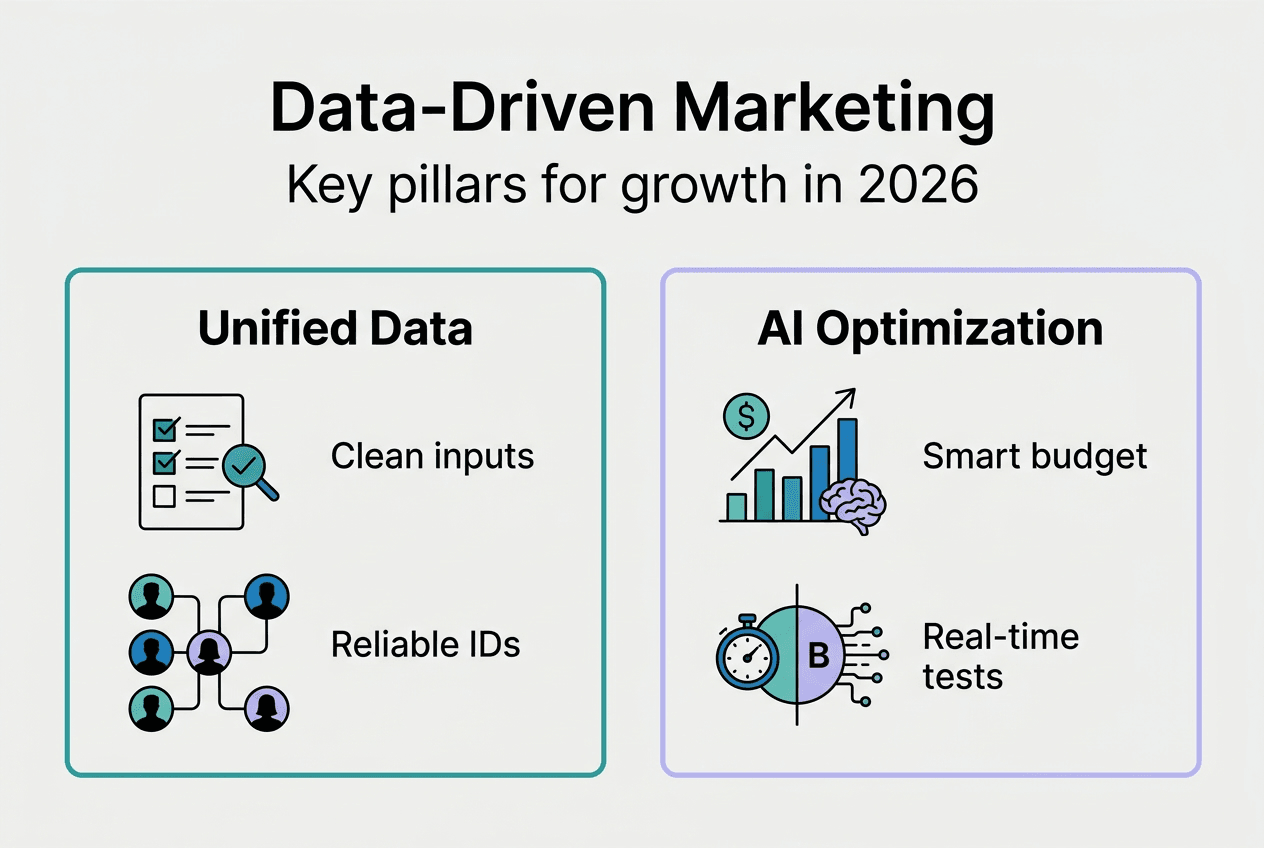
Marketing data exists everywhere: web analytics, CRM systems, ad platforms, social channels, point of sale terminals. Yet B2B teams juggle roughly 12 customer data sources and B2C teams manage about 9, long before analysis begins. This fragmentation creates a paradox where marketers drown in data but starve for insights. Data-driven marketing transforms this chaos into measurable growth by unifying fragmented sources, optimizing budget allocation through accurate attribution, and leveraging AI for real-time campaign improvements. This guide explains why embracing data-driven approaches is essential for marketing performance in 2026 and how to implement strategies that deliver results.
Table of Contents
- Understanding The Complexity Of Marketing Data Sources And Its Impact
- How Data-Driven Marketing Improves Attribution And Budget Allocation
- Leveraging AI And Automation To Optimize Marketing Campaigns And Reduce Costs
- Common Pitfalls In Data-Driven Marketing And How To Avoid Them
- Implementing A Practical Data-Driven Marketing Strategy For Measurable Growth
- How AdVenture Media Empowers Your Data-Driven Marketing Success
- What Is Data-Driven Marketing And Why Is It Essential?
Key takeaways
| Point | Details |
|---|---|
| Data fragmentation challenges marketers | Only 31% of marketers are satisfied with current data unification efforts, creating blind spots. |
| Attribution models improve efficiency | Data-driven attribution delivers 10-15% better marketing efficiency compared to simplistic models. |
| AI reduces costs and boosts productivity | Marketing automation powered by AI can cut costs by 20% while increasing sales productivity. |
| Data quality trumps quantity | 30% of CMOs identify improving data quality as the biggest lever for marketing performance. |
| Adaptation enables competitive advantage | Data-driven marketing allows rapid response to emerging technologies and shifting market trends. |
Understanding the complexity of marketing data sources and its impact
Marketing data lives in scattered silos across your organization. Web analytics platforms track visitor behavior. CRM systems store customer interactions and purchase history. Ad platforms like Google Ads and Meta collect campaign performance metrics. Point of sale systems capture transaction data. Customer support tools log service interactions. Email marketing platforms monitor engagement rates.
This fragmentation creates serious operational challenges. Each platform uses different customer identifiers, making it nearly impossible to track the same person across touchpoints. Data schemas vary wildly between systems, requiring constant translation and normalization. Timestamps don’t always sync properly. Privacy regulations add complexity to data collection and storage. The result is a fractured view of customer behavior that leads to poor decisions.
These silos produce tangible business consequences. You waste media spend targeting customers who already converted on another channel. Personalization efforts fail because you can’t see the complete customer journey. Attribution becomes guesswork when touchpoints exist in separate systems. Compliance risks increase when customer data sprawls across disconnected platforms. Marketing teams spend more time wrangling data than analyzing it.
Research confirms this struggle is widespread. Only 31% of marketers express satisfaction with their current data unification efforts, revealing a massive gap between data availability and actionable insight. Most organizations recognize the problem but lack the infrastructure or expertise to solve it effectively.
Building a unified marketing data platform creates the foundation for everything else. Invest in tools that consolidate data sources, resolve customer identities across platforms, and standardize schemas. This infrastructure work feels tedious but pays dividends by enabling accurate analysis and effective activation. Start with your highest-value data sources rather than attempting to unify everything simultaneously.
Pro Tip: Prioritize building a unified marketing data platform to create a reliable foundation for analytics and activation.
How data-driven marketing improves attribution and budget allocation
Attribution models determine which marketing touchpoints receive credit for conversions. Traditional approaches oversimplify the customer journey, leading to misallocated budgets and missed opportunities. Understanding the differences between models helps you choose the right approach for your business.
| Attribution Model | How It Works | Best For | Limitations |
|---|---|---|---|
| First-Click | Credits the first touchpoint | Brand awareness campaigns | Ignores nurturing and closing touchpoints |
| Last-Click | Credits the final touchpoint before conversion | Direct response campaigns | Overlooks awareness and consideration stages |
| Data-Driven | Uses machine learning to assign credit based on actual impact | Complex, multi-touch journeys | Requires significant data volume and technical expertise |
Data-driven attribution analyzes thousands of customer journeys to identify which touchpoints genuinely influence conversions. Machine learning algorithms evaluate patterns across devices, channels, and time periods. This holistic view accounts for the reality that customers interact with your brand multiple times before purchasing.
The business impact is substantial. Companies implementing data-driven attribution models see a 10-15% improvement in marketing efficiency by reallocating budget from overvalued touchpoints to underappreciated ones. You discover that mid-funnel content drives more conversions than credited by last-click models. Display ads that seemed ineffective actually play crucial awareness roles. Email nurture sequences deserve more investment than first-click attribution suggests.

This accuracy enables smarter budget decisions. You shift spending from channels that look good in simplistic models to channels that actually drive results. Campaign optimization becomes data-informed rather than assumption-based. ROI calculations reflect true performance rather than arbitrary credit assignment. Customer journey insights reveal opportunities to improve messaging and timing at specific touchpoints.
Implementing data-driven attribution requires investment in both technology and expertise. Choose platforms that integrate with your existing marketing stack and provide transparent methodology. Train your team to interpret attribution data correctly and avoid over-indexing on any single metric. Test attribution models against holdout groups to validate their predictive accuracy.
Pro Tip: Avoid simplistic models; invest in tools and expertise to implement data-driven attribution effectively.
Leveraging AI and automation to optimize marketing campaigns and reduce costs
Artificial intelligence transforms marketing operations by handling repetitive tasks and identifying optimization opportunities humans would miss. Machine learning algorithms analyze campaign performance data in real time, adjusting bids, budgets, and targeting parameters continuously. This automation frees marketers to focus on strategy and creative development while AI handles tactical execution.
The operational benefits compound quickly. AI-powered tools test thousands of audience segments simultaneously, identifying high-value microsegments. Dynamic creative optimization serves personalized ad variations based on user behavior and context. Predictive analytics forecast campaign performance and recommend budget adjustments before problems occur. Chatbots handle routine customer inquiries, improving response times while reducing support costs.
Real-time optimization delivers measurable improvements. Campaigns adapt to performance signals within minutes rather than days. Budget automatically flows toward high-performing channels and away from underperformers. Customer targeting becomes more precise as algorithms learn from conversion patterns. Cross-channel coordination improves as AI identifies complementary touchpoint sequences.
The financial impact justifies the investment. AI-powered marketing automation can reduce marketing costs by up to 20% while increasing sales productivity. Cost savings come from eliminating manual tasks, reducing wasted ad spend, and improving conversion rates. Sales productivity increases because marketing delivers higher-quality leads and better nurture sequences.
Success requires clean, unified data as a foundation. AI algorithms are only as good as the data they analyze. Garbage in means garbage out, regardless of how sophisticated your models are. Invest in data quality and integration before deploying AI tools. Start with focused use cases like bid optimization or email send-time prediction. Measure results rigorously and scale successful implementations gradually.
Pro Tip: Start small, test AI-powered tools, and scale as you observe measurable improvements.
Common pitfalls in data-driven marketing and how to avoid them
Data-driven marketing promises significant advantages but contains hidden traps that derail initiatives. Understanding common mistakes helps you avoid costly missteps and build sustainable strategies.
Imbalanced datasets represent a particularly insidious problem. When your training data contains far more negative examples than positive ones, machine learning models achieve misleadingly high accuracy but poor targeting. A model that predicts no one will convert can be 99% accurate if only 1% of visitors actually convert, yet it provides zero business value. This false accuracy causes failed marketing models that look good in testing but perform terribly in production.
Several other pitfalls plague data-driven marketing efforts:
- Ignoring data quality in favor of data quantity creates unreliable insights and poor decisions
- Over-reliance on historical data blinds you to market shifts and emerging opportunities
- Perfectionism paralysis prevents launching initiatives because conditions never feel ideal
- Neglecting strategic alignment means optimizing metrics that don’t drive business outcomes
- Underestimating integration complexity leads to abandoned projects and wasted investment
Avoiding these traps requires disciplined execution and realistic expectations. Follow this framework:
- Set clear business objectives before collecting data, ensuring metrics align with actual goals rather than vanity numbers
- Validate data quality rigorously through audits, testing, and cross-referencing against known benchmarks
- Test models on holdout samples and real-world scenarios before full deployment to catch issues early
- Iterate continuously based on performance feedback, treating initial implementations as learning opportunities rather than final solutions
Experts emphasize that trying to do everything at once stalls data strategy and early projects won’t deliver flawless insight initially. Perfectionism ensures no results because you never launch. Accept that first attempts will be imperfect and plan for iteration.
The idea of having everything perfect the first time ensures no results. Data-driven marketing requires experimentation, learning, and continuous refinement.
Balance data insights with human judgment and market knowledge. Data reveals patterns but doesn’t explain causation or predict black swan events. Combine quantitative analysis with qualitative research and industry expertise. Question counterintuitive findings rather than accepting them blindly. Use data to inform decisions, not make them automatically.
Implementing a practical data-driven marketing strategy for measurable growth
Successful implementation requires prioritizing foundational elements before pursuing advanced tactics. Research shows 30% of CMOs say improving data quality is the biggest lever to improve marketing performance. Start there rather than jumping to sophisticated analytics or AI tools.
Follow these best practices for sustainable data-driven marketing:
- Define clear business objectives that connect marketing metrics to revenue outcomes and strategic priorities
- Unify data sources through integration platforms that resolve customer identities and standardize schemas
- Leverage AI and automation for repetitive optimization tasks while humans focus on strategy and creativity
- Integrate channels to create cohesive customer experiences rather than optimizing platforms in isolation
- Measure holistically using attribution models that reflect true customer journey complexity
Data-driven marketing enables adaptation to evolving market conditions and emerging technologies. Nielsen’s 2025 annual marketing report highlights how data-driven approaches help marketers respond to trends like OTT/CTV growth and retail media expansion.
| Emerging Trend | Market Impact | Data-Driven Response |
|---|---|---|
| OTT/CTV ad spend increase | Streaming platforms capture growing audience attention | Target cord-cutters with precise demographic and behavioral data |
| Retail media network growth | Retailers monetize first-party purchase data | Leverage high-intent shopping signals for product campaigns |
| Regional revenue vs brand focus | Markets prioritize different objectives based on maturity | Customize measurement frameworks and KPIs by geography |
| Privacy regulation expansion | Stricter data collection and usage requirements | Build first-party data strategies and consent management |
Ongoing testing and agile adaptation separate successful programs from stagnant ones. Market conditions shift constantly. Customer preferences evolve. Competitors launch new tactics. Regulations change. Your data-driven marketing strategy must adapt continuously rather than following a static playbook.
Partner with experts who have implemented successful data-driven programs across industries and platforms. Agencies bring specialized expertise in data integration, attribution modeling, and AI optimization that takes years to develop internally. Creative services that understand data-driven principles produce campaigns optimized for measurable performance rather than just aesthetic appeal.
Pro Tip: Start with focused projects to gain directional insights, then scale and refine strategy.
How AdVenture Media empowers your data-driven marketing success
AdVenture Media applies data analytics and AI automation to drive measurable ROI for clients across industries. Our approach combines technical expertise in data integration and attribution modeling with strategic insight into customer behavior and market dynamics.
The Alludo Software case study demonstrates tangible results: 35% monthly SEM cost savings through custom strategies that optimized budget allocation and improved targeting precision. This outcome came from rigorous data analysis, strategic testing, and continuous optimization based on performance signals.
Our services accelerate your data-driven marketing maturity:
- Data integration consulting to unify fragmented sources and build reliable analytics foundations
- Attribution modeling implementation that reveals true customer journey dynamics and budget opportunities
- AI campaign optimization leveraging machine learning for real-time performance improvements
Reach out early to leverage expert consulting that accelerates your data-driven marketing maturity. Contact AdVenture Media to discuss how we can help you implement strategies that deliver measurable growth in 2026.
Pro Tip: Reach out early to leverage expert consulting that accelerates your data-driven marketing maturity.
What is data-driven marketing and why is it essential?
Data-driven marketing means making marketing decisions based on data insights rather than intuition alone. You analyze customer behavior, campaign performance, and market trends to inform strategy, budget allocation, and creative development. This approach replaces guesswork with evidence, leading to more effective campaigns and better resource utilization. In complex digital environments with fragmented customer journeys, data-driven marketing is essential for improving targeting accuracy, personalization relevance, and return on investment.
How do I overcome data fragmentation in large marketing organizations?
Centralize marketing data with a unified platform that resolves customer identities across systems and standardizes data schemas. Prioritize integration of your highest-value data sources first rather than attempting to connect everything simultaneously. Choose tools compatible with your existing technology architecture to reduce implementation complexity. Focus on data quality over quantity initially, ensuring foundational sources are accurate and reliable before expanding integration scope.
What are the best attribution models to use in 2026?
Data-driven attribution models are preferred for accuracy because they track multiple touchpoints across the customer journey rather than oversimplifying credit assignment. These models improve budget allocation and marketing efficiency by up to 15% compared to first-click or last-click approaches. Implementation requires investment in tools that integrate with your marketing stack and expertise to interpret results correctly. Test attribution models against holdout groups to validate their predictive accuracy before making major budget shifts.
How can AI benefit my marketing campaigns?
AI automates repetitive optimization tasks like bid adjustments, budget allocation, and audience targeting while enabling real-time campaign improvements based on performance signals. It can reduce marketing costs by up to 20% and increase sales productivity by delivering higher-quality leads and better nurture sequences. Clean, unified data is essential for successful AI-driven marketing because algorithms require accurate information to identify patterns and make effective recommendations. Start with focused AI use cases and scale successful implementations gradually.
Recommended


.png)
Campaign Consolidation and Smart Bidding Helps Local Business Expand Into New Territories
.avif)

PictureFrames.com Sees Profitable Ecommerce Sales Growth Year Over Year

.png)
Optimizing for Purchases and App Installs Leads to 69% Decrease in CPA for Woodspoon
Request A Marketing Proposal
We'll get back to you within a day to schedule a quick strategy call. We can also communicate over email if that's easier for you.
Visit Us
New York
1074 Broadway
Woodmere, NY
Philadelphia
1429 Walnut Street
Philadelphia, PA
Florida
433 Plaza Real
Boca Raton, FL
General Inquiries
info@adventureppc.com
(516) 218-3722
AdVenture Education
Over 300,000 marketers from around the world have leveled up their skillset with AdVenture premium and free resources. Whether you're a CMO or a new student of digital marketing, there's something here for you.
OUR BOOK
We wrote the #1 bestselling book on performance advertising
Named one of the most important advertising books of all time.
buy on amazon
OUR EVENT
DOLAH '24.
Stream Now.
Over ten hours of lectures and workshops from our DOLAH Conference, themed: "Marketing Solutions for the AI Revolution"
check out dolah
The AdVenture Academy
Resources, guides, and courses for digital marketers, CMOs, and students. Brought to you by the agency chosen by Google to train Google's top Premier Partner Agencies.
Bundles & All Access Pass
Over 100 hours of video training and 60+ downloadable resources
 view bundles →
.png)


