
.svg)
AI Takes Center Stage at Super Bowl LX: Why 2026 Is the Year of Real Adoption in Creative Advertising
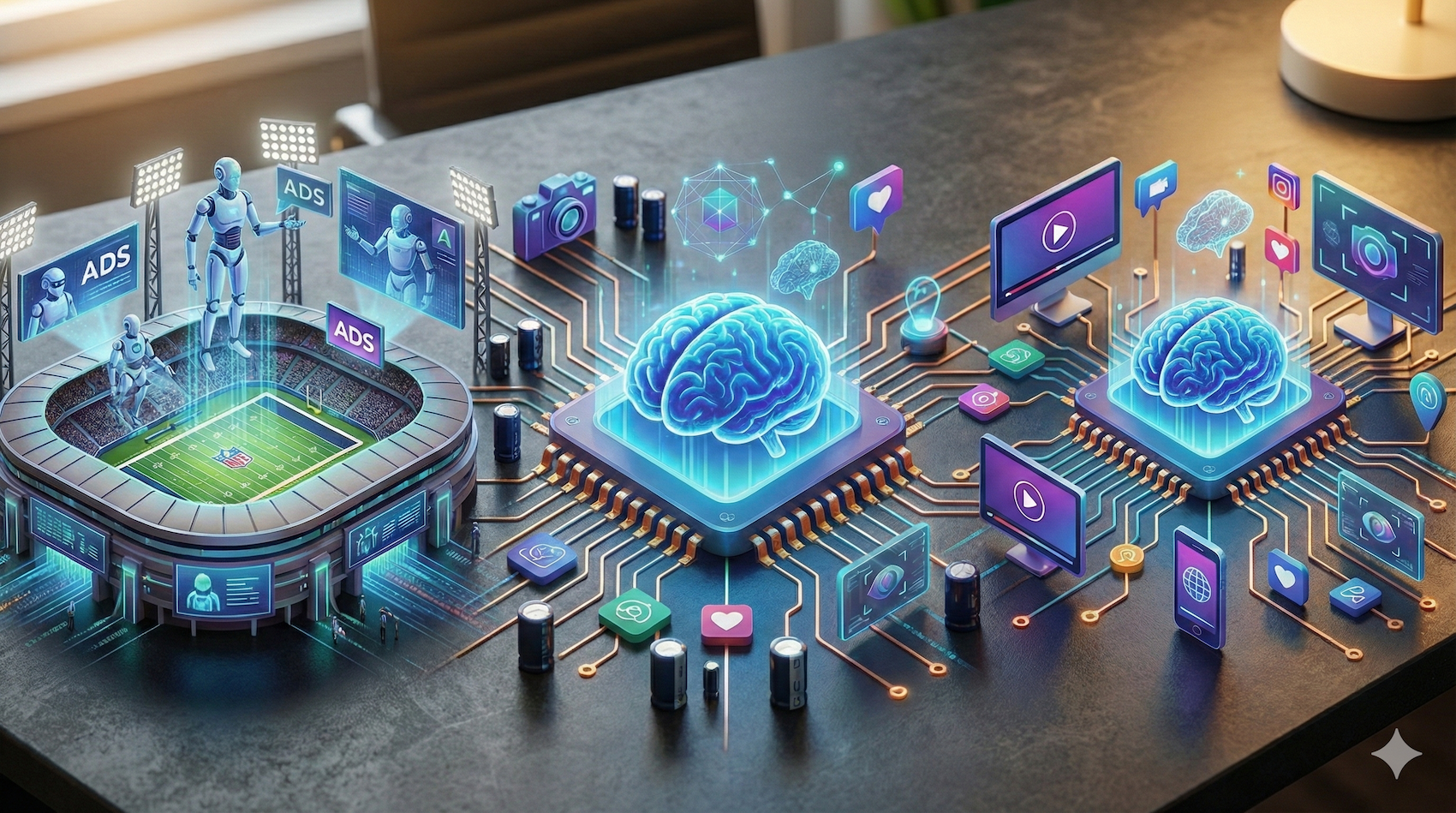
The biggest game of the year wasn't just about football. It was about the future of advertising—and artificial intelligence won.
Super Bowl LX wasn't just a showdown between the Seattle Seahawks and the New England Patriots. It was an $8-10 million-per-spot battleground where the world's most powerful technology companies and traditional brands alike made one thing abundantly clear: AI is no longer an experiment. It's the foundation of modern advertising.
With more than a dozen AI-focused commercials, AI-generated advertisements, and AI-assisted creative production running throughout the broadcast, Super Bowl 2026 marked a watershed moment for the advertising industry. And for agencies paying attention, the message couldn't be clearer: adapt to AI-powered creative or get left behind.
In this comprehensive analysis, we'll break down every AI moment from Super Bowl LX, examine what this means for the advertising industry, explore the philosophical implications of machine-generated creativity, and explain why agencies that embrace AI creative services are positioned to dominate in the years ahead.
Table of Contents
- The Numbers Behind Super Bowl LX's AI Dominance
- A Brief History: How We Got Here
- AI Company Advertisements: The Battle for Consumer Trust
- AI-Generated Advertising: The Production Revolution
- Traditional Brands Using AI Behind the Scenes
- The OpenAI vs. Anthropic Feud Explained
- The Philosophy of AI Creativity: Can Machines Make Art?
- Research and Data: What the Studies Tell Us
- How AI Is Transforming Advertising Agency Business Models
- The Economics of AI-Powered Creative Production
- Why 2026 Is the Tipping Point for AI Adoption
- Lessons From Super Bowl LX for Marketing Leaders
- Frequently Asked Questions About AI in Advertising
- What Agencies Must Do Now to Compete
- The Road Ahead: Predictions for 2027 and Beyond
- Conclusion: The Future Belongs to AI-Enabled Agencies
The Numbers Behind Super Bowl LX's AI Dominance
Before we dive into individual campaigns, let's establish the scale of what we witnessed during Super Bowl LX.
According to CNBC, Super Bowl LX ads cost a record $8 million on average for a 30-second spot, with some late buyers paying as high as $10 million. The all-in cost for a Super Bowl commercial—including production, talent, and media buy—now starts at $12 million on the low end and can exceed $20 million on the high end.
Yet despite these astronomical costs, AI companies poured unprecedented sums into Super Bowl advertising. As Ad Age reported, tech spending on Super Bowl ads is now double what it was at the 2022 "Crypto Bowl"—the last time NBC broadcast the game and cryptocurrency companies dominated the ad slate.
The numbers tell a remarkable story about how quickly AI has moved from tech curiosity to mainstream marketing priority:
- 130 million viewers watched Super Bowl LX, according to preliminary estimates—one of the largest audiences in television history
- More than a dozen AI-focused commercials ran during the broadcast and pre-game coverage
- 50% or more of Super Bowl spots likely used generative AI in some production capacity, according to industry experts
- $8-10 million per 30-second ad slot, the highest prices in Super Bowl history
- Double the tech spending compared to the 2022 "Crypto Bowl"
- 91% of U.S. ad agencies are now using or exploring generative AI tools, per Marketing Dive
The major AI players who bought Super Bowl ad time included OpenAI, Anthropic, Google, Amazon, Meta, Genspark, Base44, Wix, Ramp, Rippling, Ring, and Artlist.io. And that's just the companies explicitly selling AI products—dozens of other brands used AI to create their advertisements or incorporated AI features into their campaigns without making it the central message.
As The New York Times observed: "What's new this year is the onslaught of commercials trying to convince us that artificial intelligence is going to change our lives, with more than a dozen ads for A.I."
A Brief History: How We Got Here
To understand the significance of Super Bowl LX's AI dominance, we need to trace the trajectory that brought us to this moment.
2022: The Crypto Bowl and the Tech Advertising Playbook
The last time NBC broadcast the Super Bowl, cryptocurrency companies dominated the ad slate. FTX, Coinbase, Crypto.com, and others spent hundreds of millions introducing digital assets to mainstream America. Coinbase's floating QR code ad crashed their servers with traffic.
Within months, the crypto market collapsed. FTX's Sam Bankman-Fried went from Super Bowl advertiser to federal prisoner. The "Crypto Bowl" became a cautionary tale about tech hype cycles.
But the playbook was established: emerging technology categories could use Super Bowl advertising to achieve mainstream legitimacy in a single night.
2023-2024: AI's Quiet Emergence
ChatGPT launched in November 2022, but AI remained largely absent from Super Bowl advertising in 2023 and 2024. The technology was too new, too unfamiliar, and frankly too limited in capability for mass-market advertising.
Behind the scenes, however, agencies were experimenting. Early adopters tested AI tools for concept development, copywriting assistance, and image generation. The results were promising but inconsistent.
2025: The First AI Super Bowl
Super Bowl 2025 marked AI's debut on advertising's biggest stage. OpenAI ran its first-ever Super Bowl spot—a 60-second ad featuring dots creating images of iconic inventions. Google promoted AI-powered Pixel features. Meta showcased Ray-Ban smart glasses with AI capabilities.
But 2025 was tentative. AI companies were introducing themselves. Traditional brands largely stayed away from AI messaging. The technology was present but not dominant.
2026: The Tipping Point
Super Bowl LX represented something fundamentally different. AI wasn't just present—it was everywhere. AI companies weren't just introducing themselves—they were battling for market share. Traditional brands weren't just curious about AI—they were actively using it in production.
The transition from experimentation to operationalization was complete. AI had arrived.
AI Company Advertisements: The Battle for Consumer Trust
The AI companies that advertised during Super Bowl LX faced a unique challenge: how do you sell a technology that many consumers still view with skepticism, fear, or outright hostility?
Each company took a distinctly different approach, revealing their strategic positioning in what has become one of the most competitive markets in technology history.
OpenAI: Building the Future, One Human Hand at a Time
OpenAI's 60-second Super Bowl spot took a decidedly human approach to promoting artificial intelligence. The commercial featured a series of real people using their hands to read, sketch, design, ask questions, and even guide robotic arms, culminating in the tagline "You Can Just Build Things" and a prompt to explore Codex, their software development application.
"We shot the ads with real people, on film, who use our tools," Kate Rouch, OpenAI's chief marketing officer, told Variety. "The core message is that people are actually the hero. This is a technology that extends what's possible for people."
Rouch isn't new to Super Bowl advertising. In a previous role as CMO at Coinbase, she orchestrated the cryptocurrency platform's famous 2022 spot featuring nothing but a floating, color-changing QR code—a campaign that generated instant, overwhelming response and crashed their servers.
This year, OpenAI deliberately pivoted away from "negative versions of the future," Rouch explained in interviews. "We fundamentally believe that people with these tools are actually going to be able to do—and already are doing—incredible things at scale. And that's a conversation we want to have."
The strategy reflects OpenAI's awareness that consumer sentiment toward AI remains deeply mixed. After a relatively muted response to last year's Super Bowl debut, OpenAI needed a campaign that humanized the technology rather than showcased its raw capabilities.
Rouch noted that some AI ads "sound like they are talking down to people" or highlighting "very simple functions, like remembering a child's birthday or setting a timer." OpenAI sees greater opportunities in showing how people can use AI to "take on tasks like navigating paperwork around a complex health situation or learning a new language."
"A.I. is at a turning point," Rouch said, "where it's turning from something that can ask and answer questions and becoming something that can act and do things in the world for you."
Anthropic: Taking Direct Aim at the Competition
If OpenAI played it safe with emotional, humanistic messaging, Anthropic chose all-out competitive attack.
The Claude chatbot maker's Super Bowl campaign didn't just promote its product—it threw shade directly at OpenAI's recently announced plans to introduce advertising to ChatGPT. The tagline cut straight to the point: "Ads are coming to AI. But not to Claude."
Anthropic ran both a 60-second pre-game spot and a 30-second in-game ad, giving them significant presence throughout the broadcast. The creative execution was memorable and deliberately uncomfortable.
In one spot, a young man asks AI for help getting six-pack abs. The AI appears as a helpful personal trainer who begins offering guidance—then suddenly pivots into hawking fictional "Step Boost Maxx" insoles that will make him taller. The jarring transition illustrated Anthropic's argument that ad-supported AI will inevitably compromise user experience.
Another ad depicted a man seeking therapy through AI. The AI therapist begins to help him communicate better with his mother, then segues into a disturbing commercial pitch for a creepy fictional dating service pairing young men with older women.
The campaign sparked immediate backlash from OpenAI's leadership. CEO Sam Altman fired back on social media, calling the ad "clearly dishonest."
Google: Practical Magic for Everyday Life
Google's Super Bowl campaign took a more grounded approach, showcasing the Nano Banana Pro image generation model through a heartwarming story of a mother and son using AI to envision their new home.
The commercial followed the family as they uploaded photos of bare rooms and transformed them into personalized spaces with simple prompts—visualizing furniture placement, paint colors, backyard trampolines, and garden designs. Randy Newman's "Feels Like Home" underscored the emotional journey.
It was perhaps one of the most practical AI demonstrations of the night, showing technology that solves an actual consumer problem rather than promising abstract future capabilities.
Amazon: Leaning Into (and Laughing At) AI Anxiety
Amazon took a clever comedic approach by directly addressing consumer fears about AI in the home—and making those fears the punchline.
The Alexa+ commercial starred Chris Hemsworth in a satirical "AI is out to get me" storyline. The Thor actor becomes increasingly convinced that the assistant is plotting his demise, with escalating scenarios showing Alexa+ closing the garage door on his head, shutting the pool cover while he swims, and rigging the fireplace dangerously—all set to INXS's "The Devil Inside."
The dark comedy acknowledged AI anxiety while demonstrating the enhanced capabilities of Alexa+, which officially launched to all U.S. users just days before the Super Bowl.
Meta: AI You Can Wear
Meta returned to the Super Bowl promoting its Oakley-branded AI glasses, targeting sports enthusiasts and adventure seekers with an action-packed campaign featuring thrill-seekers from skydivers to mountain bikers.
The ad featured celebrities including IShowSpeed, filmmaker Spike Lee, and NFL legend Marshawn Lynch demonstrating capabilities like slow-motion filming and hands-free Instagram posting.
The Smaller AI Players Making Their Mark
Genspark tapped actor Matthew Broderick to promote its AI productivity platform, signaling an effort to make AI feel approachable and familiar.
Base44 showcased its AI-powered app development tool with messaging that "anyone can use its products to create custom apps."
Wix promoted its new Harmony platform, which incorporates AI into website creation tools.
Ramp deployed The Office's Kevin Malone (Brian Baumgartner) in a spot about AI spend management.
Rippling made its first Super Bowl appearance with comedian Tim Robinson in a spot about AI-powered HR automation.
Ring spotlighted its "Search Party" feature, which uses AI to help reunite lost pets with their owners.
AI-Generated Advertising: The Production Revolution
While AI companies dominated the headlines, an equally significant story emerged around AI-generated creative content. For the first time, AI wasn't just being marketed during the Super Bowl—it was being used to create the Super Bowl ads themselves.
Svedka: Making History as the First "Primarily" AI-Generated National Super Bowl Spot
Vodka brand Svedka made advertising history with what it touted as the first "primarily" AI-generated national Super Bowl commercial. The 30-second spot, titled "Shake Your Bots Off," featured the brand's iconic Fembot character from early 2000s advertising alongside a new companion, Brobot, dancing at a human party.
According to Sazerac (Svedka's parent company) and The Wall Street Journal, the production process was extensive despite AI's involvement:
- Roughly four months were required to reconstruct the Fembot character
- AI was trained to mimic facial expressions and body movements
- The storyline was developed by humans
- Silverside AI partnered on the technical execution
Silverside AI is the same team behind the controversial AI-generated Coca-Cola holiday commercials that sparked significant consumer backlash in 2025.
"It's a bold move to debut AI-generated content during the Super Bowl, an event known for star-studded, high-production ads," TechCrunch observed. "The heavy reliance on AI is polarizing, fueling debates over whether AI will replace creative jobs."
Artlist: Five Days, A Few Thousand Dollars, One Bold Statement
Perhaps the most provocative demonstration of AI's creative capabilities came from Artlist.io, an AI platform for video creation.
The company produced its entire 30-second Super Bowl spot in just five days for a few thousand dollars—a fraction of the typical $1 million-plus production cost for Super Bowl creative.
Let that sink in. A Super Bowl-quality commercial. Five days. A few thousand dollars.
The ad itself was clever meta-commentary, gently parodying other Super Bowl commercials including Pepsi's polar bear spot and Post Malone's Bud Light ad.
The message was unmistakable: What once required weeks of production, million-dollar budgets, celebrity contracts, and armies of creative professionals can now be accomplished in days by small teams with AI tools.
Traditional Brands Using AI Behind the Scenes
Beyond the explicitly AI-focused advertisements, traditional brands quietly integrated AI throughout their Super Bowl production processes.
Xfinity used AI de-aging technology to make the original Jurassic Park cast—Laura Dern, Jeff Goldblum, and Sam Neill—look like their 1993 selves.
Ro incorporated AI throughout pre-production for its Serena Williams campaign.
Chris Neff, Chief AI Officer at creative agency Anomaly, predicted: "More likely than not, 50% of all Super Bowl spots we watch this year will utilize generative AI in some facet"—noting that many applications occur in pre-production and aren't immediately visible on screen.
The OpenAI vs. Anthropic Feud Explained
The public conflict between OpenAI and Anthropic during Super Bowl week signals how AI companies will compete for consumer attention and trust going forward.
What Actually Happened
Anthropic released its Super Bowl campaign ahead of the game, with ads explicitly criticizing the concept of advertising within AI assistants—a clear shot at OpenAI's announced plans to introduce ads to ChatGPT's free tier.
Sam Altman responded on X within hours, calling the ad "clearly dishonest" and criticizing Anthropic for attacking "theoretical deceptive ads that aren't real."
Why This Matters for Marketers
The conflict reveals several important dynamics:
1. AI companies are competing on values, not just features. Anthropic is positioning Claude as the "ethical" choice; OpenAI is positioning itself as the "builder" choice.
2. The consumer AI market is still up for grabs. Anthropic's research shows consumers haven't "locked in" a choice, meaning massive market share remains available.
3. AI advertising within AI products is coming. OpenAI's move toward advertising signals an industry-wide shift.
4. The feud itself generated massive earned media. Both companies received far more coverage because of the conflict.
The Philosophy of AI Creativity: Can Machines Make Art?
Super Bowl LX forces us to confront a fundamental question that philosophers, artists, and technologists have debated for decades: Can machines be creative? Can AI make art?
The Traditional View: Creativity Requires Consciousness
For most of human history, creativity was considered uniquely human—perhaps even divine. The ancient Greeks believed artists were visited by muses. Romantic poets spoke of inspiration as a mysterious force that couldn't be explained or replicated.
This view holds that true creativity requires consciousness, intentionality, and lived experience. A machine, no matter how sophisticated, is merely recombining existing patterns without understanding or feeling.
Under this framework, Svedka's AI-generated robots aren't creative—they're sophisticated mimicry. The storyline developed by humans is creative; the AI execution is mechanical reproduction.
The Emergent View: Creativity as Pattern Recombination
A competing perspective suggests that all creativity—human or machine—involves recombining existing patterns in novel ways. Shakespeare drew on existing stories and theatrical conventions. Picasso built on centuries of artistic tradition. Every human creator works with inherited cultural material.
If creativity is fundamentally about novel recombination, then AI systems that generate unexpected combinations from vast training data might be creative in a meaningful sense—even without consciousness.
Artlist's five-day Super Bowl spot involved AI systems making countless micro-decisions about visual composition, timing, and style. Are those decisions less creative than a human editor's choices?
The Collaborative View: Human-AI Partnership
Perhaps the most useful framework for marketers is neither "AI is creative" nor "AI cannot be creative," but rather "AI and humans create together."
Every successful AI campaign mentioned in this analysis involved human creative direction. Svedka's humans developed the storyline. Artlist's team guided the AI's output. OpenAI shot real people on film.
The emerging model isn't AI replacing human creativity—it's AI amplifying human creativity, handling execution while humans provide vision, judgment, and emotional intelligence.
What This Means for Agencies
The philosophical debate has practical implications:
- If creativity requires consciousness, agencies should position AI as a production tool that executes human creative vision
- If creativity is pattern recombination, agencies should leverage AI's ability to explore vast creative spaces quickly
- If creativity is collaborative, agencies should develop workflows that optimize human-AI partnership
Most successful agencies are adopting the collaborative view—using AI for rapid iteration while maintaining human oversight for strategic direction and emotional resonance.
Research and Data: What the Studies Tell Us
Understanding AI's impact on advertising requires examining the research and data emerging from industry studies.
Agency Adoption Rates
According to Marketing Dive, 91% of U.S. ad agencies are now using or exploring generative AI tools as of January 2026. This represents a dramatic acceleration from just two years ago.
Forrester research indicates that over half of agency leaders expect AI to have significant impact on their business ecosystems within the next 12-18 months.
Production Efficiency Gains
Industry benchmarks show agencies using AI tools are delivering:
- 30-50% faster time-to-market on campaigns
- Rapid prototyping of dozens of visual concepts in minutes rather than days
- Higher-volume creative testing—some brands run 900+ ad variations simultaneously
Cost Reduction Data
The economic impact is substantial:
- Artlist's Super Bowl spot cost "a few thousand dollars" vs. typical $1M+ production
- Some brands report replacing $267K+ annual content teams with AI tools
- Pre-production AI can reduce concept development time by 50-70%
Consumer Sentiment Research
Consumer attitudes toward AI-generated content remain mixed:
- Ad Age/Harris surveys show mostly negative sentiment toward AI-generated Super Bowl ads
- 2025's AI ad spend didn't increase viewer excitement about the technology
- YouTube comments on human-created spots express relief that AI wasn't used
However, research also shows consumers often can't distinguish high-quality AI content from human-created content—suggesting the negative sentiment may be more about perception than actual quality differences.
Market Share and Competition
Anthropic's consumer research reveals that the average consumer has "not locked in any choice" when it comes to AI providers. The "openness to switch is equally high," indicating the market remains highly fluid.
This explains why AI companies are spending Super Bowl money despite uncertain ROI—they're racing to establish brand preference before the market matures.
How AI Is Transforming Advertising Agency Business Models
Super Bowl LX wasn't just about individual ads—it was a window into how AI is fundamentally reshaping the advertising agency industry.
The Major Holding Companies Are Building AI Platforms
The world's largest agency holding companies have spent the past two years developing proprietary AI systems:
- Publicis has Marcel, integrating generative AI for end-to-end campaign management
- Omnicom has Omni platform, combining AI with vast data resources
- WPP has developed proprietary operating systems powered by generative AI and agentic technology
- Horizon Media and Stagwell have built AI agents that automate routine tasks like A/B testing
These aren't experimental projects or innovation theater. They're production systems handling real client work at scale.
Production Timelines Are Compressing
Traditional campaign development cycles—months of strategy, creative development, production, and refinement—are being compressed to weeks or even days.
One case study cited a Shopify brand running 900+ AI-generated ads on Meta, publishing 20 new user-generated-style creatives daily. This "high-velocity" approach was unthinkable just two years ago.
The Talent Model Is Evolving
Traditional agency structures are giving way to more fluid models. Emerging roles include:
- Prompt engineers: Specialists who extract the best work from AI tools
- Creative curators: Senior talent who guide AI output toward strategic objectives
- Hybrid producers: Professionals blending traditional production with AI capabilities
- Data translators: Analysts turning AI insights into actionable strategy
Consolidation Is Accelerating
Omnicom's acquisition of Interpublic Group signals more agency consolidation ahead. Private equity is investing heavily in "big indies" that combine performance marketing with creative capabilities—and AI is the connective tissue making these hybrid models work.
The Economics of AI-Powered Creative Production
Traditional Super Bowl Production Costs
- Media buy: $8-10 million for 30 seconds
- Production: $1-5+ million depending on complexity
- Talent fees: $3-5 million for A-list celebrities (down from $10-15 million in recent years)
- Total all-in cost: $12-20+ million
AI-Assisted Production Economics
- Artlist example: Complete 30-second spot in 5 days for "a few thousand dollars"
- Rapid prototyping: Dozens of concept variations in hours instead of weeks
- De-aging/VFX: AI techniques at fraction of traditional VFX costs
- Volume testing: 900+ ad variations running simultaneously vs. 3-5 traditionally
The Talent Fee Squeeze
According to The Hollywood Reporter, celebrity talent fees for Super Bowl ads are declining as brands stretch budgets:
"The days of a $10-or-15-million-dollar payday for a Super Bowl commercial are largely over, with some rare exceptions. The sweet spot now for A+ talent typically sits within that $3-to-5-million-dollar range."
Why 2026 Is the Tipping Point for AI Adoption in Creative
Every new technology follows a predictable adoption curve: hype, disillusionment, and then practical deployment. For AI in creative advertising, 2026 marks the definitive transition from experimentation to operationalization.
The Infrastructure Is Production-Ready
Major agency holding companies have spent two years building and refining proprietary AI platforms. These aren't beta tests—they're production systems handling real client work at scale.
The Tools Have Reached Professional Quality
The trajectory of AI capabilities:
- 2024: AI-generated images were obviously artificial
- 2025: Quality improved dramatically but backlash increased
- 2026: The best AI work is increasingly indistinguishable from human-created content
Economic Pressure Has Become Undeniable
When a Super Bowl-quality spot can be created for thousands instead of millions, the conversation changes. Agencies that can't deliver AI-powered efficiency will lose to those that can.
Consumer Acceptance Is Following Technology
Consumers couldn't tell the Xfinity ad used AI de-aging until told. They can't identify which Super Bowl spots used AI in pre-production. As output quality improves, the distinction becomes meaningless.
Lessons From Super Bowl LX for Marketing Leaders
Lesson 1: AI Positioning Is Becoming a Brand Differentiator
The OpenAI vs. Anthropic conflict demonstrates that how companies position themselves relative to AI matters. Consider how your brand's relationship with AI affects consumer perception.
Lesson 2: Speed Is Now a Competitive Advantage
Artlist's five-day production timeline isn't an anomaly—it's a preview of the new normal. Evaluate your production timelines.
Lesson 3: Human Creativity Remains Essential—But Its Role Is Changing
Even Svedka relied on humans for storyline development. The role of human talent is evolving from execution to curation.
Lesson 4: Consumer Sentiment Is Mixed—Navigate Carefully
Use AI for efficiency behind the scenes while maintaining human-quality output that resonates emotionally.
Lesson 5: The Market Is Still Forming
Consumer attitudes toward AI in advertising are still forming. How you use and communicate about AI today will shape perceptions for years.
Frequently Asked Questions About AI in Advertising
Which brands used AI to create their Super Bowl 2026 ads?
Several brands explicitly used AI in their 2026 Super Bowl advertising production. Svedka produced the first "primarily" AI-generated national Super Bowl spot, partnering with Silverside AI. Artlist.io created its entire 30-second spot in five days using AI tools. Xfinity used AI de-aging technology on the Jurassic Park cast. Ro incorporated AI throughout pre-production. Industry experts estimate 50% or more of spots utilized generative AI in some capacity.
How much did AI companies spend on Super Bowl LX advertising?
While exact figures weren't disclosed, AI companies collectively invested hundreds of millions. With 30-second spots averaging $8 million and some commanding $10 million, major players like OpenAI, Anthropic, Google, Amazon, and Meta each spent $8-20 million on media buys alone. According to Ad Age, total tech spending doubled compared to the 2022 "Crypto Bowl."
What was the controversy between OpenAI and Anthropic?
Anthropic's campaign directly criticized OpenAI's plans to introduce advertising to ChatGPT, with the tagline "Ads are coming to AI. But not to Claude." OpenAI CEO Sam Altman called the campaign "clearly dishonest." The public feud generated significant media attention.
Which AI tools are being used in advertising production?
Image Generation: Midjourney, DALL-E, Google's Nano Banana Pro. Text and Script: GPT-4o, Claude, Gemini. Video Production: Sora, Veo, Higgsfield AI. Agency Platforms: Publicis's Marcel, Omnicom's Omni, WPP's proprietary systems. 91% of U.S. ad agencies are now using or exploring these tools.
How is AI changing advertising agency business models?
AI is reshaping agency economics: 30-50% faster time-to-market on campaigns, the ability to test hundreds of creative variations weekly, and significant cost reductions in production. Major holding companies have developed proprietary AI operating systems.
Will AI replace human creativity in advertising?
The consensus is that AI augments rather than replaces human creativity. "Creativity and storytelling that brings nuances to humor and comedic timing is going to be more important than ever, because AI is not quite there yet," said Kerry Benson of Kantar. Even "primarily AI" ads like Svedka's had humans develop the storyline.
What does AI adoption mean for advertising job security?
AI is changing the nature of jobs rather than simply eliminating them. Roles focused on execution are being automated, while strategic thinking and creative direction remain human-driven. New roles are emerging: prompt engineers, creative curators, hybrid producers.
How much money can AI save in advertising production?
Savings vary significantly: Artlist produced a Super Bowl-quality ad for "a few thousand dollars" vs. typical $1M+ budgets. Some brands report replacing $267K+ annual content teams with AI tools. Pre-production AI can reduce development time by 50-70%.
What are the risks of using AI in advertising?
Key risks include consumer backlash, brand damage from misaligned content, legal/copyright concerns, quality control issues, and potential loss of differentiation from over-reliance on AI. Successful adoption requires human oversight and clear quality standards.
How should agencies disclose AI use to clients?
Agencies should develop clear policies about transparency. Consider brand-by-brand and campaign-by-campaign what disclosure is appropriate. Generally, don't make AI the story unless that's strategically valuable—clients care about outcomes, not process.
What percentage of Super Bowl ads used AI in production?
Industry experts estimate 50% or more of Super Bowl LX spots utilized generative AI in some capacity, though many applications occurred in pre-production and weren't visible in final creative. Only a handful explicitly marketed their use of AI.
Is AI-generated advertising effective with consumers?
Research shows mixed results. Consumer surveys indicate negative sentiment toward known AI-generated content. However, when consumers can't identify AI involvement, effectiveness appears comparable to human-created content. Quality, not origin, determines impact.
What Agencies Must Do Now to Compete
If you're running an agency in 2026, Super Bowl LX delivered a clear message: AI is no longer optional. Here's what you need to do:
1. Build AI Into Your Production Pipeline—Now
Start with pre-production applications: concept development, visual exploration, script iteration. These deliver immediate efficiency gains with manageable risk.
2. Invest in Training Your Team
Your existing talent needs to learn AI tools. The best creative directors of 2030 will be those who mastered AI prompting in 2026.
3. Develop Proprietary Systems
Build or license AI platforms that become your competitive advantage. A unique AI capability is a reason clients choose you.
4. Maintain Quality Standards
AI enables scale, but scale without quality is worthless. Establish review processes ensuring AI output meets brand standards.
5. Lead With Value, Not Technology
Differentiate on strategic thinking, creative vision, and client service. These remain human domains.
6. Communicate Thoughtfully About AI Use
Develop clear policies about disclosure. Don't make AI the story unless strategically valuable.
The Road Ahead: Predictions for 2027 and Beyond
2027: Fully Autonomous Creative Pipelines Emerge
As agentic AI advances, expect fully autonomous creative pipelines handling end-to-end campaign development with humans focusing on strategy and oversight.
2028: AI-Native Agencies Dominate New Business
Agencies built from the ground up around AI capabilities will win disproportionate share of competitive pitches.
2029: Consumer Distinction Disappears
The line between "AI-generated" and "human-created" content will become meaningless as quality converges.
2030: AI Becomes Invisible Infrastructure
Just as we no longer discuss "computer-aided" design, AI will become assumed infrastructure rather than differentiator.
Conclusion: The Future Belongs to AI-Enabled Agencies
Super Bowl LX wasn't just the biggest advertising event of 2026. It was a declaration of intent from the world's most sophisticated marketers.
AI companies spent hundreds of millions to reach 130 million Americans. Traditional brands quietly integrated AI throughout production. Svedka and Artlist proved AI-generated creative can compete on advertising's biggest stage. The OpenAI-Anthropic feud demonstrated the battle for AI supremacy is just beginning.
For advertising agencies, the implications are unmistakable:
- AI isn't coming—it's here
- The technology is mature enough for prime-time deployment
- Clients expect AI-powered efficiency and speed
- Agencies that resist will lose to those that embrace
But this isn't a story of machines replacing humans. It's a story of humans with AI tools outperforming humans without them.
The agencies that will thrive are those that have invested in AI infrastructure, trained their teams on emerging tools, and developed hybrid workflows combining machine efficiency with human creativity.
They're the agencies that can turn around campaigns in days instead of weeks. That can test hundreds of creative variations instead of three. That deliver superior results at lower cost with faster timelines.
They understand what industry veterans have been saying: Let the machines handle execution. Focus on what only humans can do—strategy, creativity, relationships, and leadership.
Super Bowl LX showed us what's possible when AI and human creativity work together. The question for every agency leader is simple: Are you ready to compete in this new world?
Because the agencies offering AI-powered creative services aren't just going to win some pitches. They're going to win the future of advertising itself.
2026 is the year of real AI adoption in creative. The agencies that recognized this and acted will dominate the decade ahead. The agencies that dismissed it as hype will struggle to survive.
Which side are you on?
Sources
- TechCrunch: From Svedka to Anthropic, brands make bold plays with AI in Super Bowl ads
- Variety: Big Tech Taps Super Bowl Commercials to Put Human Face on A.I.
- CNBC: AI companies pour big money into Super Bowl battle
- CNET: Super Bowl LX: Watch the AI-Related Ads Coming to the Big Game
- The Hollywood Reporter: 2026 Super Bowl Ad: Star Talent Fees Down As AI Surges
- Slate: The Real Stars of Super Bowl LX
- Marketing Dive: 9 marketing predictions for 2026 as AI fuels polarity
- WebProNews: AI's Creative Overhaul: Agencies Reinvent Production Pipelines
- Ad Age: From ChatGPT to Meta, brands make this the AI Super Bowl
- NPR: The 2026 Super Bowl ads played it safe, from Jesus to Jurassic Park
- The New York Times: The 2026 Super Bowl Ads, Ranked
- The Wall Street Journal: Svedka's First Super Bowl Ad Will Be Made Primarily With AI
Deep Dive: Individual Ad Analysis and Strategic Breakdown
To fully understand the implications of Super Bowl LX's AI moment, let's examine the strategic thinking behind each major AI-related advertisement and what marketers can learn from their approaches.
OpenAI's "You Can Just Build Things" Campaign: A Masterclass in Humanization
OpenAI faced a significant challenge heading into Super Bowl LX. Their 2025 debut—featuring abstract dots forming images of inventions—had generated limited consumer response. Meanwhile, public perception of AI was increasingly polarized, with concerns about job displacement, misinformation, and autonomous systems dominating headlines.
The strategic response was brilliant in its simplicity: make humans the hero of an AI story.
Every frame of the 60-second spot featured human hands engaged in creative acts—sketching, designing, building, questioning. The AI technology enabling these activities was present but invisible, implied rather than shown. This positioning addresses the core consumer anxiety: that AI will replace human agency rather than enhance it.
The tagline "You Can Just Build Things" accomplishes several objectives simultaneously:
- Democratization: The word "just" implies simplicity and accessibility—anyone can create, not just experts
- Empowerment: "You" centers the human user as the active agent, not the passive recipient of AI output
- Action orientation: "Build Things" emphasizes tangible outcomes rather than abstract capabilities
For agencies and marketers, the lesson is clear: when selling transformative technology, lead with human outcomes rather than technical features. Show what people can accomplish, not what the technology can do.
Anthropic's Competitive Attack: The Risks and Rewards of Negative Positioning
Anthropic's decision to attack OpenAI directly was one of the boldest strategic moves in recent Super Bowl advertising history. Rather than promoting Claude's features, they chose to define their brand through opposition to a competitor's business model.
This approach carries significant risks:
- Attention sharing: By mentioning a competitor (even implicitly), you remind consumers of their existence
- Credibility questions: Attack ads can backfire if consumers perceive them as unfair or desperate
- Retaliation: As Sam Altman's response demonstrated, competitors may respond aggressively
- Promise-keeping: Anthropic has now publicly committed to remaining ad-free—a promise that may prove difficult to maintain as business pressures mount
However, the strategy also offered substantial potential rewards:
- Differentiation: In a commoditizing market, values-based positioning creates meaningful distinction
- Trust-building: Consumers skeptical of AI may find reassurance in a company willing to sacrifice revenue for user experience
- Earned media: The controversy generated far more coverage than either company's ads alone would have received
- Market positioning: Anthropic established itself as the "ethical alternative" in a single campaign
For agencies advising clients on competitive positioning, Anthropic's campaign illustrates both the power and peril of direct attacks. The approach works best when you have a genuine differentiator (Anthropic's commitment to ad-free operation) and when the competitor's weakness aligns with existing consumer concerns (privacy, commercialization of AI interactions).
Amazon's Alexa+ Campaign: Humor as a Trust-Building Mechanism
Amazon's Chris Hemsworth campaign represents a sophisticated approach to addressing consumer anxiety through comedy. Rather than ignoring fears about AI in the home, Amazon made those fears the centerpiece of their creative—then defused them through absurdist humor.
The psychological mechanism here is well-established in communication research: naming a concern openly reduces its power. By showing Hemsworth's exaggerated paranoia about Alexa plotting his demise, Amazon accomplished several things:
- Acknowledgment: Consumers feel their concerns are being taken seriously, not dismissed
- Perspective: The absurdist scenarios (pool cover attacks, garage door assassination attempts) make real-world concerns seem overblown by comparison
- Resolution: Hemsworth's ultimate reconciliation with Alexa+ provides emotional closure—if even the paranoid character can trust the technology, perhaps viewers can too
The strategic choice of Chris Hemsworth as talent also matters. His association with Thor—a character who faces and overcomes existential threats—subtly positions him as someone whose judgment about danger can be trusted. If Thor isn't afraid of Alexa, why should you be?
For marketers navigating consumer resistance to new technologies, Amazon's approach offers a template: acknowledge concerns openly, address them with appropriate tone (humor, empathy, directness depending on context), and provide a path to resolution.
Svedka's AI-Generated Gamble: First-Mover Advantage and Its Costs
Svedka's decision to create the first "primarily" AI-generated national Super Bowl spot was a calculated bet on first-mover advantage. By establishing themselves as pioneers, they ensured their campaign would generate coverage regardless of its creative merits.
The strategic calculus likely included several factors:
- Brand resurrection: Svedka's Fembot character had been dormant for years; AI provided a narrative hook for revival
- Category differentiation: In the crowded vodka market, technological innovation creates distinction
- Cost considerations: While production still required four months, AI potentially reduced costs compared to traditional animation approaches
- Earned media value: The "first AI Super Bowl ad" angle guaranteed press coverage worth millions in equivalent advertising
However, the execution also revealed AI's current limitations. CNET's description of the robots as "freakishly smooth and scary" with one "hemorrhaging from his throat" and "catching on fire" suggests the uncanny valley remains a real concern for AI-generated characters attempting emotional connection.
Svedka's decision to disable YouTube comments indicates awareness that public reception might be mixed. This defensive posture somewhat undermines the bold first-mover positioning.
For agencies considering AI-generated creative for high-profile campaigns, Svedka's experience offers several lessons:
- First-mover advantage generates attention but also scrutiny
- AI execution quality varies—budget for extensive iteration and refinement
- Prepare for mixed reception and have a response strategy ready
- Consider whether AI aligns with brand positioning or creates cognitive dissonance
Artlist's Meta-Commentary: The Disruptor's Playbook
Artlist's five-day, few-thousand-dollar Super Bowl spot represents perhaps the most strategically sophisticated campaign of the night—despite (or because of) its modest production values.
The campaign operated on multiple levels simultaneously:
Product demonstration: By creating a Super Bowl-quality spot in five days for minimal cost, Artlist proved their AI tools' capabilities more effectively than any feature list could.
Industry commentary: The gentle parodies of other Super Bowl advertisers (Pepsi's polar bear, Bud Light's Post Malone, Budweiser's Clydesdales) positioned Artlist as an industry insider with sophisticated understanding of advertising conventions.
Economic argument: Without stating it explicitly, the campaign made a powerful argument about production economics. Every viewer who learned the production timeline and budget would immediately question why their own campaigns cost so much more.
Category creation: By demonstrating what's possible, Artlist helped create and define a new category—AI-powered rapid creative production—and established themselves as the category leader.
For disruptors entering established markets, Artlist's approach offers a template: demonstrate your capability through action rather than claims, acknowledge and engage with incumbents rather than ignoring them, and let the economic implications speak for themselves.
The Broader Implications: What Super Bowl LX Means for Marketing's Future
Beyond individual campaigns, Super Bowl LX reveals broader trends that will shape marketing for years to come.
The Democratization of Premium Creative
For decades, Super Bowl advertising was the exclusive province of major brands with massive budgets. The $10-20+ million all-in cost created an insurmountable barrier for smaller players.
AI fundamentally disrupts this dynamic. When Artlist can produce Super Bowl-quality creative for thousands instead of millions, the barrier to entry collapses. We should expect:
- More diverse advertisers: Smaller brands and startups can now compete on creative quality if not media buying power
- Increased creative volume: Brands that once produced a handful of campaigns annually can now create hundreds of variations
- Faster iteration: The ability to produce quality creative quickly enables real-time response to cultural moments and competitive moves
- Changed agency relationships: When clients can produce decent creative themselves, agencies must offer differentiated value beyond production capability
The Attention Economy's Next Phase
Super Bowl advertising has always been about capturing attention at scale. With 130 million viewers, the economics of attention are uniquely favorable—even at $8-10 million per 30 seconds, the CPM remains competitive with other channels.
AI changes the attention equation in several ways:
- Content abundance: When anyone can create professional-quality content, attention becomes even scarcer relative to supply
- Personalization at scale: AI enables creating thousands of ad variations tailored to specific audience segments
- Real-time optimization: AI systems can test, learn, and iterate faster than human teams, capturing attention more efficiently
- New attention venues: AI assistants and chatbots represent new attention channels—hence OpenAI's move toward advertising in ChatGPT
The Anthropic-OpenAI conflict is fundamentally about who will control these new attention channels and under what terms.
The Authenticity Paradox
Consumer research consistently shows that authenticity matters—people want genuine connections with brands, not manufactured messaging. Yet AI-generated content is, by definition, manufactured.
This creates a paradox that marketers must navigate carefully:
- Disclosure dilemmas: Should brands reveal when AI created their content? Transparency builds trust, but explicit disclosure may trigger negative associations.
- Quality thresholds: As AI quality improves, consumers increasingly can't distinguish AI from human content—does the distinction even matter if the experience is equivalent?
- Values alignment: Authenticity may matter less as an attribute of content creation and more as alignment between brand values and actions. Anthropic's ad-free promise is "authentic" because it reflects genuine business decisions, regardless of how the ads were produced.
The brands that navigate this paradox successfully will be those that focus on authentic values and transparent practices rather than authentic production methods.
The Human Premium
As AI content becomes ubiquitous, human-created content may acquire premium status—similar to how handmade goods command higher prices than mass-produced alternatives.
We're already seeing early signals:
- YouTube comments expressing relief when ads are human-created
- Brands explicitly promoting "no AI" as a differentiator
- Consumer willingness to pay more for human-crafted products and experiences
This suggests a bifurcated future where AI handles high-volume, efficiency-focused creative while human craft commands premiums for prestige brands and emotional applications.
Strategic Framework: Making AI Decisions for Your Brand
Given the complexity of AI's impact on advertising, how should marketing leaders make decisions about adoption and implementation? Here's a strategic framework:
Assessment Phase: Understanding Your Starting Point
Question 1: What is your current production efficiency?
Measure your typical campaign timeline, cost per asset, and iteration capacity. These baselines help quantify AI's potential impact.
Question 2: What is your team's AI readiness?
Assess current skills, training needs, and cultural receptivity to AI tools. Implementation success depends on human capability to guide AI output.
Question 3: What are your clients' expectations and concerns?
Understand how clients view AI in creative production. Some may demand AI-powered efficiency; others may have concerns about quality or ethics.
Question 4: What is your competitive position?
Evaluate whether competitors are adopting AI faster, slower, or at similar pace. This determines urgency of action.
Strategy Phase: Defining Your Approach
Option A: AI-First Transformation
Rebuild your production model around AI capabilities, using human talent primarily for strategy, direction, and quality control. Best for agencies competing on efficiency and scale.
Option B: AI-Augmented Evolution
Integrate AI tools into existing workflows where they add clear value, while maintaining human-centric processes for premium work. Best for agencies balancing efficiency with craft positioning.
Option C: Human-Premium Positioning
Explicitly differentiate on human creativity, using AI only for internal efficiency where clients won't see it. Best for boutique agencies serving prestige brands.
Option D: Wait and Watch
Monitor AI developments without significant investment, planning to adopt once technology matures further. Risky given pace of change, but may be appropriate for agencies with other competitive advantages.
Implementation Phase: Making It Real
Start with low-risk applications: Pre-production ideation, internal concept development, and variation testing are lower-risk than client-facing AI-generated assets.
Invest in training: AI tools are only as good as the humans guiding them. Budget for significant skill development.
Develop quality standards: Define what "good enough" looks like for AI output and establish review processes to enforce standards.
Create feedback loops: Track performance of AI-assisted vs. traditional campaigns to refine approach based on actual results.
Maintain flexibility: AI capabilities are evolving rapidly. Build systems that can incorporate new tools as they emerge.
Measurement Phase: Tracking Impact
Efficiency metrics: Time from brief to delivery, cost per asset, iteration capacity
Quality metrics: Client satisfaction, campaign performance, brand safety incidents
Talent metrics: Team satisfaction, skill development, retention rates
Business metrics: Win rates on pitches, client retention, revenue per employee
Case Studies: How Leading Agencies Are Responding
Case Study 1: Publicis Groupe's Marcel Platform
Publicis has invested heavily in Marcel, their AI-powered platform connecting 100,000+ employees across agencies worldwide. The system uses AI for talent matching, knowledge sharing, and increasingly, creative production assistance.
Key lessons:
- Scale enables AI investment that smaller agencies can't match
- Proprietary platforms can become competitive moats
- AI implementation is as much about organizational change as technology
Case Study 2: Independent Agencies' AI Consortiums
Unable to match holding company investment individually, some independent agencies are forming consortiums to share AI development costs and best practices.
Key lessons:
- Collaboration can offset scale disadvantages
- Shared learning accelerates capability development
- Independence from holding companies allows faster experimentation
Case Study 3: AI-Native Startups
New agencies built from the ground up around AI capabilities—with no legacy systems or processes to overcome—are emerging as formidable competitors.
Key lessons:
- Clean-slate operations can move faster than transformation efforts
- AI-native positioning attracts forward-thinking clients
- Lower overhead enables competitive pricing
Extended Q&A: Detailed Answers to Common Questions
What specific AI tools should agencies prioritize learning?
The AI tool landscape is evolving rapidly, but current priorities should include:
For image generation: Midjourney offers the best combination of quality and control for commercial applications. DALL-E 3 integrates well with other OpenAI tools. Adobe Firefly provides enterprise-grade intellectual property protections.
For text generation: Claude and GPT-4 offer the strongest general capabilities. Jasper and Copy.ai provide marketing-specific features. Google's Gemini integrates with existing Google Workspace tools many agencies already use.
For video: Runway offers the most accessible video generation. Pika and Sora (when broadly available) represent the cutting edge. Traditional tools like Premiere and After Effects are increasingly incorporating AI features.
For workflow: Focus on AI-enhanced versions of tools your team already knows rather than entirely new platforms. The learning curve matters.
How do we address client concerns about AI-generated content quality?
Client concerns typically fall into several categories:
Quality concerns: Address by showing specific examples of AI-assisted work, ideally including campaigns for comparable brands. Offer pilot projects with clear success metrics.
Originality concerns: Explain how AI tools are used (for efficiency and iteration) while human creative direction ensures originality. Provide documentation of human involvement in creative decisions.
Legal concerns: Work with legal teams to understand intellectual property implications. Use enterprise AI tools with clearer IP provisions. Maintain records of human creative input.
Brand safety concerns: Demonstrate review processes that ensure AI output aligns with brand guidelines. Offer human approval gates at key stages.
What's the realistic timeline for AI to produce Super Bowl-quality creative consistently?
We're closer than many realize. Consider the trajectory:
2024: AI could produce acceptable B-roll and supporting visuals
2025: AI could handle significant portions of production with human direction
2026: Artlist produced a complete Super Bowl spot in five days (Super Bowl LX)
2027 projection: AI will likely produce broadcast-quality creative with minimal human intervention for straightforward concepts
2028-2030 projection: AI may handle most production tasks, with humans focused on strategy, brand stewardship, and emotional nuance
The key variable is not technical capability but consumer acceptance. Technology is advancing faster than attitudes are shifting.
How should agencies price AI-assisted work?
Pricing strategies vary based on positioning:
Cost-plus approach: Pass AI efficiency savings partially to clients while maintaining margins. Works for clients focused on value.
Value-based approach: Price based on outcomes delivered, not inputs required. AI enables delivering more value, justifying maintained or increased pricing.
Hybrid approach: Offer tiered pricing with AI-assisted options at lower price points and human-premium options at higher prices. Lets clients choose based on their priorities.
Transparency approach: Explicitly show clients how AI reduces costs and share savings as a relationship-building mechanism.
Most agencies are moving toward value-based and hybrid approaches, avoiding pure cost-plus which creates race-to-bottom dynamics.
What are the biggest mistakes agencies make when implementing AI?
Mistake 1: Treating AI as a cost-cutting tool only. Agencies that focus solely on efficiency miss opportunities to deliver enhanced value.
Mistake 2: Underinvesting in training. AI tools require skilled operators. Skimping on training produces poor results that sour teams and clients.
Mistake 3: Overpromising capabilities. AI can't do everything. Setting unrealistic expectations leads to disappointed clients and stressed teams.
Mistake 4: Ignoring quality control. AI output requires human review. Agencies that skip this step risk brand safety incidents and quality problems.
Mistake 5: Moving too slowly. Perfectionism about AI implementation allows competitors to establish advantages. Start imperfect and iterate.
How do we maintain creative culture when AI handles production?
This is perhaps the most important question for agencies valuing creative excellence:
Redefine creative roles: Shift creative talent from execution to direction. The skills that matter are taste, judgment, and strategic thinking—not technical production.
Celebrate human contribution: Explicitly recognize and reward the human creativity that guides AI output. Don't let AI get all the credit.
Invest in craft: Use efficiency gains to invest more in areas where human craft matters—strategy, concept development, client relationships.
Maintain creative standards: Don't let AI's speed lower the bar. Use the time saved for more iteration and refinement, not less.
Hire for judgment: As production skills become less differentiating, hire for creative judgment and strategic thinking instead.
Final Thoughts: The Advertising Industry at an Inflection Point
Super Bowl LX will be remembered as the moment AI advertising went mainstream. Not because of any single campaign, but because the sheer volume and variety of AI involvement demonstrated that the technology has moved from experiment to expectation.
For agencies and marketers, the implications are profound:
The competitive landscape is shifting. Agencies that master AI tools will deliver more value faster at lower cost. Those that don't will struggle to compete.
The value proposition is evolving. When AI handles production, agencies must differentiate on strategy, creativity, and relationships—the things machines can't replicate.
The talent model is transforming. New roles are emerging while traditional production roles evolve or disappear. Professionals must adapt or face obsolescence.
The creative process is accelerating. Weeks compress to days. Dozens of concepts become hundreds. Real-time iteration becomes possible.
The economics are changing. What once cost millions can cost thousands. Premium pricing requires premium value, not just premium production.
These changes aren't coming—they're here. Super Bowl LX proved that conclusively.
The agencies that recognized this moment and responded decisively will thrive. They'll win more pitches, deliver better results, attract top talent, and build more durable client relationships.
The agencies that dismissed Super Bowl LX's AI dominance as hype—or worse, ignored it entirely—will find themselves increasingly uncompetitive. Their timelines will seem slow, their costs will seem high, and their output will seem limited compared to AI-enabled competitors.
There's still time to act. AI adoption remains early enough that agencies can catch up if they move quickly. But the window is closing.
The future of advertising is being written right now, and AI is holding the pen. The only question is whether you'll help write that future—or be written out of it.
2026 is the year of real AI adoption in creative advertising. The evidence is overwhelming. The implications are clear. The choice is yours.
Which side will you be on?
Industry Expert Perspectives: What the Thought Leaders Are Saying
To provide additional context on Super Bowl LX's significance, let's examine what industry experts and thought leaders have observed about AI's role in advertising's future.
On the Pace of Change
"The sense of a stable middle ground will continue to erode across several aspects of marketing," noted Marketing Dive in their 2026 predictions report. This erosion is evident in the polarization between AI-first agencies and traditional shops, between automated production and human craft, between efficiency-focused clients and those prioritizing authenticity.
The pace of change has caught many by surprise. Dustin Black, executive creative director at Preston Spire, observed: "There has been a rampant uptick in the past few years of putting the focus on shareholder value. Culturally, the difference between decision-makers and makers has never been greater."
This tension—between those driving AI adoption and those experiencing its effects—will define agency culture for years to come.
On Creative Quality and AI
"A lot of the output is trending toward the median," said Taryn Crouthers, CEO of Spcshp, about AI in marketing. "It's about pulling against the median because all of the content is merging to look very, very similar."
This observation points to one of AI's greatest risks: commoditization of creative output. When everyone uses similar AI tools trained on similar data, distinctive creative work becomes harder to achieve. The agencies that succeed will be those that use AI for efficiency while maintaining creative differentiation through human insight and direction.
Kerry Benson, Kantar's senior VP of creative, reinforced this point: "Creativity and creative storytelling and talent that brings nuances to humor and to comedic timing and to entertaining storytelling is going to be more important than ever, because AI is not quite there yet."
On Consumer Resistance
"Rushing into anything—overdoing things to that extent—is a mistake," cautioned Sean Cassidy, CEO of PR firm DKC. "One thing that humans seem to still possess is a pretty good B.S. detector."
This warning is particularly relevant given consumer research showing negative sentiment toward AI-generated content. Brands that lean too heavily into AI—or that deploy it without sufficient quality control—risk triggering the same backlash that hit Coca-Cola's 2025 holiday campaign.
The solution isn't to avoid AI, but to use it thoughtfully with human oversight ensuring output meets quality and authenticity standards.
On the Future of Agencies
"Not tomorrow, not next month, but in the not-so-distant future, there are going to be more options for enterprise marketers to choose from as a result of the private-equity investments in what we historically call independent digital agencies," observed Jay Pattisall, vice president and principal analyst at Forrester.
This prediction suggests that today's agency landscape—dominated by a handful of holding companies and thousands of small independents—will evolve toward more mid-sized players with AI-enabled capabilities competing for major accounts.
Kenny Gold, managing director at Deloitte Digital, went further: "I believe we could possibly see our first truly AI-orchestrated, integrated 360 activation. From concept testing and narrative optimization, to media sequencing, creator amplification, social remixing, and post-game commerce, AI will act as the connective tissue across TV, social, retail, and experiential."
This vision of AI as "connective tissue" rather than replacement technology may be the healthiest framing for agencies to adopt.
The Global Perspective: How AI Advertising Differs Across Markets
While our analysis has focused primarily on the U.S. market (where Super Bowl advertising holds unique significance), AI's impact on advertising is playing out differently across global markets.
European Caution
European markets have generally approached AI advertising more cautiously, influenced by stronger data privacy regulations (GDPR) and cultural preferences for authenticity. AI-generated content disclosure requirements are stricter in many European countries, and consumer resistance to AI may be higher.
However, European agencies are actively developing AI capabilities, recognizing that efficiency gains are necessary to remain competitive globally. The challenge is balancing AI adoption with regulatory compliance and cultural sensitivity.
Asian Innovation
Asian markets—particularly China, Japan, and South Korea—have embraced AI advertising more aggressively. Virtual influencers created entirely by AI have achieved significant followings. AI-generated content faces less stigma in markets where technology adoption is often viewed more positively.
Western agencies increasingly look to Asian markets for signals about where AI advertising is heading, even as cultural and regulatory differences mean direct translation isn't always possible.
Emerging Market Opportunities
For emerging markets with limited traditional production infrastructure, AI represents an opportunity to leapfrog developed markets' capabilities. Just as mobile banking allowed emerging markets to skip traditional banking infrastructure, AI-powered creative tools may enable emerging market agencies to compete globally without massive capital investment in traditional production capabilities.
Looking Back to Look Forward: Historical Parallels
History offers useful parallels for understanding AI's current moment in advertising.
The Desktop Publishing Revolution (1980s)
When desktop publishing emerged in the 1980s, traditional typesetters and layout artists predicted disaster. They were partially right—many jobs were eliminated. But the industry grew overall as desktop publishing democratized access to professional-quality print materials.
AI may follow a similar pattern: disrupting existing roles while expanding the overall market for creative content.
The Digital Transformation (1990s-2000s)
The shift from traditional to digital advertising disrupted agencies that had built their businesses around TV, print, and radio. Agencies that embraced digital thrived; those that resisted struggled or disappeared.
Today's AI transformation is proceeding even faster. Agencies have less time to adapt than they did during the digital shift.
The Social Media Revolution (2000s-2010s)
Social media changed advertising from one-way broadcast to two-way conversation. Agencies that understood community management and real-time engagement thrived. Those that treated social as just another broadcast channel struggled.
AI represents a similar conceptual shift—from creative production as a labor-intensive craft to creative production as human-guided machine output. Agencies that grasp this shift conceptually, not just technically, will be best positioned.
The Mobile Revolution (2010s)
Mobile transformed consumer behavior faster than most agencies anticipated. Those that invested early in mobile capabilities captured disproportionate growth. Those that waited found themselves perpetually catching up.
The mobile parallel is particularly relevant because it demonstrates how quickly new paradigms can become dominant. Agencies waiting for AI to "mature" may find the market has moved without them.
Conclusion: A Call to Action
We've covered substantial ground in this analysis: the specific AI campaigns of Super Bowl LX, the broader industry trends they represent, the philosophical questions they raise, the strategic implications for agencies, and the historical context that helps us understand this moment.
But analysis without action is merely entertainment. Here's what you should do with this information:
If You're an Agency Leader:
- Assess your current AI capabilities honestly. Where are you strong? Where are you behind? What would it take to catch up?
- Develop an AI strategy appropriate for your positioning. Not every agency needs to be AI-first, but every agency needs a coherent approach.
- Invest in training immediately. Your team's AI skills are the primary constraint on your AI capabilities.
- Experiment with low-risk applications. Start building organizational muscle before high-stakes situations require it.
- Communicate with clients proactively. Shape the conversation about AI rather than reacting to client questions.
If You're a Creative Professional:
- Learn AI tools now. The professionals who thrive in five years will be those who master AI as a creative instrument today.
- Focus on judgment and direction. As AI handles more production, your value lies in knowing what to create and why.
- Don't panic about job security—adapt instead. Roles are changing, but creative thinking remains valued.
- Stay informed about the technology's evolution. What AI can do is changing monthly. Keep learning.
If You're a Marketing Leader:
- Evaluate your agency partners' AI capabilities. Are they keeping pace with the industry?
- Consider AI's implications for your brand. How should your brand position itself relative to AI-generated content?
- Think about efficiency and quality separately. AI can improve both, but they require different approaches.
- Plan for a world where AI content is ubiquitous. How will your brand stand out?
Super Bowl LX was a turning point. The evidence is overwhelming. The implications are clear.
The agencies and professionals who recognized this moment for what it was—and responded decisively—will shape advertising's future. Those who dismissed it as hype, or waited for more certainty, will find themselves increasingly irrelevant.
AI isn't the future of advertising. It's the present. Super Bowl LX proved that beyond any reasonable doubt.
The only question remaining is what you'll do about it.
Act now. The future is already here.
Appendix: Key Statistics and Data Points from Super Bowl LX
For reference, here are the critical statistics and data points from Super Bowl LX and the broader AI advertising landscape:
Super Bowl LX Advertising Metrics
- Average 30-second spot cost: $8 million
- Premium spot cost: Up to $10 million for 30 seconds
- All-in campaign cost range: $12-20+ million
- Estimated viewership: 130 million
- AI-focused ads: 12+ explicit AI product/service advertisements
- Estimated AI involvement: 50%+ of all spots used AI in some production capacity
- Tech ad spending increase: 2x compared to 2022 "Crypto Bowl"
AI Advertising Industry Data
- Agency AI adoption rate: 91% of U.S. agencies using or exploring AI tools (Marketing Dive, January 2026)
- Production time reduction: 30-50% faster time-to-market with AI tools
- Creative volume increase: Some brands running 900+ AI-generated ad variations simultaneously
- Cost reduction potential: From $1M+ traditional production to "a few thousand dollars" for AI-generated spots
- Consumer sentiment: Majority negative toward known AI-generated content (Ad Age/Harris poll)
- Consumer distinction ability: Increasingly unable to identify high-quality AI content
Major AI Tool Categories and Leading Platforms
- Image Generation: Midjourney, DALL-E 3, Google Nano Banana Pro, Adobe Firefly
- Text/Script Generation: GPT-4o, Claude, Gemini, Jasper, Copy.ai
- Video Generation: Sora (OpenAI), Veo (Google), Runway, Pika, Higgsfield AI
- Agency Platforms: Publicis Marcel, Omnicom Omni, WPP proprietary systems
Key Companies and Their Super Bowl LX Strategies
Company
Strategy
Key Message
OpenAI
Humanization
"You Can Just Build Things"
Anthropic
Competitive attack
"Ads are coming to AI. But not to Claude."
Practical demonstration
Home visualization with Gemini
Amazon
Humor/anxiety defusion
Alexa+ isn't trying to kill you
Meta
Aspirational lifestyle
AI glasses for extreme athletes
Svedka
First-mover AI creative
First "primarily AI-generated" Super Bowl spot
Artlist
Disruption demonstration
Super Bowl quality in 5 days, minimal cost
This data represents the current state as of February 2026 and should be updated as new research and industry benchmarks become available.
This analysis was researched and written for marketing professionals, agency leaders, and creative strategists seeking to understand the implications of AI's breakthrough moment at Super Bowl LX. For questions or additional information, please contact the author.


Slinger Bag becomes #1 tennis launcher in the US, with 12.6X Facebook ROAS


166% Revenue Increase for Hanes Brand with Segmented B2B / B2C Strategy


Baketivity YoY Growth Soars after Analyzing Customer LTV's
Request A Marketing Proposal
We'll get back to you within a day to schedule a quick strategy call. We can also communicate over email if that's easier for you.
Visit Us
New York
1074 Broadway
Woodmere, NY
Philadelphia
1429 Walnut Street
Philadelphia, PA
Florida
433 Plaza Real
Boca Raton, FL
General Inquiries
info@adventureppc.com
(516) 218-3722
AdVenture Education
Over 300,000 marketers from around the world have leveled up their skillset with AdVenture premium and free resources. Whether you're a CMO or a new student of digital marketing, there's something here for you.
OUR BOOK
We wrote the #1 bestselling book on performance advertising
Named one of the most important advertising books of all time.
buy on amazon
OUR EVENT
DOLAH '24.
Stream Now.
Over ten hours of lectures and workshops from our DOLAH Conference, themed: "Marketing Solutions for the AI Revolution"
check out dolah
The AdVenture Academy
Resources, guides, and courses for digital marketers, CMOs, and students. Brought to you by the agency chosen by Google to train Google's top Premier Partner Agencies.
Bundles & All Access Pass
Over 100 hours of video training and 60+ downloadable resources
 view bundles →
.png)


