
.svg)

TL;DR:
- Revenue-driven metrics like ROAS and CPA are essential for measuring marketing effectiveness.
- Advanced methodologies such as MMM, MTA, and incrementality testing improve measurement accuracy.
- Privacy restrictions and cross-device challenges require server-side tracking and first-party data solutions.
More traffic doesn’t mean more revenue. That’s one of the most expensive misconceptions we see enterprises carry into their digital advertising strategies. When your campaigns are spending six or seven figures annually, knowing that sessions are up 20% tells you almost nothing about whether that spend is working. Performance tracking, the disciplined practice of measuring campaign impact through revenue-tied metrics, is the real lever that separates growing enterprises from those burning budget in the dark. In this article, we’ll walk through the KPIs that actually matter, the advanced methodologies that power elite marketing organizations, the practical obstacles you’ll face, and how to build a tracking foundation that drives real growth.
Table of Contents
- Understanding performance tracking in digital marketing
- Core KPIs and frameworks: What to track and why
- Advanced enterprise methodologies: MMM, incrementality, and attribution
- addressing real-world challenges: Privacy, attribution, and lag
- A fresh perspective: What most enterprises get wrong and how to fix it
- Ready to optimize your digital performance?
- frequently asked questions
Key Takeaways
| Point | Details |
|---|---|
| Revenue-driven metrics matter | Prioritize KPIs like ROAS, CPA, ROMI, and CAC for impactful performance tracking. |
| Advanced methodologies yield results | Using MMM, incrementality, and attribution together can drive up to 70% higher revenue growth. |
| Privacy changes demand adaptation | Switch to server-side and consent-mode tracking to sustain data accuracy. |
| Test and calibrate routinely | Regular experimentation and analysis ensure that performance tracking delivers actionable insights. |
| Alignment with business goals | KPIs must always be connected to overarching business objectives—not just digital campaigns. |
Understanding performance tracking in digital marketing
Now that we’ve set the stage, let’s clarify what performance tracking entails for your organization. At its core, performance tracking is a data-driven discipline. It’s not about collecting every metric your platform dashboard offers. It’s about identifying which numbers connect directly to business outcomes and building a system around those.
For medium and large enterprises, this distinction is critical. Basic analytics tells you what happened on your website. Performance tracking tells you why it happened, whether it was worth the spend, and what to do next. That’s a fundamentally different relationship with data.
Revenue-driving metrics like cost per acquisition, return on ad spend, and conversion rate sit at the center of any serious tracking program. These are the numbers that map directly to profit. According to the basics of performance marketing, key KPIs include CTR, CPC, CPA, conversion rate, and engagement rate, with revenue-driving metrics prioritized over vanity metrics.
Vanity metrics like raw traffic volume, total impressions, and page views have their place in awareness reporting. But they should never be the primary lens through which you evaluate campaign effectiveness. We’ve seen too many marketing teams celebrate a record-breaking traffic month while their cost per acquisition quietly doubled.
Key metrics to prioritize:
- Return on ad spend (ROI): Revenue generated per dollar of ad spend
- Cost per acquisition (CPA): Total spend divided by conversions
- Click-through rate (CTR): Signal of creative and targeting relevance
- Customer acquisition cost (CAC): Full-funnel cost to acquire a new customer
- Marketing efficiency ratio (MER): Total revenue divided by total ad spend
For a practical framework on connecting these numbers to business growth, our e-commerce ROI guide walks through exactly how to structure this at scale.
Pro tip: Before you touch a single campaign setting, document what business goal each KPI is meant to reflect. Platform defaults are built for platform engagement, not your revenue targets. Build your own KPI map from the bottom up.
Core KPIs and frameworks: What to track and why
With performance tracking defined, let’s look at which metrics truly matter and why. Not every number in your reporting suite deserves equal attention. In our experience, the organizations that grow fastest are the ones that trim their KPI lists, not expand them.
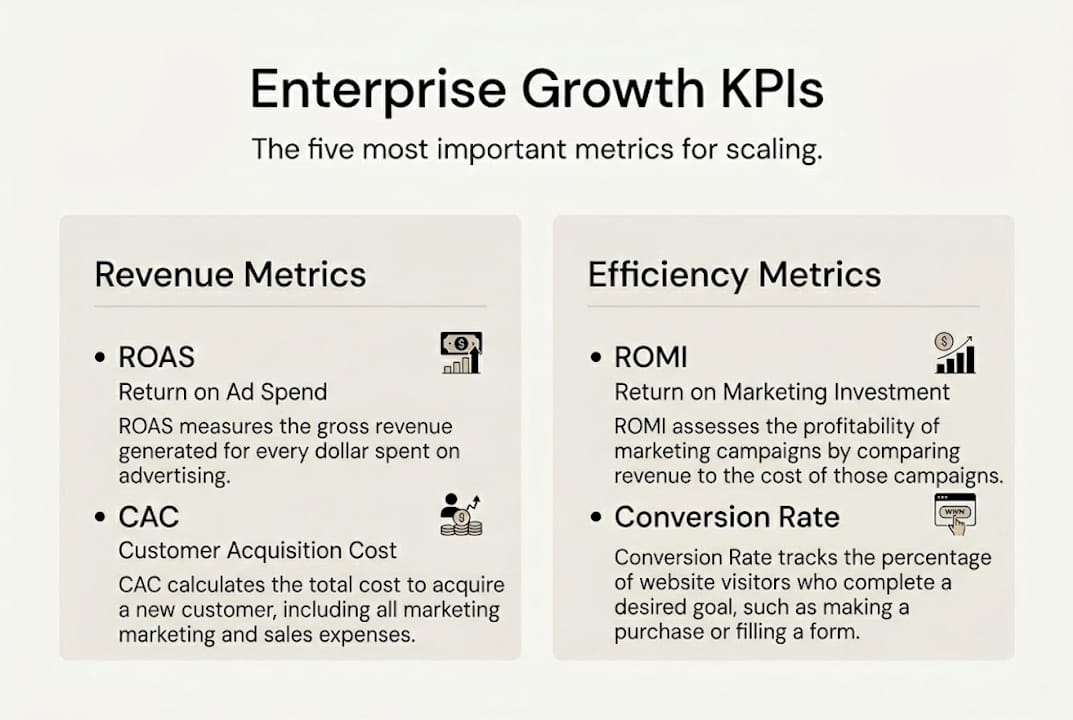
Here’s a direct comparison to help you prioritize:
| Revenue-driving metrics | What they measure | Why they matter more than vanity metrics |
|---|---|---|
| Return on ad spend (ROI) | Revenue per dollar spent | Direct link to profitability |
| Cost per acquisition (CPA) | Cost to earn one conversion | Controls growth efficiency |
| Return on marketing investment (ROI) | Revenue minus cost over cost | Full business impact view |
| Customer acquisition cost (CAC) | Full-funnel customer cost | Long-term sustainability signal |
| Traffic, impressions, reach | Volume and exposure | No direct profit connection |
The bottom row is not worthless. But making it your primary reporting language is a strategic error.
Beyond individual KPIs, frameworks for interpreting these numbers matter just as much. Three approaches dominate advanced enterprise measurement: marketing mix modeling (MMM), incrementality testing, and multi-touch attribution (MTA). Each answers a different question about your campaigns. Your ROI measurement guide can help you see how these frameworks interact in practice.
For each KPI on your dashboard, ask these questions:
- Is this metric tied to a revenue outcome or a platform behavior?
- Can we act on this data, or does it just describe what already happened?
- Is this number being gamed by the reporting environment (e.g., view-through conversions)?
- Does this metric change how we allocate budget?
The CTR calculator tool is a practical resource for stress-testing whether your click data is telling you what you think it is.
Organizations that integrate advanced measurement frameworks like MMM, incrementality, and MTA see 70% higher revenue growth than those relying on basic last-click attribution alone.
That’s not a small edge. That’s a structural advantage built into your measurement approach.
Advanced enterprise methodologies: MMM, incrementality, and attribution
Armed with the right KPIs, your next step is applying sophisticated measurement tools to gain clarity. These aren’t tools for analysts alone. They’re strategic assets that should inform where your budget goes and how fast you scale.

Marketing mix modeling (MMM) is a statistical method that uses historical data to estimate each channel’s contribution to revenue. It accounts for external factors like seasonality and economic shifts, making it ideal for strategic planning and annual budget allocation. It doesn’t track individual users, so it holds up in privacy-restricted environments.
Multi-touch attribution (MTA) operates at the user level, assigning credit to each touchpoint in a conversion path. It’s built for campaign-level optimization and works best in digital-only environments with strong data pipelines.
incrementality testing, using geo-experiments and holdout groups, provides the most causally rigorous answer to one question: did this campaign actually cause conversions, or would those customers have converted anyway? According to BCG’s measurement framework, integrating MMM, MTA, and incrementality alongside platform tools like Google’s Performance Max reports creates a robust enterprise measurement ecosystem.
Here’s how to integrate these methodologies step by step:
- Build first-party data infrastructure and server-side tracking before anything else
- Run a baseline MMM to understand historical channel contribution
- Layer in MTA for campaign-level daily optimization signals
- Design incrementality tests to validate your top-spending channels
- Feed results back into budget allocation decisions quarterly
Method strengths and limitations:
| Method | Best for | Main limitation |
|---|---|---|
| MMM | Strategic budget planning | Not real-time; needs 2+ years of data |
| MTA | Daily optimization | Privacy erosion limits user tracking |
| incrementality | causal truth | Time-intensive; needs proper holdout design |
Our media mix modeling guide goes deeper on setting up MMM for an enterprise context.
Pro tip: Server-side tracking is your foundation. Without it, every methodology above is working with incomplete data. Get your first-party tracking stack solid before investing in advanced modeling.
addressing real-world challenges: Privacy, attribution, and lag
Even the best strategies face real-world obstacles. Here’s how to overcome them.
Privacy changes have fundamentally altered the tracking landscape. Browser restrictions, the deprecation of third-party cookies, and increasingly strict consent requirements mean that client-side tracking is losing signal fast. According to performance marketing analytics research, privacy restrictions degrade client-side tracking accuracy, and server-side tracking paired with consent-mode configurations is now the baseline for reliable data.
Cross-device attribution is another persistent challenge. A user who sees your ad on a mobile device, researches on a tablet, and converts on a desktop is nearly impossible to track as a single journey without a first-party identity solution. This inflates conversion counts in some channels while undercounting others.
Key statistic: incrementality tests need 4-8 weeks to reach statistical significance. Running them shorter produces unreliable conclusions that can mislead budget decisions.
Conversion lag compounds this further. Many enterprises make the mistake of pulling optimization reports too soon. If your average sales cycle is two weeks, a report pulled five days after a campaign launch is not showing you the full picture. Build a standard 2-4 week delay into your analysis window.
Common challenges and their solutions:
- Privacy signal loss: Move to server-side tagging and enable consent mode for all markets
- Cross-device gaps: Build a first-party identity layer using CRM data and login-based matching
- Attribution inflation: Use incrementality testing to validate what attribution claims
- conversion lag: Set reporting windows to reflect actual purchase cycle length
- Multi-channel confusion: Use MMM to get a channel-agnostic view of portfolio contribution
Building a structured campaign optimization workflow helps teams apply these solutions consistently rather than reactively.
A fresh perspective: What most enterprises get wrong and how to fix it
Having tackled technical and practical details, let’s step back and consider what truly sets high-performing enterprises apart.
Here’s what we see repeatedly: organizations invest in beautiful dashboards and then make decisions based on platform-reported metrics that are built to make the platform look good. Last-click attribution rewards the final paid click. Platform dashboards minimize visibility into wasted spend. The reporting environment is not neutral. It’s designed by channels with a vested interest in showing their own value.
The enterprises that outperform their peers don’t just have better tools. They have better questions. They ask whether their spend caused growth, not just whether growth happened during their spend period. That’s the shift from correlation to causation.
First-party tracking foundations combined with north-star metrics like marketing efficiency ratio or incremental return on ad spend give leadership a ground-truth view that no platform dashboard can replicate. Weekly testing rhythms on audiences and creative keep the insights fresh and actionable.
Use our marketing checklist for ROI to audit your current tracking setup against these principles. Most enterprises find at least two or three significant gaps the first time through.
The organizations winning in digital advertising aren’t necessarily the ones with the biggest budgets. They’re the ones who know exactly what’s working, and why.
Ready to optimize your digital performance?
If you’re looking for expert guidance to accelerate your digital marketing ROI, here’s how we can help. At AdVenture Media, we build performance tracking systems that go far beyond platform dashboards. We engineer measurement strategies around your actual business goals, the kind that tell you exactly where to invest more and where to pull back. Our case studies speak directly to this: from brand creative transformation to year-over-year conversion growth, we’ve built the frameworks that move the needle. Ready to build yours? Let’s talk.
frequently asked questions
What are the most important KPIs for digital ad performance tracking?
ROAS, CPA, conversion rate, and customer acquisition cost are the priority metrics for enterprises focused on profitable growth rather than vanity metrics like traffic or impressions. Revenue-tied KPIs directly connect ad spend to business outcomes.
What is marketing mix modeling and why is it important?
MMM is a statistical approach that measures each channel’s true contribution to revenue using historical data. It’s critical for strategic budget planning and works reliably even as privacy restrictions limit user-level tracking.
How do privacy restrictions affect performance tracking?
Privacy changes reduce the accuracy of client-side tracking, requiring enterprises to adopt server-side tracking and consent-mode configurations. Server-side solutions preserve signal fidelity as browser restrictions continue to tighten.
How long should you wait before attributing conversions?
A 2-4 week delay is standard before drawing conclusions from conversion data, especially in categories with longer consideration windows or multi-session buying behavior.
Why is incrementality testing preferred over attribution?
Incrementality testing establishes causal impact, proving whether your campaign actually drove a conversion rather than just being present during one. 4-8 weeks of testing is typically required for statistically reliable results.
Recommended


Conversion Rate Optimization Transforms SaaS Content Into Profitable Advertising Collateral


Advanced Retargeting Helps Illustrate Jewelry Brand's Buyer Journey


Slinger Bag becomes #1 tennis launcher in the US, with 12.6X Facebook ROAS
Request A Marketing Proposal
We'll get back to you within a day to schedule a quick strategy call. We can also communicate over email if that's easier for you.
Visit Us
New York
1074 Broadway
Woodmere, NY
Philadelphia
1429 Walnut Street
Philadelphia, PA
Florida
433 Plaza Real
Boca Raton, FL
General Inquiries
info@adventureppc.com
(516) 218-3722
AdVenture Education
Over 300,000 marketers from around the world have leveled up their skillset with AdVenture premium and free resources. Whether you're a CMO or a new student of digital marketing, there's something here for you.
OUR BOOK
We wrote the #1 bestselling book on performance advertising
Named one of the most important advertising books of all time.
buy on amazon
OUR EVENT
DOLAH '24.
Stream Now.
Over ten hours of lectures and workshops from our DOLAH Conference, themed: "Marketing Solutions for the AI Revolution"
check out dolah
The AdVenture Academy
Resources, guides, and courses for digital marketers, CMOs, and students. Brought to you by the agency chosen by Google to train Google's top Premier Partner Agencies.
Bundles & All Access Pass
Over 100 hours of video training and 60+ downloadable resources
 view bundles →
.png)


