
.svg)

TL;DR:
- Native advertising is a paid format designed to seamlessly match the appearance and behavior of the surrounding media, requiring clear disclosure for compliance and trust. Unlike content marketing, native advertising involves paid placement within publisher platforms, which significantly boosts engagement rates by reducing user friction. Successful native campaigns balance transparency with creative strategy, fostering organic engagement and measurable ROI through contextual relevance and full-funnel integration.
Native advertising occupies a uniquely powerful position in the enterprise marketing toolkit, yet it’s one of the most consistently misunderstood formats in the industry. Many marketing leaders treat it as a synonym for content marketing, a softer form of display, or simply “ads that look like articles.” None of those descriptions get it quite right. The FTC focuses on whether material is advertising and whether it’s distinguishable from surrounding editorial, which means your legal exposure and campaign credibility depend on getting this definition precise. This guide cuts through the confusion and gives you the strategic clarity to deploy native advertising with confidence.
Table of Contents
- Defining native advertising: What it is and what it isn’t
- How native advertising drives engagement and ROI
- Native advertising vs. display: Key differences for marketers
- Best practices for enterprise native advertising success
- The real challenge: Native advertising’s blurred lines and what actually works
- Elevate your campaigns with expert-driven native advertising solutions
- Frequently asked questions
Key Takeaways
| Point | Details |
|---|---|
| Clear definition matters | Distinguish native advertising from related formats to ensure compliance and campaign effectiveness. |
| Trust hinges on transparency | Strong disclosure practices are non-negotiable for building brand credibility in native campaigns. |
| Engagement drives ROI | Well-designed native ads yield higher audience engagement and stronger returns compared to traditional formats. |
| Platform fit is strategic | Align native placements with channels where they seamlessly integrate for maximum performance. |
| Expert strategy prevents pitfalls | Structured processes and compliance checks protect both reputation and results in enterprise environments. |
Defining native advertising: What it is and what it isn’t
With the stakes set, let’s clarify exactly what native advertising means and what it doesn’t.
Native advertising is a paid format specifically engineered to match the visual design, tone, and functional behavior of the media environment where it appears. A sponsored article on a premium publisher site that looks and reads like editorial content is native advertising. A promoted post in a social feed that mirrors organic posts is native advertising. A “recommended content” unit at the bottom of a news article is native advertising. The common thread is intentional integration with the surrounding experience.
What it is not is content marketing. Content marketing is a brand-owned strategy where you produce and distribute valuable information to attract and retain an audience. You own the channel, you own the asset, and there’s no paid placement transaction involved. Native advertising, by contrast, always involves paying a publisher or platform for placement. The FTC’s focus on labeling makes that distinction legally significant, not just conceptually tidy.
Here’s a quick breakdown of how the three formats differ:
- Native advertising: Paid placement that matches the platform’s look and feel; requires clear “Sponsored” or “Paid” disclosure; short or long form; distributed through publisher networks or social platforms.
- Content marketing: Brand-owned content distributed through owned channels; no paid placement required; goal is audience building and organic trust.
- Display advertising: Clearly distinct visual units (banners, interstitials, rich media); does not attempt to blend with editorial; lower cognitive engagement but high reach.
When it comes to compliance, the line between native and editorial content must be visible to a reasonable consumer. That’s not optional, and it’s not a creative judgment call.
| Format | Paid placement | Matches platform UX | Disclosure required | Primary metric |
|---|---|---|---|---|
| Native advertising | Yes | Yes | Yes (mandatory) | Engagement rate |
| Content marketing | No | N/A | No | Organic reach |
| Display advertising | Yes | No | No (format is obvious) | Impressions/clicks |
Your overall digital ad strategy should treat these formats as complementary levers, not interchangeable tools. And your content strategy in ads will determine how effectively each format carries your brand message.
Pro Tip: Never rely solely on a logo or tiny font to satisfy disclosure requirements. Use explicit language like “Sponsored,” “Paid Promotion,” or “Advertisement” placed prominently above or within the unit. Audiences reward brands that are upfront, and regulators require it.
How native advertising drives engagement and ROI
Now that you know where native advertising sits, it’s essential to understand why it delivers results and what makes those results sustainable.
The core mechanics are straightforward. Traditional display advertising examples work through interruptive placement. Native advertising works by reducing friction. When an ad visually and contextually belongs in the feed or page a user is already engaged with, the psychological resistance that causes banner blindness simply doesn’t activate the same way.
This isn’t just a nice theory. Studies consistently show native ads generate significantly higher click-through rates than standard display units, often 2x to 8x higher depending on the platform and creative quality. For enterprise campaigns where you’re spending at scale, even a modest lift in engagement can translate to millions of additional brand touchpoints without increasing budget.
Here’s how the path from attention to ROI actually plays out in a native campaign:
- Contextual relevance triggers attention. The user encounters content that matches what they’re already consuming. Their guard is lower. They read.
- Value exchange builds interest. If the native unit delivers genuinely useful information or tells a compelling story, the user progresses deeper into the content.
- Brand association forms organically. Unlike a banner ad, the user has spent meaningful time with your brand’s voice and perspective. That’s brand equity being built in real time.
- Intent signals emerge. Users who engage with native content are warmer leads. They’ve self-selected into a longer interaction with your brand.
- Conversion lift becomes measurable. Whether through direct response or assisted attribution, native-engaged users consistently show higher downstream conversion rates.
“Native advertising can raise consumer-skepticism concerns because it resembles editorial content. Compliance and transparency are therefore central to trust and campaign risk management.” — FTC
Enterprises that want to maximize ROI through measurable digital ad growth should treat native as a mid-to-upper funnel workhorse. It primes audiences for conversion-focused retargeting. The brands investing in display ads alongside native formats often see synergistic effects, where display retargeting converts the warm intent native creates.
Pro Tip: Transparency isn’t just a compliance checkbox; it’s a trust asset. Users who notice a clear “Sponsored” label and still click are showing high-quality intent. That signal is far more valuable than an accidental click from a consumer who thought they were reading editorial content. Build your campaigns around earning intentional engagement.

Native advertising vs. display: Key differences for marketers
Building on performance insights, it’s time to weigh native versus display solutions directly.
These formats are not rivals. They solve different problems in your funnel, and the smartest enterprise teams use both deliberately. But the decision about when to lean on each format requires honest evaluation of what you’re trying to accomplish.
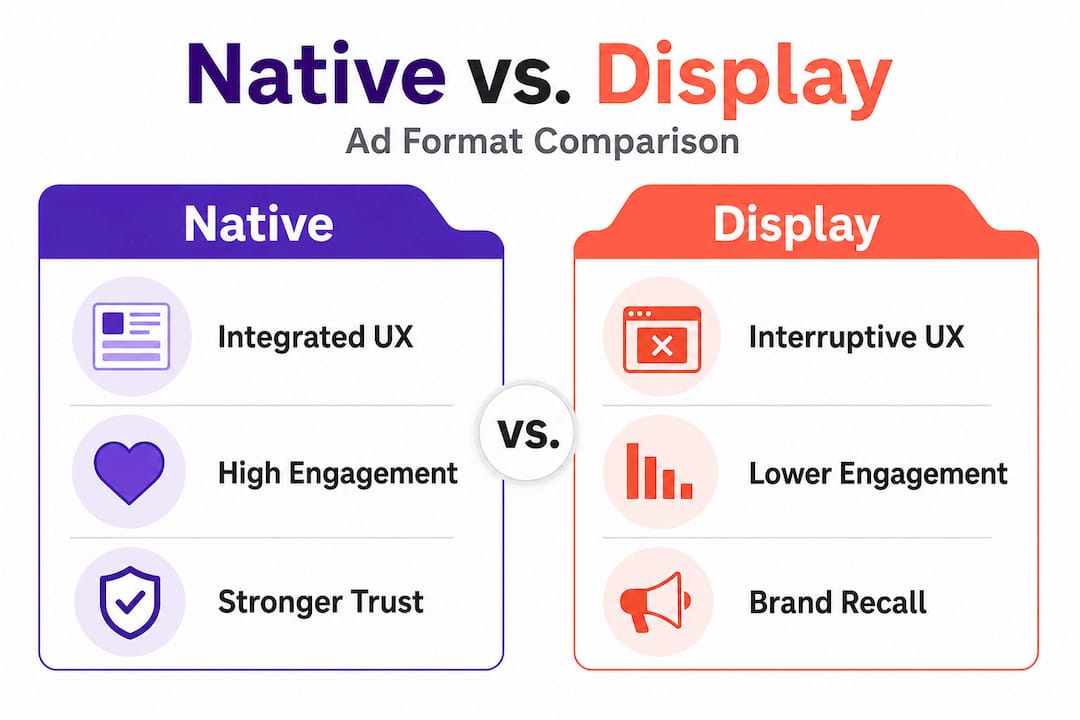
| Dimension | Native advertising | Display advertising |
|---|---|---|
| User experience | Integrated, low interruption | Distinct, interruptive |
| Engagement rate | High (2x to 8x vs. display) | Lower, high ad blindness risk |
| Compliance complexity | High (disclosure mandatory) | Low (format is self-evident) |
| Creative requirements | High (tone, format, platform match) | Moderate (visual impact focus) |
| Targeting sophistication | Platform-native, contextual | Programmatic, cookie-based |
| Brand safety risk | Moderate to high | Low to moderate |
| Best funnel stage | Awareness, consideration | Retargeting, conversion |
Looking at display ad examples compared to native placements, the visual contrast is immediate. Display units announce themselves. Native units integrate. Neither is superior in the abstract. Each has a defined job to do.
For enterprise marketing portfolios, the strategic implications break down like this:
- Use native when you need to build awareness among a cold audience, when your message requires more than three seconds to land, or when you’re entering a new market and need to borrow credibility from a trusted publisher.
- Use display when you’re retargeting warm audiences, running time-sensitive promotions, or need broad reach at efficient CPMs.
- Use both when you’re running an omni-channel campaign where native primes intent and display closes it. This sequencing strategy often produces ROI with display ads that neither format achieves in isolation.
“Native tactics can blur the lines if disclosure and labeling aren’t strong.” This is especially true in social environments where organic and paid content share the same visual templates.
The regulatory nuance here deserves serious attention from enterprise legal and compliance teams. Native advertising that fails to clearly distinguish itself from editorial content doesn’t just create FTC risk. It erodes consumer trust at the moment of engagement, which undermines the very advantage native is designed to deliver.
Best practices for enterprise native advertising success
Equipped with strategic choices, the next step is execution, where strong processes set winning brands apart.
At the enterprise level, native advertising campaigns involve multiple stakeholders: creative teams, legal reviewers, media buyers, platform specialists, and analytics teams. Without a structured workflow, even a well-funded campaign can collapse at the execution stage. Here’s a process-oriented approach that keeps campaigns both compliant and high-performing.
- Define platform fit before you design creative. Every platform where you plan to run native has its own content norms. LinkedIn articles have a different voice than in-feed social content, which differs from premium publisher placements. Research the platform’s top-performing editorial content before briefing your creative team.
- Build disclosure into the design brief. Don’t treat the “Sponsored” label as a legal afterthought. Make it part of the initial creative spec so designers integrate it cleanly rather than tacking it on at the end.
- Conduct a pre-launch compliance review. Have your legal or compliance team review every native unit against FTC guidelines on disclosure before it goes live. This is non-negotiable for regulated industries like finance, healthcare, and supplements.
- Align native content with your full-funnel narrative. Native rarely converts directly on first contact. Map each native piece to a specific funnel stage and ensure your retargeting sequences are set up to capture and convert the intent it generates.
- A/B test the content angle, not just the headline. Most native advertisers test surface-level variables. The real performance gains come from testing fundamentally different editorial angles, for example, a problem-solution frame versus a data-driven insight frame versus a personal narrative frame.
- Track beyond clicks. Engagement time, scroll depth, return visits, and assisted conversions tell the real story of native performance. Set up your analytics stack to capture these signals before launch, not after.
- Run quarterly brand safety audits. Native placements on publisher networks can appear alongside content that conflicts with your brand values. Review your placement reports regularly and exclude problematic inventory proactively.
Your digital ad planning process should embed these checkpoints as standard workflow, not optional extras. And your advertising UX strategies need to account for how native placements interact with the destination page experience. A beautifully crafted native unit that lands users on a slow, confusing page wastes every dollar you spent on placement.
Pro Tip: Train your internal creative and media teams on FTC disclosure requirements at least once per year. Regulations evolve, platforms change their policies, and team turnover means institutional knowledge erodes. A simple annual briefing reduces compliance risk significantly and keeps everyone aligned on what “good” looks like.
The real challenge: Native advertising’s blurred lines and what actually works
Here’s the part most native advertising guides don’t want to say out loud. The “seamless integration” that makes native powerful is also the quality that creates its biggest risk. The goal is to fit in so naturally that users engage without friction. But if you fit in too well, and the advertising nature of the content isn’t obvious, you’ve crossed a line that damages both your brand and your relationship with the audience.
We see this pattern repeatedly. Brands invest heavily in beautifully crafted native content, prioritize the aesthetic blend with editorial, and then minimize the disclosure element because it “disrupts the flow.” The result is a short-term engagement bump followed by audience backlash when consumers realize they’ve been consuming paid content they thought was independent editorial.
Social media ad trends show that consumer sophistication around paid content has grown dramatically. Audiences in 2026 are more capable than ever of recognizing native advertising, and their expectation is that brands will be honest about it. The penalty for obscuring that distinction isn’t just regulatory. It’s reputational.
“Compliance and transparency are central to trust and campaign risk management.” This isn’t just a legal warning. It’s a performance insight.
The brands we’ve seen win consistently with native advertising lean into the disclosure, not away from it. They treat the “Sponsored” label as a statement of confidence. “Yes, this is paid content, and we believe it’s worth your time.” That posture builds the kind of credibility that drives repeat engagement and long-term brand equity.
The practical takeaway: creativity and compliance aren’t in tension. They’re allies. The most effective native campaigns we’ve worked on are both beautifully crafted and completely transparent. Audiences respect brands that don’t try to hide the ball. Make clarity part of your creative brief, and you’ll find it enhances performance rather than limiting it.
Elevate your campaigns with expert-driven native advertising solutions
With a clear understanding of native advertising’s challenges and wins, partnering with experts for your next campaign is the logical next step.
At AdVenture Media, we engineer native advertising campaigns that balance creative impact with compliance rigor. Our work with luxury brand digital transformation demonstrates how precise creative strategy amplifies engagement without sacrificing brand integrity. For clients seeking conversion growth, our year-over-year conversion rate results show what happens when native strategy is paired with disciplined analytics and full-funnel thinking. If your enterprise is ready to make native advertising a genuine growth lever rather than a costly experiment, talk to our team about building a strategy that delivers measurable, repeatable results.
Frequently asked questions
How is native advertising different from content marketing?
Native advertising is a paid placement designed to blend with its host platform, while content marketing is a brand-owned strategy that distributes assets through owned channels to grow an organic audience. The key distinction is the paid transaction, and as the FTC emphasizes around labeling, that transaction requires clear disclosure.
What are the risks of poorly disclosed native advertising?
Inadequate labeling exposes your brand to FTC enforcement action and, more immediately, consumer backlash when audiences feel misled. Compliance and transparency aren’t just regulatory obligations; they’re fundamental to sustaining audience trust over time.
Can native advertising improve brand trust?
Yes, but only when it’s clearly labeled and genuinely valuable to the reader. Transparent native campaigns signal brand confidence and respect for the audience, which consistently outperforms deceptive integration in long-term brand equity measurements.
Where are native ads most effective?
Native ads perform best on platforms where paid and organic content share the same visual framework, including social media feeds, premium publisher sites, and curated content networks. These environments allow the format’s contextual relevance to do its best work.
How do I measure ROI for native advertising?
Go beyond click-through rates and track engagement time, scroll depth, assisted conversions, and return visit rates to understand the full impact. Pairing these engagement signals with downstream conversion attribution gives you a clear picture of how native is contributing to pipeline and revenue.
Recommended


Advanced A/B Testing Framework Results in 284% Conversion Rate Increase for Educational Institution
.avif)

TurnPoint Services Revenue Soars with AdVenture's PE Playbook


Advanced Retargeting Helps Illustrate Jewelry Brand's Buyer Journey
Request A Marketing Proposal
We'll get back to you within a day to schedule a quick strategy call. We can also communicate over email if that's easier for you.
Visit Us
New York
1074 Broadway
Woodmere, NY
Philadelphia
1429 Walnut Street
Philadelphia, PA
Florida
433 Plaza Real
Boca Raton, FL
General Inquiries
[email protected]
(516) 218-3722
AdVenture Education
Over 300,000 marketers from around the world have leveled up their skillset with AdVenture premium and free resources. Whether you're a CMO or a new student of digital marketing, there's something here for you.
OUR BOOK
We wrote the #1 bestselling book on performance advertising
Named one of the most important advertising books of all time.
buy on amazon
OUR EVENT
DOLAH '24.
Stream Now.
Over ten hours of lectures and workshops from our DOLAH Conference, themed: "Marketing Solutions for the AI Revolution"
check out dolah
The AdVenture Academy
Resources, guides, and courses for digital marketers, CMOs, and students. Brought to you by the agency chosen by Google to train Google's top Premier Partner Agencies.
Bundles & All Access Pass
Over 100 hours of video training and 60+ downloadable resources
 view bundles →
.png)


