
.svg)

Many marketers still rely on single-channel tactics, missing out on the 78% higher ROI that coordinated cross-channel advertising delivers. While running campaigns on multiple platforms seems complex, the data shows that integrated approaches dramatically outperform isolated efforts in both conversion rates and brand engagement. This guide explains why cross-channel advertising transforms marketing performance and how you can implement strategies that deliver measurable results across your entire customer journey.
Table of Contents
- Key takeaways
- What is cross-channel advertising and how does it differ from multichannel?
- The measurable ROI advantages of cross-channel advertising
- Cross-channel attribution models and measuring campaign synergy
- Implementing cross-channel advertising strategies for enterprise success
- Enhance your marketing with expert cross-channel advertising support
- Frequently asked questions about cross-channel advertising
Key Takeaways
| Point | Details |
|---|---|
| ROI advantage | Coordinated cross channel campaigns deliver 78 percent higher ROI and about 13 percent higher ROAS than single channel efforts. |
| Attribution focus | Unified data and attribution models enable measurement and optimization across all touchpoints. |
| Synergy lift | Integrated cross channel campaigns boost attention and trust beyond what isolated channels can achieve. |
| Implementation guidance | Practical guidance includes selecting attribution models and coordinating campaign management across platforms. |
What is cross-channel advertising and how does it differ from multichannel?
Cross-channel advertising coordinates campaigns across multiple platforms with shared data and unified customer journey tracking. Every touchpoint connects to create a seamless experience where insights from one channel inform optimization across all others. This integration allows marketers to understand how channels work together rather than viewing them as separate silos.
Multichannel advertising runs campaigns on multiple platforms independently. Each channel operates with its own goals, budgets, and reporting without sharing data or coordinating messaging. While this approach reaches audiences on different platforms, it misses the synergy that comes from integration.
The critical difference lies in data integration and strategic coordination. Cross-channel outperforms multichannel by actively sharing data for synergy, unlike uncoordinated multichannel efforts. When your search campaigns inform your social targeting, and your display ads reinforce messages from email, you create compound effects that isolated channels cannot achieve.
This coordination fosters higher attention and trust because customers encounter consistent messaging that acknowledges their previous interactions. A prospect who clicked your search ad sees display creative that builds on that interest rather than starting from zero. Understanding what is ad attribution becomes essential for tracking these interconnected touchpoints.
Key differences between approaches:
- Data integration: Cross-channel shares insights across platforms, multichannel keeps data isolated
- Customer journey visibility: Cross-channel tracks complete paths, multichannel sees only individual channel interactions
- Message coordination: Cross-channel aligns creative and timing, multichannel runs independent campaigns
- ROI potential: Cross-channel achieves synergy effects, multichannel adds channels without multiplication
- Optimization capability: Cross-channel adjusts based on complete picture, multichannel optimizes channels separately
The measurable ROI advantages of cross-channel advertising
The financial case for cross-channel advertising rests on empirical evidence showing substantial performance improvements. 78% of marketers report higher ROI from coordinated campaigns, with ROAS improvements reaching 13% compared to single-channel efforts. These gains come from multiple factors working together rather than simple channel addition.

Purchasing frequency tells an even more compelling story. Cross-channel campaigns increase purchasing frequency by up to 250% because coordinated touchpoints keep brands top of mind without overwhelming audiences. A customer might see a social ad, receive a targeted email, and encounter a search ad at the perfect moment when they’re ready to buy.
| Metric | Single-Channel | Multichannel | Cross-Channel |
|---|---|---|---|
| Average ROAS | 3.2x | 4.1x | 4.6x |
| Conversion Rate | 2.1% | 3.4% | 4.8% |
| Customer Lifetime Value | $420 | $580 | $890 |
| Cost Per Acquisition | $85 | $68 | $52 |
Brand impact extends beyond immediate conversions. Coordinated campaigns build recognition faster because customers encounter consistent messaging across contexts. This repetition with variation creates familiarity without fatigue, establishing trust that single touchpoints cannot achieve.
Understanding digital marketing ROI measurement becomes crucial for capturing these benefits. Cross-channel success requires tracking how channels influence each other rather than crediting conversions to single touchpoints. Our remarketing campaign case study demonstrates how coordinated efforts deliver exceptional returns.
Key ROI benefits from cross-channel integration:
- Higher conversion rates from coordinated touchpoints that guide customers through complete journeys
- Improved ROAS through budget allocation based on channel synergy rather than isolated performance
- Increased customer lifetime value from consistent experiences that build loyalty
- Lower acquisition costs by eliminating wasted spend on uncoordinated efforts
- Better attribution accuracy revealing true channel contributions
“Coordinated cross-channel campaigns deliver up to 13% higher ROAS while increasing purchasing frequency by 250%, transforming marketing efficiency and customer engagement.”
Pro Tip: Analyze which channel combinations drive your highest-value conversions, then allocate budget to amplify those synergies rather than spreading resources evenly across all platforms.
Cross-channel attribution models and measuring campaign synergy
Attribution models provide the framework for understanding how channels contribute to conversions across the customer journey. Core methodologies include multi-touch, data-driven, linear, and time-decay models for attribution, each offering different insights into channel performance and interaction effects.
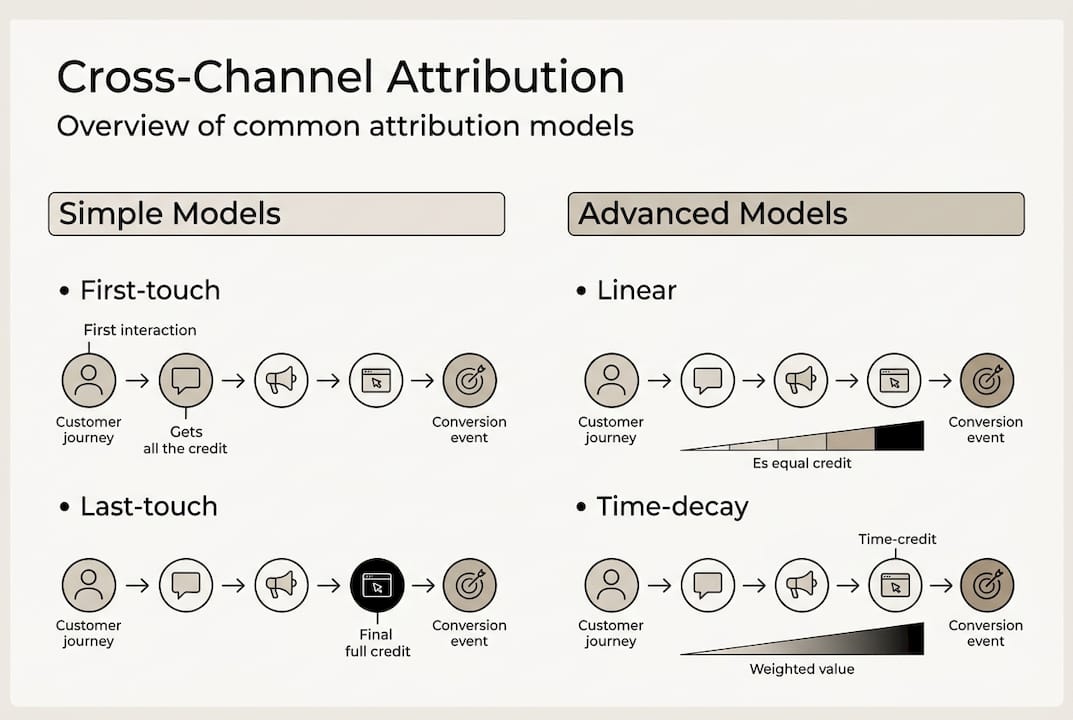
First-touch attribution credits the initial interaction that introduced a customer to your brand. This model highlights channels that excel at awareness and prospecting but ignores everything that happens afterward. It’s useful for understanding discovery patterns but incomplete for optimization.
Last-touch attribution assigns full credit to the final touchpoint before conversion. While simple to implement, this approach overlooks the nurturing and consideration phases that made the final click effective. It tends to over-value bottom-funnel channels while under-crediting awareness efforts.
Linear attribution distributes credit equally across all touchpoints in the customer journey. This model acknowledges that multiple interactions matter but treats a casual first impression the same as a decisive final click. It provides a more balanced view than single-touch models but lacks nuance.
Time-decay attribution gives more credit to touchpoints closer to conversion, recognizing that recent interactions often have greater influence. This approach balances awareness and conversion contributions but still uses a predetermined formula rather than analyzing actual impact.
Data-driven attribution uses machine learning to analyze conversion patterns and assign credit based on actual contribution to outcomes. This sophisticated approach reveals which touchpoints genuinely drive results rather than following predetermined rules. Understanding ads attribution tracking 2026 helps marketers implement these advanced models.
Unified data integration empowers accurate synergy measurement by connecting touchpoints across platforms. When your analytics platform sees that search ads followed by social engagement leads to 3x higher conversion rates than either channel alone, you can optimize for that combination. This visibility transforms budget allocation from guesswork to strategy.
Model selection criteria and applications:
- Business goals: Choose models that align with whether you prioritize awareness, consideration, or conversion
- Sales cycle length: Longer cycles benefit from multi-touch models that credit nurturing touchpoints
- Data availability: Data-driven models require sufficient conversion volume for machine learning
- Channel mix: Diverse channel strategies need attribution that captures cross-platform effects
- Team structure: Select models your stakeholders understand and trust for decision-making
Pro Tip: Start with data-driven attribution to uncover which touchpoints actually drive conversions, then use those insights to refine channel strategy and budget allocation for maximum impact.
Implementing cross-channel advertising strategies for enterprise success
Successful cross-channel implementation starts with unified data infrastructure that connects customer interactions across platforms. Your CRM, advertising platforms, analytics tools, and marketing automation must share information in real time. This integration enables the coordinated decision-making that separates true cross-channel from disconnected multichannel efforts.
Team coordination matters as much as technology. When your search, social, and email specialists work in silos, campaigns remain disconnected regardless of data integration. Regular cross-functional planning sessions ensure messaging, timing, and targeting align across channels to create synergy rather than competition.
| Challenge | Solution |
|---|---|
| Data silos preventing unified view | Implement customer data platform connecting all touchpoints |
| Inconsistent messaging across channels | Develop unified creative guidelines and shared content calendar |
| Attribution complexity | Start with linear model, progress to data-driven as data matures |
| Budget allocation disputes | Use attribution insights to fund channel combinations, not channels |
| Technology integration costs | Begin with native platform integrations before custom solutions |
Creative consistency amplifies cross-channel effectiveness. Customers should recognize your brand instantly whether they encounter you on search, social, display, or email. This doesn’t mean identical ads across platforms but rather coordinated themes, visual language, and value propositions that reinforce each other.
Empirical studies show cross-media campaigns enhance attention, trust, and ROI over single-media approaches. This synergy emerges from strategic coordination rather than simple channel addition. When your display ads prime audiences for your search messaging, and your email campaigns reinforce social engagement, you create compound effects.
Best practices for cross-channel excellence:
- Select technology platforms with robust API connections enabling real-time data sharing across channels
- Use consistent audience segmentation across platforms so targeting aligns rather than conflicts
- Implement frequency capping across channels to prevent oversaturation while maintaining presence
- Coordinate campaign timing so channels support each other during key buying moments
- Test creative variations systematically using shared learnings to improve all channels
- Review attribution reports weekly to identify emerging synergies and optimization opportunities
Testing and refinement separate good cross-channel programs from great ones. Regular experimentation reveals which channel combinations drive the best results for your specific audience and business model. Managing cross-platform ads 2026 requires systematic testing frameworks that capture interaction effects.
Pro Tip: Run controlled experiments where you coordinate channels for one audience segment while keeping them separate for another, measuring the lift from integration to prove ROI and guide expansion.
Enhance your marketing with expert cross-channel advertising support
Implementing sophisticated cross-channel strategies requires specialized expertise in both platform management and strategic coordination. AdVenture Media delivers proven results through data-driven approaches that maximize synergy across advertising channels. Our team understands how to orchestrate campaigns that work together rather than compete for credit.
Our Survey Money Machines case study demonstrates how coordinated strategies drive year-over-year conversion rate growth through systematic optimization. We’ve helped clients achieve remarkable results by applying the attribution models and integration tactics covered in this guide.
The advanced A/B testing case study showcases our systematic approach to refining campaigns across channels for maximum impact. Whether you’re looking to implement your first cross-channel program or optimize existing efforts, our team brings the expertise to accelerate results. Contact AdVenture Media to discuss how we can elevate your marketing performance through strategic cross-channel advertising.
Frequently asked questions about cross-channel advertising
What channels are most effective for cross-channel advertising?
The most effective channels depend on your audience and business model, but search and social typically form the core of successful cross-channel programs. Display advertising amplifies awareness while email nurtures engaged prospects. Start with channels where you have existing performance data, then expand based on attribution insights showing which combinations drive conversions.
How do I start measuring ROI across multiple channels?
Begin with linear attribution to understand basic touchpoint patterns, then progress to time-decay or data-driven models as your data matures. Implement tracking that connects customer interactions across platforms using unified customer IDs. Focus first on measuring channel combinations that drive conversions rather than isolated channel performance.
What are the biggest challenges when implementing cross-channel campaigns?
Data integration tops the list, as connecting platforms and maintaining unified customer views requires technical infrastructure. Team silos create coordination problems when specialists optimize individual channels without considering cross-channel effects. Budget allocation becomes complex when attribution shows that channel combinations matter more than individual performance. Start small with two channels to prove value before expanding.
How often should I update cross-channel attribution models?
Review attribution settings quarterly to ensure models reflect current customer behavior and business priorities. Major changes to your channel mix, product offerings, or target audience warrant immediate attribution review. Data-driven models adapt automatically but still need periodic validation to confirm they’re capturing meaningful patterns rather than noise.
Can small budgets benefit from cross-channel strategies?
Absolutely, though you’ll focus on fewer channels initially. Start with search and one complementary channel like social or email where you can create meaningful synergy. Even modest budgets benefit from coordinated messaging and unified tracking. The key is choosing channels where you can maintain consistent presence rather than spreading too thin across many platforms.
Recommended

.avif)

PictureFrames.com Sees Profitable Ecommerce Sales Growth Year Over Year
.avif)

TurnPoint Services Revenue Soars with AdVenture's PE Playbook


20% Increase in Subscribers for Forbes Magazine
Request A Marketing Proposal
We'll get back to you within a day to schedule a quick strategy call. We can also communicate over email if that's easier for you.
Visit Us
New York
1074 Broadway
Woodmere, NY
Philadelphia
1429 Walnut Street
Philadelphia, PA
Florida
433 Plaza Real
Boca Raton, FL
General Inquiries
info@adventureppc.com
(516) 218-3722
AdVenture Education
Over 300,000 marketers from around the world have leveled up their skillset with AdVenture premium and free resources. Whether you're a CMO or a new student of digital marketing, there's something here for you.
OUR BOOK
We wrote the #1 bestselling book on performance advertising
Named one of the most important advertising books of all time.
buy on amazon
OUR EVENT
DOLAH '24.
Stream Now.
Over ten hours of lectures and workshops from our DOLAH Conference, themed: "Marketing Solutions for the AI Revolution"
check out dolah
The AdVenture Academy
Resources, guides, and courses for digital marketers, CMOs, and students. Brought to you by the agency chosen by Google to train Google's top Premier Partner Agencies.
Bundles & All Access Pass
Over 100 hours of video training and 60+ downloadable resources
 view bundles →
.png)


