
.svg)

TL;DR:
- Measuring advertising ROI is complex due to attribution gaps and cross-channel intricacies.
- Leading marketers use combined models like MMM and MTA for comprehensive insights.
- ROI should guide decisions and clarity, not perfection or short-term focus.
Even the most seasoned marketing teams at major enterprises can spend millions on digital advertising and still struggle to answer one basic question: is it actually working? ROI sounds simple on paper, but the reality is messier. Attribution gaps, long sales cycles, and cross-channel complexity make it genuinely hard to connect spend to revenue. The standard ROI formula gives you a starting point, but knowing how to apply it, what it misses, and how to act on it is where the real work begins. This guide covers all of that.
Table of Contents
- What is advertising ROI and why does it matter?
- Core methods for measuring advertising ROI
- The risks and limitations of focusing too much on ROI
- What great enterprise marketers do differently with ROI
- Why the real value of ROI is clarity, not perfection
- Ready to maximize your advertising ROI?
- Frequently asked questions
Key Takeaways
| Point | Details |
|---|---|
| ROI aligns spend with value | Measuring advertising ROI connects your budget to measurable business results for better accountability. |
| Models shape measurement accuracy | Advanced methods like MMM and attribution offer deeper, cross-channel insight than basic ROI calculations. |
| Beware short-term bias | Focusing only on ROI risks missing long-term growth and brand-building opportunities. |
| Top marketers triangulate | Elite enterprise teams pair ROI data with strategic planning to justify spend and maximize impact. |
What is advertising ROI and why does it matter?
Now that we’ve set the stage, let’s clarify what advertising ROI truly means.
Advertising ROI measures how much revenue your campaigns generate relative to what you spent to run them. The standard formula is straightforward: [(Revenue - Cost) / Cost] x 100. If you spent $500,000 on a campaign and generated $2 million in attributable revenue, your ROI is 300%. Clean, simple, and useful. But only if the inputs are accurate.
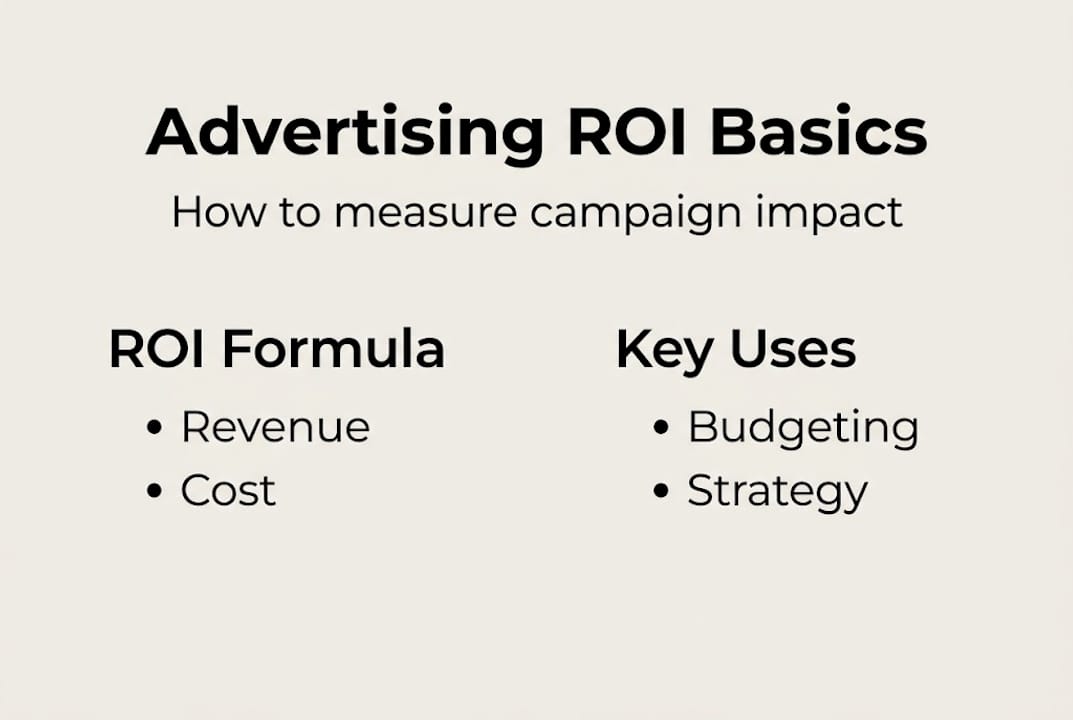
For measuring marketing ROI at scale, that “if” carries a lot of weight. Revenue attribution is rarely clean across channels, and cost calculations often exclude creative production, agency fees, or internal labor. The formula is only as good as the data feeding it.
So why ROI matters in advertising goes beyond math. It’s about accountability. Marketing leaders at enterprise organizations need to justify budget decisions to CFOs, boards, and business unit leaders who speak in revenue, not impressions. ROI is the common language that bridges marketing activity and business outcomes.
The stakes are significant. Global ad spend crossed $1 trillion in 2026. That’s a staggering amount of capital being deployed across paid search, social, programmatic, and beyond. Without a disciplined approach to ROI, even a small percentage of wasted spend represents enormous dollar amounts.
| Metric | What it measures | Limitation |
|---|---|---|
| Advertising ROI | Revenue per dollar spent | Misses soft value and delayed returns |
| ROAS | Revenue per ad dollar | Channel-specific, not holistic |
| CPA | Cost per acquisition | Ignores revenue size per customer |
| LTV | Long-term customer value | Hard to attribute to single campaigns |
Pro Tip: Before running your ROI calculation, align with your executive team on which revenue definition to use. Gross revenue, net revenue, and contribution margin all produce very different ROI numbers from the same campaign.
Core methods for measuring advertising ROI
With a foundation in place, let’s explore how ROI can actually be measured in modern marketing organizations.

Not all measurement approaches are created equal. The method you choose shapes what you can see, what decisions you can make, and how confident you can be in the numbers. Two dominant frameworks define the enterprise conversation: Marketing Mix Modeling (MMM) and Multi-Touch Attribution (MTA).
Media mix modeling uses aggregate data and statistical regression to estimate the contribution of each marketing channel to overall revenue. It’s privacy-safe, works across both online and offline channels, and is ideal for long-term budget planning. MTA, by contrast, tracks individual user journeys across digital touchpoints, giving you tactical, granular insight into which ads drove which conversions. MMM provides holistic ROI using aggregate data suited for privacy-safe planning, while MTA delivers user-level insights for tactical optimization.
Neither is perfect alone. MMM can be slow to update and requires significant historical data. MTA struggles with cross-device journeys and is increasingly limited by cookie deprecation. The smartest enterprise teams use both in tandem.
| Model | Data type | Best for | Limitation |
|---|---|---|---|
| MMM | Aggregate | Long-term planning, offline channels | Slow to update, needs 2+ years of data |
| MTA | User-level | Tactical digital optimization | Cookie-dependent, cross-device gaps |
| Simple ROI | Financial | Executive reporting | Misses channel-level insight |
Here’s a practical approach to implementing ROI measurement in an enterprise setting:
- Define your revenue attribution window. Decide whether you’re measuring 7-day, 30-day, or 90-day post-click revenue, and apply it consistently.
- Audit your cost inputs. Include media spend, creative production, agency fees, and internal team time.
- Choose your primary model. MMM for strategic planning, MTA for campaign-level optimization.
- Run incrementality tests. Use holdout groups to validate whether your campaigns are actually driving lift.
- Build a reporting cadence. Monthly for MMM outputs, weekly for MTA and campaign-level data.
For teams just getting started with analyzing ad results, even a simplified version of this process creates far more accountability than relying on platform-reported numbers alone.
The risks and limitations of focusing too much on ROI
Understanding the how is crucial, but it’s equally important to recognize the pitfalls in how ROI is used.
ROI is a powerful tool. It’s also a dangerous one when it becomes the only tool. The core problem is that ROI is a measure of efficiency, not effectiveness. Those are not the same thing.
“ROI measures efficiency, not effectiveness, and can encourage short-termism while ignoring long-term brand building.” This tension, identified by researchers studying marketing effectiveness, is one of the most persistent blind spots in enterprise marketing strategy.
Here’s what standard ROI calculations typically miss:
- Brand equity and awareness lift, which influence purchase decisions months or years later
- Customer loyalty and repeat purchase behavior driven by brand campaigns
- Delayed revenue effects from customers who saw your ad but converted in a different channel or session
- Competitive defense value, where spending prevents share loss rather than driving new growth
- Earned media and word-of-mouth amplification triggered by paid campaigns
- Organizational learning from testing and experimentation, which compounds over time
An improving ad ROI mindset that obsesses over short-term efficiency often leads teams to cut brand investment, over-rotate into bottom-funnel tactics, and starve the pipeline of future demand. You optimize yourself into a corner.
There’s also a budget scale insight worth sitting with: for large enterprises, the absolute size of the marketing budget explains more profit variation than ROI percentage improvements alone. A 10% budget increase at the right moment can outperform a 20% ROI efficiency gain on a constrained budget.
Pro Tip: Use ROI as a guide, not a finish line. It tells you where you’ve been. Pair it with leading indicators like brand search volume, category share, and pipeline velocity to understand where you’re going. Your digital marketing strategy and ROI should work together, not compete.
What great enterprise marketers do differently with ROI
To move from common mistakes to best-in-class strategy, see how leading marketers use ROI in practice.
Elite marketing teams don’t treat ROI as a report card. They treat it as one input in a broader decision-making system. The difference sounds subtle. The results are not.
For enterprise marketers, the goal is to link 60 to 80% of sales to specific marketing activities through revenue attribution, while simultaneously using MMM to understand cross-channel truth that platform dashboards will never show you. That dual approach gives you both the executive-ready narrative and the strategic depth to make smarter bets.
Here’s what the best marketing teams actually do:
- Triangulate across models. They don’t rely on one measurement approach. MMM, MTA, and incrementality tests are used together to cross-validate findings.
- Tie ROI to brand metrics. They track brand search volume, unaided awareness, and NPS alongside revenue ROI to build a complete picture.
- Build finance-ready reporting. They translate marketing data into language CFOs trust: revenue contribution, payback period, and customer lifetime value.
- Run structured experiments. They use geo-based holdout tests and A/B creative tests to isolate true campaign impact before scaling budgets.
- Plan budgets with MMM outputs. Rather than allocating based on last year’s spend or gut feel, they use modeled ROI curves to find the point of diminishing returns per channel.
Ad campaign optimization at this level requires discipline and infrastructure. But the payoff is real.
| Channel | Typical ROI benchmark |
|---|---|
| SEO | 748% ROI |
| Email marketing | 261% ROI |
| Google Ads (paid search) | ~200% ROI (2:1 ratio) |
| Average across channels | ~500% ROI (5:1 ratio) |
Those benchmarks matter when you’re measuring ad performance and trying to justify a multimillion-dollar campaign to a finance team. Showing that your paid search program delivers a 2:1 return while your SEO investment is generating 7:1 is a powerful budget allocation argument.
Why the real value of ROI is clarity, not perfection
Having seen the advanced strategies, here’s what most marketers miss when chasing ROI.
We’ve worked with teams that spent months building attribution models, debating methodology, and refining dashboards, only to still feel uncertain about whether their campaigns were working. The problem wasn’t the data. It was the expectation.
ROI will never be a perfect number. There will always be edge cases, soft metrics that resist quantification, and channels whose value shows up in ways your model doesn’t capture. Chasing perfection here is a trap. The marketers who get the most value from ROI measurement are the ones who use it to create clarity, not certainty.
The right question isn’t “what is our exact ROI?” It’s “does this data tell us clearly enough where to double down and where to pull back?” That shift in framing changes everything. It makes ROI a strategic tool rather than a compliance exercise.
We’d also argue that cross-channel ROI visibility, even when imperfect, is more valuable than precise measurement of a single channel in isolation. Knowing roughly how all your channels work together beats knowing exactly how one performs alone.
The most successful enterprise marketers we’ve partnered with aren’t the ones with the best models. They’re the ones who use their models to make faster, more confident decisions. That’s the real ROI of measuring ROI.
Ready to maximize your advertising ROI?
If you’re committed to smarter, more accountable advertising results, here’s how to take the next step.
Measuring advertising ROI is not a one-time project. It’s an ongoing discipline that separates teams who grow with confidence from those who guess and hope. At AdVenture Media, we’ve engineered ROI measurement frameworks for clients across industries, delivering results you can see in the numbers. Check out how we helped Survey Money Machines achieve year-over-year growth in conversion rate, or explore the International Culinary Center case study to see how structured A/B testing drove measurable lift. If you’re ready to build a measurement system that actually informs your strategy, speak with our experts and let’s map out what that looks like for your organization.
Frequently asked questions
What is the formula for advertising ROI?
Advertising ROI is calculated as (Revenue - Cost) / Cost] x 100, expressing your return as a percentage of what you spent. The [standard ROI formula works best when both revenue and cost inputs are fully and consistently defined.
Why can advertising ROI be misleading?
ROI focuses on short-term efficiency and can miss long-term brand value, customer loyalty, and delayed sales impact. Researchers tracking marketing effectiveness consistently find that ROI-only thinking leads to underinvestment in brand building.
What is a good ROI for digital marketing?
A 5:1 revenue-to-cost ratio is considered a strong benchmark across channels, with SEO and email often delivering much higher returns than paid media. B2B benchmarks show SEO at 748% and email at 261%, making channel mix decisions critical.
How do enterprise marketers justify advertising budgets to executives?
They use tools like MMM and revenue attribution to connect spend directly to sales in language finance teams trust. Enterprise ROI justification typically links 60 to 80% of sales to specific marketing activities through structured attribution models.
Recommended

.avif)

TurnPoint Services Revenue Soars with AdVenture's PE Playbook


Global Fintech App Uses Automation To Profitably Grow Customer Base


AdVenture Media Helps Jive Software Decrease Cost / SQL by 827%
Request A Marketing Proposal
We'll get back to you within a day to schedule a quick strategy call. We can also communicate over email if that's easier for you.
Visit Us
New York
1074 Broadway
Woodmere, NY
Philadelphia
1429 Walnut Street
Philadelphia, PA
Florida
433 Plaza Real
Boca Raton, FL
General Inquiries
info@adventureppc.com
(516) 218-3722
AdVenture Education
Over 300,000 marketers from around the world have leveled up their skillset with AdVenture premium and free resources. Whether you're a CMO or a new student of digital marketing, there's something here for you.
OUR BOOK
We wrote the #1 bestselling book on performance advertising
Named one of the most important advertising books of all time.
buy on amazon
OUR EVENT
DOLAH '24.
Stream Now.
Over ten hours of lectures and workshops from our DOLAH Conference, themed: "Marketing Solutions for the AI Revolution"
check out dolah
The AdVenture Academy
Resources, guides, and courses for digital marketers, CMOs, and students. Brought to you by the agency chosen by Google to train Google's top Premier Partner Agencies.
Bundles & All Access Pass
Over 100 hours of video training and 60+ downloadable resources
 view bundles →
.png)


