
.svg)

Most marketing teams believe their best copywriter has the sharpest instinct for what works. That assumption costs real money. Iterative ad copy testing can deliver compounded ROI gains that exceed 15% per cycle, yet the majority of enterprise teams still let creative opinion drive final decisions. This article makes the case for systematic testing, walks through exactly how to do it, and shows you how to turn test results into a continuous engine for campaign performance. If you manage significant ad spend, the gap between what you think works and what actually works is worth closing fast.
Table of Contents
- Why testing ad copy beats opinion every time
- How ad copy testing works: The evidence and process
- What to test: High-impact elements for enterprise ad performance
- Avoiding common pitfalls in ad copy testing
- Putting ad copy tests into action: From results to ROI
- How we help enterprises scale high-impact ad copy testing
- Frequently asked questions
Key Takeaways
| Point | Details |
|---|---|
| Data beats guesswork | Systematic ad copy testing reliably outperforms opinions or creative hunches for ROI. |
| Test high-impact elements | Headlines, CTAs, and offers drive the biggest gains when tested strategically. |
| Avoid common pitfalls | Ensure tests run to statistical significance and focus on one variable at a time. |
| Iterative wins compound | Stack small test wins over time for exponential growth in campaign performance. |
| Connect tests to business goals | Always align test metrics to what matters for your bottom line, like ROAS or conversion rate. |
Why testing ad copy beats opinion every time
Creative intuition has its place, but it has a ceiling. When a senior copywriter and a performance director disagree on headline direction, the debate can stall campaigns for weeks. Testing ends that debate with evidence. Systematic ad copy testing shifts decisions from opinion to data-driven optimization, compounding ROI through iterative wins that stack across quarters.
The business case is straightforward. Small copy changes, a single word in a headline or a reframed benefit statement, can move conversion rates by double digits. Multiply that across dozens of campaigns and multiple geographies, and the compounding effect becomes a genuine competitive advantage. Teams that maximize digital ROI through structured testing consistently outperform those that rely on creative consensus.
Testing also solves a political problem inside large organizations. When results are tied to data rather than seniority, budget allocation becomes easier to defend at the C-suite level. You’re not arguing taste. You’re presenting evidence.
Here’s what systematic testing replaces:
- Subjective creative reviews that slow down launch timelines
- Gut-feel budget shifts that lack accountability
- Repeated copy mistakes that go unrecognized without a feedback loop
- Missed revenue from copy that almost worked but was never refined
“The most expensive ad copy decision you’ll ever make is the one you never tested.”
Understanding ad copy’s ROI impact at the campaign level is the first step. The second is building a process that generates that data consistently. If you haven’t already done a structured audit of your ad campaigns, that’s the logical starting point before you run your first test.
How ad copy testing works: The evidence and process
A/B testing ad copy means creating two versions that differ in exactly one element, such as a headline, a call to action, or a value proposition, and showing each version to a split audience. You then measure performance on metrics like CTR, conversion rate, CPA, and ROAS to determine which version wins. The isolation of a single variable is what makes the result actionable. Change two things at once and you’ll never know which one moved the needle.

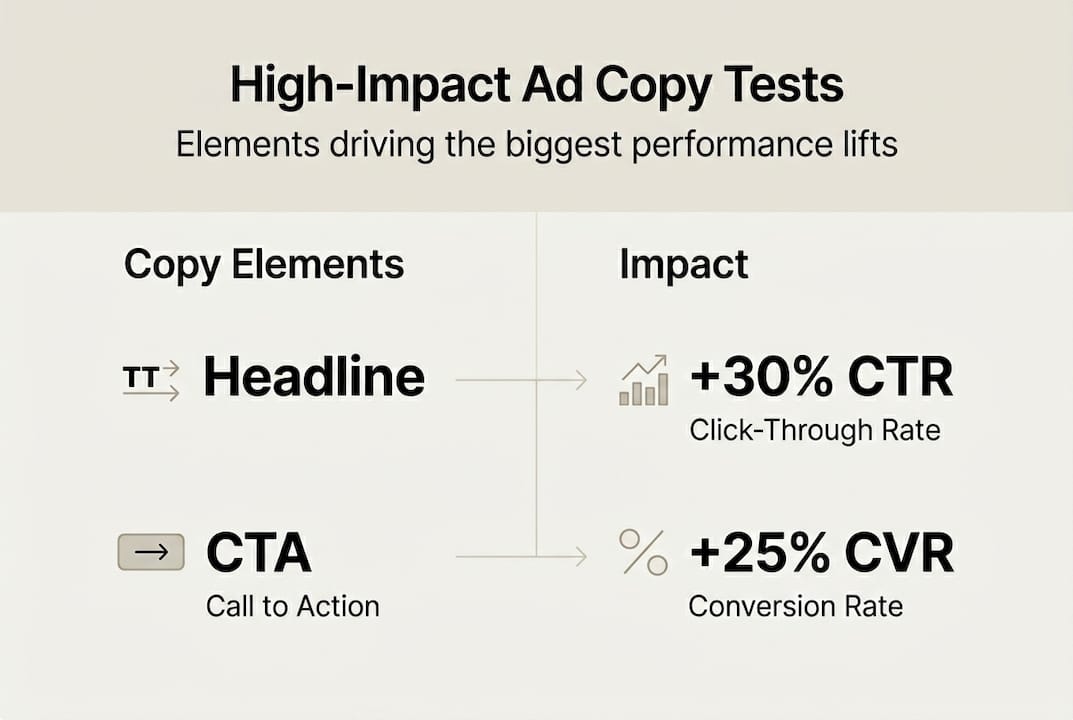
The empirical data on what testing delivers is striking. Headline tweaks alone can boost CTR by 30% and conversions by up to 25%. That’s not a marginal gain. For an enterprise running $500K in monthly ad spend, a 25% conversion lift is a transformational number.
Here’s a snapshot of how different copy approaches compare in practice:
| Copy element tested | Avg. CTR lift | Avg. conversion lift | ROI impact |
|---|---|---|---|
| Headline reframe | Up to 30% | Up to 25% | High |
| CTA language change | 10-18% | 8-15% | Medium-High |
| Urgency vs. static offer | 15-25% | 10-20% | High |
| Personalization tokens | 8-12% | 5-10% | Medium |
| Tone shift (formal vs. direct) | 5-10% | 3-8% | Medium |
To run a clean A/B ad copy test, follow these steps:
- Define your hypothesis. State what you expect to happen and why. Example: “A benefit-led headline will outperform a feature-led headline because our audience prioritizes outcomes.”
- Isolate one variable. Change only the headline, only the CTA, or only the offer. Never combine changes.
- Split your audience evenly. Use platform-level traffic splitting to ensure both versions receive comparable exposure.
- Set your success metric upfront. Decide before launch whether you’re optimizing for CTR, conversion rate, or ROAS.
- Run until statistical significance. Don’t stop early because one version looks like it’s winning. Wait for the data to be conclusive.
- Document and act. Record the result, apply the winner, and use the loser as a learning input for your next hypothesis.
For teams looking to boost eCommerce ROI through creative iteration, this process is repeatable across every product line and audience segment. Strong ad copywriting strategies give you better raw material to test with, which accelerates the pace of learning.
What to test: High-impact elements for enterprise ad performance
Not all copy elements are created equal. Some changes move the needle fast. Others produce marginal gains that take months to compound into anything meaningful. For enterprise teams managing large budgets, prioritizing the right elements is what separates efficient testing programs from ones that burn time without payoff.
Focus your first tests here:
- Headlines: The single highest-leverage element in any ad. A reframed headline can change how your entire offer is perceived.
- Calls to action: “Get a free quote” vs. “See your savings” vs. “Start today” can produce wildly different conversion rates for the same audience.
- Benefit framing: Leading with outcomes (“Cut your CPA by 30%”) consistently outperforms feature descriptions (“Advanced bidding algorithm”).
- Urgency and scarcity: Time-limited language creates action. Urgency headlines outperform static offers, and creative tests typically yield 20 to 50% performance variance across variations.
- Social proof: Adding a specific number or client name to copy often lifts trust signals and conversion rates simultaneously.
Here’s a quick reference for expected performance lifts by element:
| Ad copy element | Typical performance lift | Priority level |
|---|---|---|
| Headline | 20-30% CTR, 15-25% CVR | Highest |
| CTA text | 10-18% CVR | High |
| Urgency language | 15-25% CTR | High |
| Personalization | 8-12% CTR | Medium |
| Social proof | 5-15% CVR | Medium |
| Tone/voice | 3-10% CVR | Lower |
Exploring top ad creative types helps you understand which formats pair best with each copy element. And if you want to move faster, creative optimization at the structural level gives your tests a stronger foundation to build on.
Pro Tip: Document every test result, wins, losses, and inconclusive outcomes. Losses are often more instructive than wins because they reveal what your audience is actively rejecting. Over time, this library becomes institutional knowledge that new team members can learn from immediately.
Avoiding common pitfalls in ad copy testing
Even experienced performance teams make mistakes that quietly undermine the value of their tests. The most common errors aren’t technical. They’re process failures that produce misleading data and bad decisions.
Here are the most damaging pitfalls and how to avoid them:
- Stopping tests too early. One version pulls ahead in the first three days and the team calls it. Stopping tests early before reaching statistical significance, especially with RSA complications and seasonal variance, produces false winners that hurt performance when scaled.
- Testing multiple variables at once. Changing the headline and the CTA in the same test makes it impossible to know which change drove the result. One variable per test, always.
- Tracking the wrong metric. Tracking CTR instead of ROAS and ignoring confounding factors can kill the value of an otherwise well-run test. Align your success metric to your actual business goal before the test launches.
- Ignoring seasonality. Running a test across a holiday period or a major industry event introduces audience behavior shifts that have nothing to do with your copy. Control for timing.
- P-hacking. Checking results repeatedly and stopping when you see a favorable number is a form of data manipulation, even when unintentional. Set your significance threshold before you start and honor it.
“A test that produces a bad decision is worse than no test at all. Rigor isn’t optional.”
Pro Tip: Write a documented hypothesis before every test. Include what you’re testing, why you expect it to win, and what metric defines success. This forces clarity upfront and makes post-test analysis far more useful.
Knowing how to optimize ad campaigns for ROI means understanding the difference between a metric that looks good and one that actually matters. If you’re unsure whether CTR is telling you the full story, reviewing CTR vs. campaign value will sharpen your thinking on which numbers to trust.
Putting ad copy tests into action: From results to ROI
Running a clean test is only half the job. The other half is what you do with the results. Most teams apply the winning variation and move on. The best teams use every test, win or loss, to build a learning agenda that makes the next test smarter.
Here’s how to extract maximum value from your testing program:
- Promote winners immediately. Once a variation reaches statistical significance and outperforms the control, make it the new baseline. Don’t let a proven winner sit in a spreadsheet.
- Share results with stakeholders. Presenting both wins and losses demonstrates rigor and builds organizational trust in the testing process. It also makes budget conversations easier.
- Build a learning agenda. Each test should generate a hypothesis for the next one. If urgency language won, your next test might explore which urgency framing (deadline vs. scarcity) performs better.
- Use AI as a drafting tool, not a decision-maker. Documenting all test results and using a hybrid AI-human approach gives you scalability without sacrificing conversion quality. AI can generate 10 headline variants in seconds. Humans decide which ones are worth testing.
- Apply learnings across accounts and geographies. A winning CTA in one market is a strong hypothesis in another. Cross-pollinate insights to compound value across your entire portfolio.
For teams ready to take this further, landing page test strategies extend the same discipline beyond the ad itself, ensuring the full conversion path is optimized, not just the click.
How we help enterprises scale high-impact ad copy testing
At AdVenture Media, we’ve built and executed A/B testing frameworks that have delivered measurable results for brands across competitive verticals. Our work on creative transformation produced a 100% CTR increase for one client, and our campaign strategy for International Culinary Center drove a 284% conversion rate lift through disciplined creative testing and iteration. These aren’t one-off wins. They’re the result of a repeatable process that we apply across every engagement. If your team is ready to move from creative opinion to data-driven performance, we can help you design, execute, and scale a testing program built around your specific KPIs. Connect with our team to see how structured ad copy testing translates into compounding ROI for your campaigns.
Frequently asked questions
What is the most important ad copy element to test first?
Start with the headline. Headline tweaks alone can boost CTR by 30% and conversions by up to 25%, making it the highest-leverage starting point for any testing program.
How long should an ad copy A/B test run before making a decision?
Run the test until you reach statistical significance, typically at least one week and enough conversions to be meaningful. Stopping tests early before significance is reached produces unreliable results that can mislead your optimization decisions.
Can AI-written ad copy outperform human-written ads?
AI-generated ads match or outperform on CTR in roughly 73% of campaigns, but human-written copy tends to win on conversion rates when the messaging is tightly tied to brand voice and audience intent.
What metrics matter most in ad copy testing?
Tracking CTR instead of ROAS is one of the most common mistakes in ad copy testing. Always align your primary metric to your actual business goal, whether that’s conversions, revenue, or return on ad spend.
Recommended

.webp)

Targeting High Value Customers Leads to 80% Revenue Drive for Michael Aram

Performance Creative Drives 100% Increase in CTR for Luxury Homegoods Brand


Slinger Bag becomes #1 tennis launcher in the US, with 12.6X Facebook ROAS
Request A Marketing Proposal
We'll get back to you within a day to schedule a quick strategy call. We can also communicate over email if that's easier for you.
Visit Us
New York
1074 Broadway
Woodmere, NY
Philadelphia
1429 Walnut Street
Philadelphia, PA
Florida
433 Plaza Real
Boca Raton, FL
General Inquiries
info@adventureppc.com
(516) 218-3722
AdVenture Education
Over 300,000 marketers from around the world have leveled up their skillset with AdVenture premium and free resources. Whether you're a CMO or a new student of digital marketing, there's something here for you.
OUR BOOK
We wrote the #1 bestselling book on performance advertising
Named one of the most important advertising books of all time.
buy on amazon
OUR EVENT
DOLAH '24.
Stream Now.
Over ten hours of lectures and workshops from our DOLAH Conference, themed: "Marketing Solutions for the AI Revolution"
check out dolah
The AdVenture Academy
Resources, guides, and courses for digital marketers, CMOs, and students. Brought to you by the agency chosen by Google to train Google's top Premier Partner Agencies.
Bundles & All Access Pass
Over 100 hours of video training and 60+ downloadable resources
 view bundles →
.png)


