
.svg)

Most American companies waste nearly half their PPC budgets due to unclear goals and unfocused targeting. For digital marketing managers, setting up high performing campaigns means more than just running ads. Success comes from building a foundation rooted in measurable objectives, strategic audience segmentation, and smart creative choices. Discover how sharpening each step can drive stronger ROI and give your next American PPC campaign a true competitive edge.
Table of Contents
- Step 1: Set Clear Campaign Goals And Metrics
- Step 2: Audit And Refine Target Audience Segments
- Step 3: Optimize Ad Creative And Messaging
- Step 4: Adjust Bidding Strategies And Budgets
- Step 5: Test Performance And Analyze Results
Quick Summary
| Key Insight | Explanation |
|---|---|
| 1. Define Clear Campaign Goals | Establish specific objectives like lead generation or sales for focused PPC strategy and accountability. |
| 2. Conduct Audience Segmentation | Analyze and refine audience traits to effectively target relevant customers and improve campaign ROI. |
| 3. Optimize Ad Creative | Create personalized, compelling ads through strategic copy and A/B testing for better engagement and conversions. |
| 4. Implement Smart Bidding Strategies | Use automated bidding tools to optimize costs in achieving conversions and adapt to performance data. |
| 5. Regularly Test and Analyze Performance | Maintain continuous review of campaign metrics to identify areas for improvement and ensure effective marketing. |
Step 1: Set Clear Campaign Goals and Metrics
Successful PPC campaigns begin with crystal clear goals that align directly with your business objectives. Your campaign metrics will serve as the roadmap to measure progress and optimize performance.
Start by identifying your primary business outcomes. Are you looking to generate leads, drive online sales, increase brand awareness, or boost website traffic? Each goal requires specific tracking metrics that matter to measure success. For example, if your goal is lead generation, you might focus on conversion rate and cost per acquisition (CPA). If you’re an ecommerce business, return on ad spend (ROAS) becomes your key performance indicator.
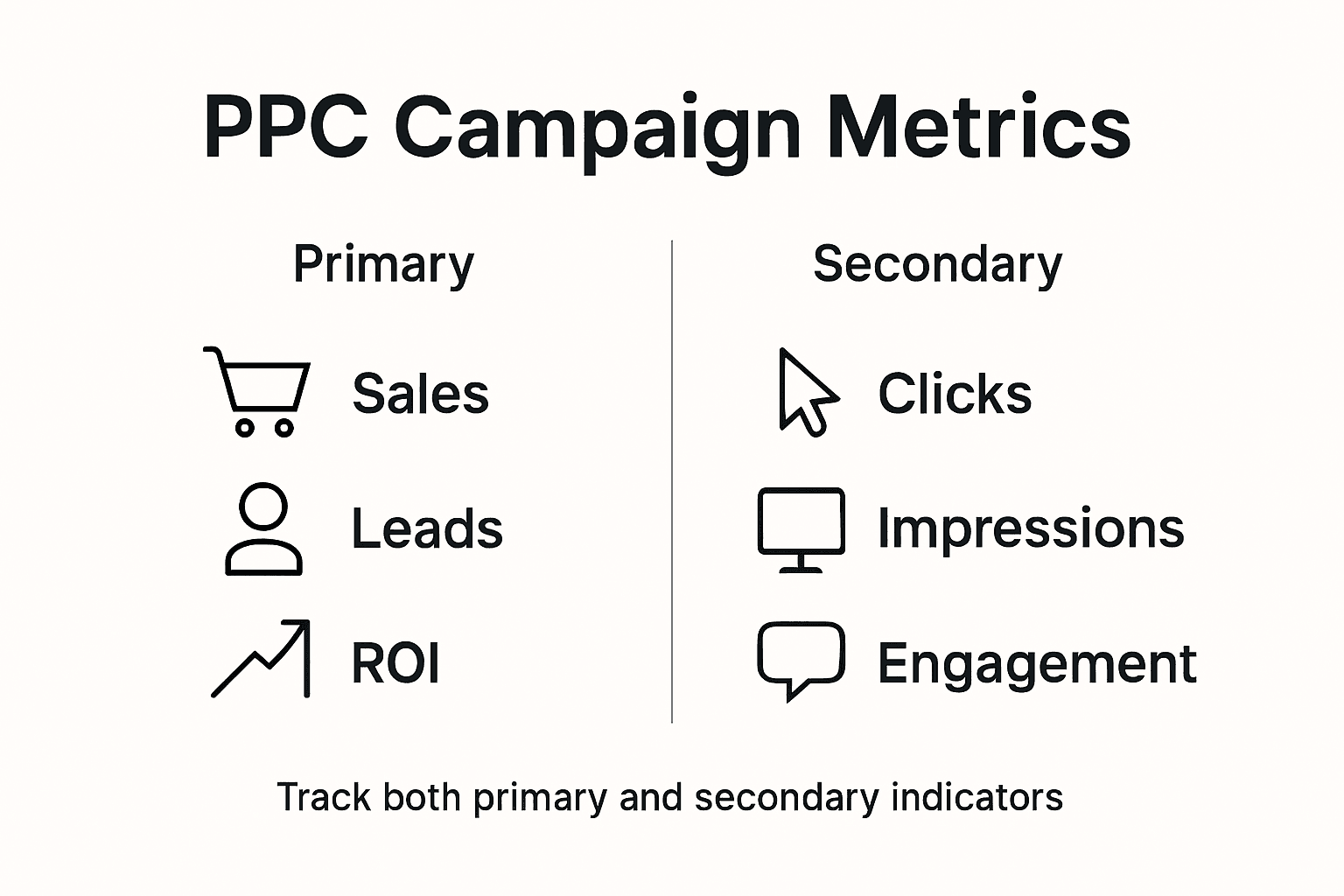
When establishing your metrics, consider both primary and secondary measurements. Primary metrics directly reflect your core business objective (like sales volume), while secondary metrics provide additional context about campaign performance (such as click through rate or engagement). A structured approach to digital advertising strategy helps ensure your metrics are meaningful and actionable.
Here’s a summary of primary vs. secondary PPC campaign metrics and their roles:
| Metric Type | Example Metrics | Purpose |
|---|---|---|
| Primary Metrics | Sales volume, lead count | Measure direct progress toward main goals |
| Secondary Metrics | Click through rate, engagement | Provide more context on campaign performance |
Pro Tip: Always set specific, measurable targets for each metric to create accountability and enable precise campaign optimization.
Step 2: Audit and Refine Target Audience Segments
Successful PPC campaigns require precision targeting that connects your ads with the most relevant potential customers. Understanding and refining your audience segments is crucial for maximizing campaign performance and return on investment.

Begin by conducting a comprehensive audience segmentation analysis that breaks down your potential customers by key characteristics. This includes demographic information like age, gender, income level, geographic location, and professional attributes. Additionally, explore psychographic data such as interests, behaviors, purchasing habits, and online engagement patterns. Modern PPC platforms offer sophisticated tools that allow you to create highly granular audience segments based on these multidimensional criteria.
Next, evaluate your existing audience segments by analyzing performance metrics. Look for segments that demonstrate high conversion rates, low cost per acquisition, and strong engagement. Systematic audience auditing helps you identify which segments are most valuable and where you might need to adjust your targeting strategy. Remove or reduce spending on underperforming segments and reallocate resources to those showing the most promise. Remember that audience segmentation is an iterative process requiring continuous monitoring and refinement.
Pro Tip: Use remarketing lists and lookalike audiences to expand your reach while maintaining precise targeting parameters.
Step 3: Optimize Ad Creative and Messaging
Crafting compelling ad creative and messaging is the difference between campaigns that generate marginal interest and those that drive significant conversions. Your goal is to create ads that not only capture attention but also resonate deeply with your target audience.
Effective ad campaign optimization requires a strategic approach to copywriting and design. Start by developing messaging that speaks directly to your audience’s core pain points and desires. This means moving beyond generic statements and creating personalized, emotionally compelling narratives that connect with specific audience segments. Analyze your target demographic’s language, motivations, and challenges to craft copy that feels like a direct conversation rather than a broadcast advertisement.
Implement a rigorous testing strategy to continuously refine your creative approach. Develop multiple ad variations with different headlines, images, and calls to action. Run systematic A/B tests to identify which elements generate the highest engagement and conversion rates. Pay close attention to metrics like click through rate, conversion rate, and cost per acquisition to understand which creative elements truly drive performance. Remember that optimization is an ongoing process your team must continuously monitor and adjust.
Pro Tip: Create ad variations that speak to different stages of the customer journey to maximize relevance and connection.
Step 4: Adjust Bidding Strategies and Budgets
Optimizing your PPC campaign’s bidding and budget allocation is crucial for maximizing return on investment and achieving your marketing objectives. The right approach can dramatically improve your campaign’s performance while keeping costs under control.
Effective PPC budgeting and bidding strategies require a nuanced understanding of your campaign goals and available automated tools. Start by evaluating your campaign objectives whether they focus on conversions, brand awareness, or website traffic. Google Ads offers several automated bidding strategies like Target CPA (Cost Per Acquisition), Target ROAS (Return on Ad Spend), and Maximize Conversions that can intelligently adjust your bids based on real time performance data. Manual bidding still has its place for campaigns with specific requirements or when you want granular control over individual keyword bids.
This table compares common automated PPC bidding strategies:
| Strategy | How It Works | Best For |
|---|---|---|
| Target CPA | Sets bids to achieve target acquisition cost | Consistent lead volume |
| Target ROAS | Optimizes bids for return on ad spend | Ecommerce profitability |
| Maximize Conversions | Uses budget to get as many conversions as possible | High conversion goals |
| Manual Bidding | Full control over individual keyword bids | Niche campaigns |
Implement a dynamic budgeting approach that allows flexibility across different campaign segments. Allocate higher budgets to top performing audience segments and ad groups while reducing spend on underperforming areas. Regularly review your budget distribution and be prepared to make quick adjustments based on performance metrics. Consider setting up shared budgets for campaigns with similar objectives to optimize overall spending efficiency and prevent budget constraints from limiting potential high performing campaigns.
Pro Tip: Create a budget buffer of 10 to 15 percent to allow for unexpected performance opportunities and market fluctuations.
Step 5: Test Performance and Analyze Results
Testing and analyzing your PPC campaign performance is the critical final step that transforms raw data into actionable insights. This process allows you to understand what works, what doesn’t, and how to continuously improve your advertising strategy.
Systematic PPC campaign analysis requires a structured approach to data collection and interpretation. Start by establishing a comprehensive set of key performance indicators (KPIs) that align with your original campaign objectives. These might include conversion rate, click through rate, cost per acquisition, return on ad spend, and overall campaign ROI. Create a centralized dashboard that tracks these metrics in real time, allowing you to quickly identify trends, anomalies, and opportunities for optimization.
Develop a rigorous testing methodology that goes beyond surface level metrics. Compare performance across different audience segments, ad creatives, keywords, and bidding strategies. Look for statistically significant variations that can inform future campaign decisions. Pay close attention to micro conversions and engagement signals that might not immediately translate to direct sales but indicate potential customer interest. Be prepared to make data driven adjustments quickly, treating your PPC campaign as a living system that requires constant refinement and attention.
Pro Tip: Schedule weekly performance reviews and monthly comprehensive audits to maintain a proactive approach to campaign optimization.
Unlock the Full Potential of Your PPC Campaigns with Expert Guidance
The challenge of optimizing PPC campaigns for maximum ROI is real and demanding. You need clear goals, precise audience targeting, compelling ad creative, and smart bidding strategies to succeed. If you find yourself overwhelmed by tracking the right metrics or struggling to refine your audience segments and creative messaging, you are not alone. These complexities require a performance-driven approach that turns data into results.
AdVenture Media specializes in exactly these pain points. With deep expertise in paid search, conversion rate optimization, and social media advertising on platforms like Google and Meta, we help businesses transform their PPC campaigns into measurable growth engines. Experience the difference of a strategy-first agency that continuously tests, analyzes, and adjusts to maximize your returns while keeping budgets in check.
Are you ready to elevate your digital advertising strategy and see real impact? Discover how our proven methods and client success stories can empower your next campaign. Visit Contact AdVenture Media to get started today and turn your PPC efforts into consistent profit. Don’t wait – driving maximum ROI begins with the right partner at your side.
Frequently Asked Questions
What are the key steps to optimize PPC campaigns for maximum ROI?
To optimize PPC campaigns for maximum ROI, begin by setting clear campaign goals and tracking metrics. Next, audit and refine your target audience segments, optimizing your ad creative and messaging, and adjust your bidding strategies and budgets accordingly.
How can I identify the best audience segments for my PPC campaigns?
Identify the best audience segments by conducting a comprehensive audience segmentation analysis focusing on demographics and psychographics. Evaluate existing segments based on performance metrics like conversion rate and cost per acquisition to allocate resources effectively.
What types of metrics should I focus on for measuring PPC success?
Focus on both primary and secondary metrics to measure PPC success. Primary metrics like sales volume and lead count reflect core objectives, while secondary metrics like click-through rate and engagement offer additional context for optimizing your campaigns.
How can I effectively test my PPC ad creative and messaging?
Effectively test your PPC ad creative by developing multiple ad variations with different headlines and images. Run systematic A/B tests to identify which versions generate the highest engagement and conversion rates, adjusting your strategy based on data insights.
What bidding strategies should I consider for my PPC campaigns?
Consider automated bidding strategies such as Target CPA, Target ROAS, and Maximize Conversions to optimize your campaigns. Experiment with manual bidding if you require precise control over specific keywords, and regularly assess performance to make necessary adjustments.
How often should I analyze and adjust my PPC campaign performance?
Analyze and adjust your PPC campaign performance weekly for general trends and monthly for comprehensive audits. Doing so will help you maintain a data-driven approach and pivot quickly in response to performance metrics or market changes.
Recommended


AdVenture Media Helps Insurance Company Scale Campaigns To All-Time Highs


Global Fintech App Uses Automation To Profitably Grow Customer Base


Unique Campaign Structure Saves Leading Logistics Company $27K Month Over Month
Request A Marketing Proposal
We'll get back to you within a day to schedule a quick strategy call. We can also communicate over email if that's easier for you.
Visit Us
New York
1074 Broadway
Woodmere, NY
Philadelphia
1429 Walnut Street
Philadelphia, PA
Florida
433 Plaza Real
Boca Raton, FL
General Inquiries
info@adventureppc.com
(516) 218-3722
AdVenture Education
Over 300,000 marketers from around the world have leveled up their skillset with AdVenture premium and free resources. Whether you're a CMO or a new student of digital marketing, there's something here for you.
OUR BOOK
We wrote the #1 bestselling book on performance advertising
Named one of the most important advertising books of all time.
buy on amazon
OUR EVENT
DOLAH '24.
Stream Now.
Over ten hours of lectures and workshops from our DOLAH Conference, themed: "Marketing Solutions for the AI Revolution"
check out dolah
The AdVenture Academy
Resources, guides, and courses for digital marketers, CMOs, and students. Brought to you by the agency chosen by Google to train Google's top Premier Partner Agencies.
Bundles & All Access Pass
Over 100 hours of video training and 60+ downloadable resources
 view bundles →
.png)


